

 iscover
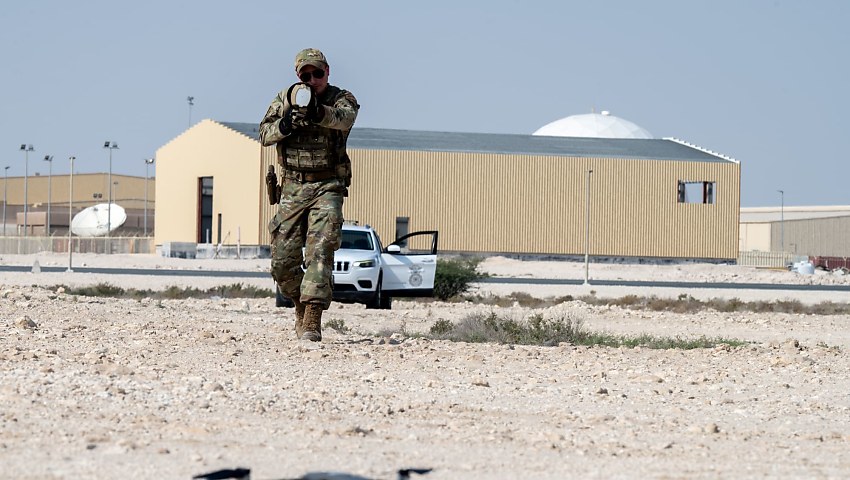
US base commanders will have empowered decision making and a larger permitted defensive area against unmanned aerial vehicles, under a new announcement from the US Department of War.
The changes have been announced by the US Department of War’s Joint Inter-Agency Task Force 401 (JIATF-401) under new updated guidance for counter-unmanned aerial systems (UAS) operations.
Key updates to the counter-UAS policy include expanded defensive perimeter including removal of “fence-line” limitations and greater decision-making space to protect covered facilities and assets.
Under the changes, unauthorised surveillance of a designated facility now explicitly constitutes a threat and commanders have authority to make threat determinations based on the “totality of circumstances”. In addition, service secretaries are now authorised to designate “covered facilities or assets” based on risk assessments.
Under the changes, trained and certified contractor personnel can be used as counter-UAS operators and UAS track or sensor data can be shared to inter-agency partners such as the Department of Homeland Security and the Department of Justice.
“Drones are a defining threat for our time, technology is evolving fast and our policies and c-UAS strategy here at home must adapt to meet this reality,” according to Brigadier General Matt Ross, director of JIATF-401.
“Countering drones does not start and stop at the fence line. With this new guidance, installation commanders are empowered to address threats as they develop, and the guidance makes clear that unauthorised drone flights are a surveillance threat even before they breach an installation perimeter.
“JIATF-401 is an entirely joint, inter-agency endeavour dedicated to defeating small UAS.

“Hardware alone is not sufficient. We need to train service members and work in concert with inter-agency partners so that we’re all pulling together toward the same mission.”
The changes are reportedly being made to combat the proliferation of inexpensive, capable and unmanned aerial systems that can be weaponised by both peer competitors and non-state actors.
US adversaries are testing resolve, seeking to exploit perceived gaps in defences to surveil operations, harass American forces and undermine homeland security, according to the US Department of War.
In accordance with the new policy, installation commanders are directed to issue installation-specific operating procedures within 60 days.

Want to see more stories from trusted news sources?
Make Defence Connect a preferred news source on Google.
Click here to add Defence Connect as a preferred news source.