

 iscover
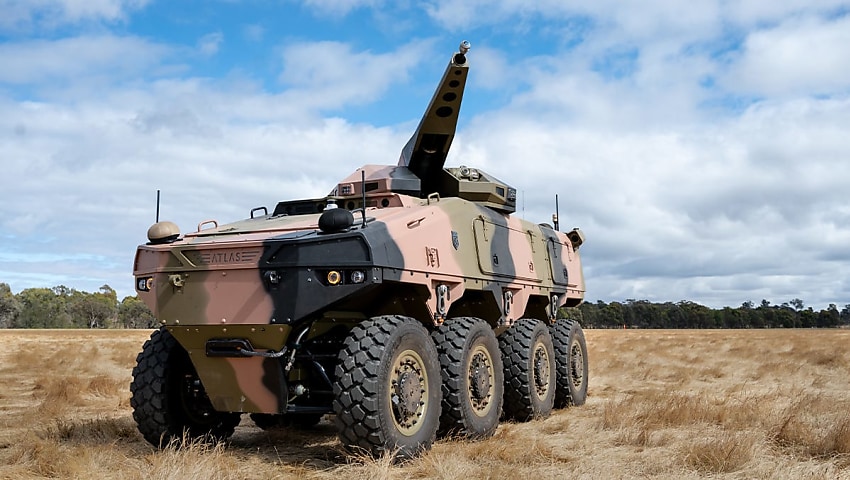
BAE Systems Australia has successfully put its new uncrewed ground combat vehicle through a demanding series of trials, marking a significant milestone in the development of Australia’s next-generation autonomous land warfare capabilities.
The trials focused on the ATLAS uncrewed ground vehicle, short for Autonomous Tactical Light Armour System, a modular, uncrewed platform designed to operate alongside main battle tanks and combat reconnaissance vehicles on the modern battlefield.
According to BAE Systems Australia, the testing campaign assessed the vehicle across multiple levels of autonomy, ranging from remote teleoperation and waypoint-based navigation through to advanced “sense and avoid” autonomous driving.
The company said the vehicle is now operating as a fully functional prototype demonstrator.
ATLAS was publicly unveiled at Land Forces International Land Defence Exposition in September 2024 and has since been the focus of an intensive development and test program. The effort reflects growing interest within the Australian Defence Force and allied militaries in autonomous systems that can increase combat power without placing additional soldiers in harm’s way.
BAE Systems describes ATLAS as a “combat multiplier”, a platform designed to add mass, mobility and firepower while reducing exposure to risk for crewed forces. The vehicle has been engineered to be fast, highly manoeuvrable and capable of operating across difficult terrain and in harsh environmental conditions, allowing it to keep pace with both tracked and wheeled combat vehicles.
A key feature of the ATLAS Collaborative Combat Variant is its modular payload design. In its assault configuration, the vehicle is fitted with a lightweight, medium-calibre automated turret known as VANTAGE turret, purpose-built for uncrewed platforms.
The VANTAGE system integrates BAE Systems’ passive multi-spectral Automatic Target Detection, Tracking and Classification System, enabling high levels of automation. The company said this reduces operator workload, supports one-to-many control of multiple uncrewed vehicles, lowers the probability of detection and shortens the time between target identification and engagement.

Andrew Gresham, managing director – defence delivery at BAE Systems Australia, said the rapid progress of the program demonstrated the maturity of the underlying technologies.
“In just 16 months, we have gone from launching ATLAS at Land Forces to operating a fully functional prototype demonstrator,” Gresham said.
“ATLAS has been developed to give soldiers a clear advantage on the modern battlefield, delivering the dull, dirty and dangerous tasks that are expected in a high-risk combat environment.”
He said the company is now actively engaging with potential customers, both in Australia and overseas, as interest grows in autonomous and collaborative combat systems.
The latest autonomous driving trials follow a structured test program that has included factory acceptance testing and live-fire trials of the Vantage turret system in Slovenia in May 2025. BAE Systems said each stage was designed to incrementally prove the platform’s survivability, lethality and autonomous performance.
ATLAS is being promoted as a sovereign Australian capability that can increase combat power without increasing manpower, while allowing soldiers to remain at a safer distance from the most dangerous tasks on the battlefield – a concept increasingly central to future land force modernisation efforts.

Want to see more stories from trusted news sources?
Make Defence Connect a preferred news source on Google.
Click here to add Defence Connect as a preferred news source.