

 iscover
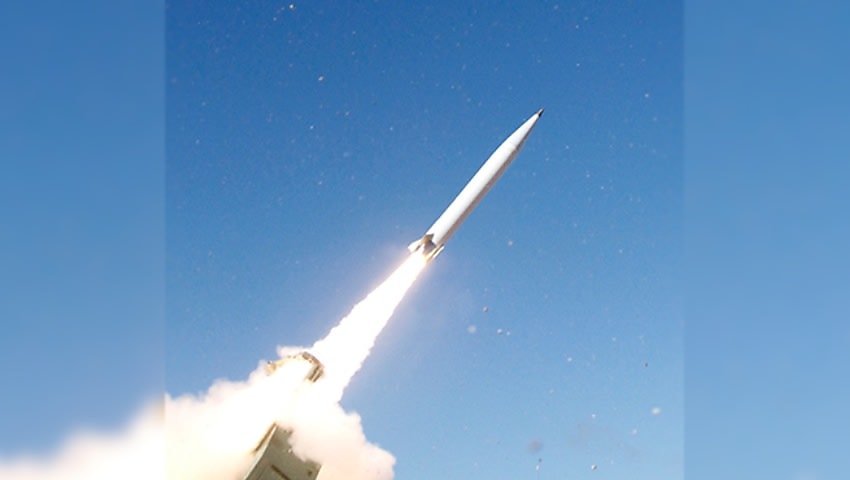
The United States has taken another step in developing its next generation of long-range precision weapons, with defence giant Lockheed Martin successfully completing the first flight test of the upgraded Precision Strike Missile (PrSM) Increment 2.
The test marks a key milestone in the United States Army’s long-range fires modernisation program, with the new variant demonstrating its ability to detect and engage moving targets at sea as well as on land.
During the trial, the missile flew approximately 350 kilometres after being launched from an M142 High Mobility Artillery Rocket System (HIMARS) launcher, collecting extensive performance data and successfully deploying protective hardware designed to safeguard its onboard seeker during launch.
The defining feature of the Increment 2 variant is a newly developed multi-mode seeker that allows the missile to track and strike moving targets.
Unlike earlier versions primarily designed for fixed land targets, the new seeker enables PrSM to identify, track and engage time-sensitive threats such as relocating missile launchers or vessels at sea.
Lockheed Martin officials said the new guidance package dramatically expands the missile’s operational flexibility, allowing land forces to contribute more directly to maritime operations.
“Increment 2 delivers the long-range capability the Army asked for to defeat moving land and maritime threats,” said Carolyn Orzechowski, vice president of precision fires launchers and missiles at Lockheed Martin.
The new maritime-strike capability is particularly significant as the United States and its allies increasingly focus on countering naval forces in contested regions.

By allowing ground-based launchers to strike ships at extended range, the weapon strengthens land-based sea-denial strategies and enables deeper integration across joint operations.
The Precision Strike Missile is being developed to replace the ageing Army Tactical Missile System (ATACMS) which has been in service since the early 1990s.
PrSM was designed to be smaller and more efficient, allowing twice as many missiles to be carried in each launcher pod while significantly increasing range and accuracy.
While early versions of ATACMS had a maximum range of around 300 kilometres due to arms-control restrictions under the now-defunct Intermediate‑Range Nuclear Forces Treaty, the PrSM program has been developed with far greater reach in mind.
Future increments are expected to exceed 500 kilometres and may eventually approach 1,000 kilometres as additional capabilities are introduced.
A major advantage of the PrSM system is that it integrates directly with the US Army’s existing rocket artillery fleet. The missile can be fired from both the highly mobile M142 HIMARS launcher and the heavier tracked M270A2 Multiple Launch Rocket System, meaning the Army can deploy the new weapon without introducing an entirely new launcher platform.
Because PrSM uses the same launcher architecture, it simplifies logistics, reduces training requirements and allows rapid fielding across existing artillery formations.
Both launcher systems are widely used by US allies, including several NATO countries and partners in the Indo-Pacific, which could potentially adopt the missile as it enters service.
The development of PrSM reflects the US military’s growing focus on long-range precision fires as a core element of modern warfare.
By combining long-range strike capability with the ability to target mobile land units and naval vessels, the missile is designed to operate within a broader “multi-domain” framework integrating land, air, sea, cyber and space capabilities.
Gaylia Campbell, vice president and general manager of tactical missiles at Lockheed Martin, said the program’s modular design is helping accelerate delivery of new capabilities.
“By leveraging modular design, agile processes and close collaboration with the Army and our supplier network, we’re moving quickly to deliver this enhanced capability to the warfighter faster without compromising performance or reliability,” she said.
As development continues, additional upgrades are expected to further expand the missile’s range, sensing capability and target set, making it one of the most important weapons in the US Army’s future long-range strike arsenal.

Want to see more stories from trusted news sources?
Make Defence Connect a preferred news source on Google.
Click here to add Defence Connect as a preferred news source.