

 iscover
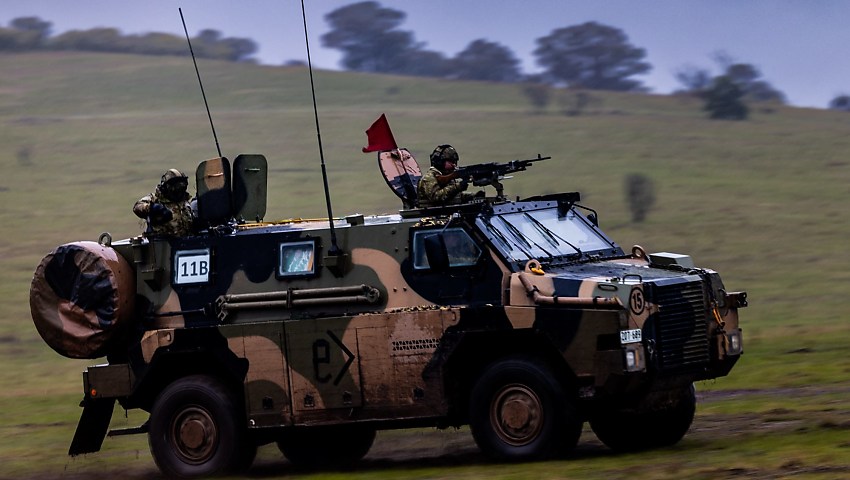
Australia’s recent announcement to invest more than $750 million on Bushmaster protected mobility vehicles brings an immediate opportunity to see if government can implement Bushmaster improvements learnt on the battlefields of Ukraine.
Earlier this week, the federal government announced it would invest $750 million to expand production of Bushmaster protected mobility vehicles and build 268 new Bushmasters for the Australian Defence Force at Thales Australia’s Bendigo facility. Production of the new fleet is expected to begin in 2027.
Of crucial importance are new capability enhancements expected to be fitted to the vehicles, such as improved protection and mobility, advanced digital systems and increased adaptability to meet the evolving needs of defence operations, including increased capacity for carrying personnel and tow capacity.
The vehicles will also reportedly feature stronger additional armour and the ability to carry more powerful weapons systems, including roof-mounted effectors, opportunity to integrate a wide range of sensors and effectors to efficiently defeat threats, a fully modular crew cabin allowing for versatile configurations based on user needs and designs for export with left-hand drive capability and next-gen communication interfaces.
Minister for Defence Industry and Minister for Pacific Island Affairs Pat Conroy confirmed that the new vehicles will be modernised with some unique capabilities.
“Next generation Bushmaster(s) [are] hitting the production line as part of this contract, which will really give the Australian Defence Force the best capability in the world,” he said during a press conference at Bendigo for the announcement.
“[The Bushmasters have] got more power. What you’re seeing with modern warfare is everything needs more power, more computing. So the next generation will have more power. It will also have modifications at the back, which means you can swap in and out modules more effectively.
“Two of the key modifications is greater power, because one thing we’ll be fitting onto these is remote weapon stations to deal with drones, including directed energy weapons, lasers, for want of a better word.

“And I made an announcement last week of a more than $7 billion announcement in counter-drone capability at another Victorian company, SYPAQ, that does conventional drones, and then AIM does lasers.
“So, the goal is to mount lasers on these vehicles to destroy drones. And obviously, you need plenty of juice to do that.”
The new vehicles are expected to form part of a broader push to modernise the ADF’s protected mobility fleet, play a key role in the Australian Army’s evolving “integrated force” and support missions such as littoral manoeuvre, long-range strike and amphibious operations.
In addition, Australia has approved the sale of recently delivered Bushmasters to the Netherlands following a formal request. Thales will replace those vehicles for the ADF in a future production run at no additional cost on top of the newly announced order. Production at Bendigo is already underway to replace vehicles donated to Ukraine, along with an additional 59 Bushmasters being acquired under the LAND 8113 program.
“This landmark contract ensures the continued evolution of one of the nation’s most trusted and successful military vehicles,” said Jeff Connolly, Thales Australia and New Zealand chief executive officer.
“The Bushmaster is more than a vehicle, it is a proven life-saving capability operating in the most challenging environments. The Australian government is investing in a unique facility. This announcement supports regional jobs, advanced manufacturing, strengthens the national industrial base, and ensures critical defence expertise remains in Australia.”
Lessons from the battlefields of Ukraine
It’s no secret that Bushmasters have become a valued asset to the Armed Forces of Ukraine, now is the perfect time for Australia to draw clear lessons learnt on the modern battlefield against near-peer adversaries.
The next generation of Bushmaster does not need to be reinvented, but rather adapted and distinguishable from previous iterations.
Most experts would agree that Minister Conroy is on the right track in his assessment that new Bushmasters must meet the growing dominance of drones as a battlefield threat. Ukraine has shown time and again that even well-armoured vehicles like main battle tanks and armoured personnel carriers are vulnerable to cheap first-person view explosive drone strikes.
We should expect to see new counter-drone measures being added on Bushmasters, such as electronic warfare systems, jamming capabilities, active protection systems and remote weapon stations as well as updated training doctrine to suit their use by personnel.
We should also expect to see the retaining of protective measures against mines, which has been widely reported in Ukraine, but also potentially new armour upgrades to protect against the increasing prevalence of top-attack drone-dropped munitions and overall shrapnel damage.
Other changes highlighted by Ukrainian personnel include the popularity of modular designs to rapidly re-role armoured vehicles into other purposes such as electronic warfare, command node, troop transport and medical evacuation.
“There are no drawbacks if you have a good driver. Bushmasters on the front line are mostly used like taxis, they only transport the troops and provide some cover. The 7.62mm round, well, it might be scary for infantry but against vehicles, it’s not much,” according to a Ukrainian driver “Tur”, speaking to a reporter from Ukrainian government-run YouTube channel UNITED24 in December 2024.
“We have good armour and there is additional armour on top of that. There’s a pretty good winch, 10 tonnes I think. Tow hitch, electrical system. Up here are hidden points for connecting antenna.”
Bushmaster armaments remain an ongoing worry as highlighted through Ukrainian soldiers. The combinations deployed on current vehicles have varied with some Bushmasters being seen in Ukraine fitted with heavy machine guns, grenade launchers and thermal-optical equipment.
Final thoughts
Bushmasters will be an important quality assurance test for Australia. Is the final product adaptive and suited to the modern battlefield or constrained to the design and battlefield ideology of past conflicts?
In addition, this is a significant opportunity for Australia to raise its defence-export credentials by using the lessons learnt in Ukraine to create a vehicle suited to the most up-to-date battlefield conditions and technology.

Want to see more stories from trusted news sources?
Make Defence Connect a preferred news source on Google.
Click here to add Defence Connect as a preferred news source.