iscover
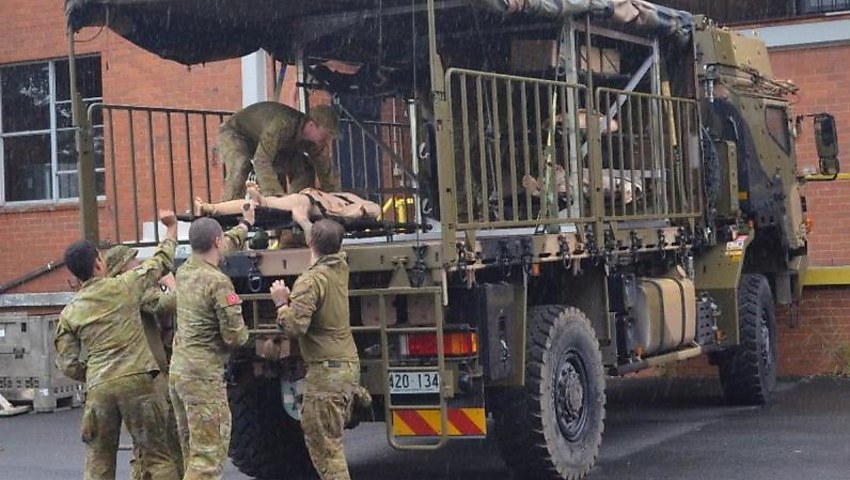
The Australian Army and Royal Australian Air Force have conducted a successful demonstration with a rapidly deployable medical racking system designed to improve casualty evacuation (CASEVAC) in austere and high-tempo operations.
At a recent field demonstration, a system was assembled in just two-and-a-half minutes in wet conditions. The initiative is being supported through the EDGY program.
Lieutenant Colonel Kylla Patterson, who is responsible for force modernisation and doctrine at Headquarters 2nd Health Brigade, said the concept focused on speed, scalability and adaptability in extreme environments.
“The ability to fit three-patient racks into common vehicles gives commanders real flexibility,” LTCOL Patterson said.
“We can source vehicles globally and convert them quickly.”
The project team has reviewed several multi-rack systems, including those used in RAAF C-130 and C-17 aircraft.
Officer Commanding Bravo Company, 2nd Health Battalion, Major Bernie Serong, said each option had trade-offs.
“The C-17 double litter system offers a better rack, but at the cost of capacity and without extension capability,” MAJ Serong said.

“Other systems are cheaper or require fewer people to assemble them, but all still require formal airworthiness assessment before Defence implementation.”
Next steps include sharing technical documentation, commencing formal engineering and airworthiness assessments, and gathering feedback from senior medical officers on additional use cases, particularly in hostile territory where efficient, scheduled evacuation is critical to reducing vulnerability on the ground.
Wing Commander Kylie Cimen, director of Preparedness Innovation – Air Force, said the strength of the EDGY program laid in its networks.
“EDGY connects innovators with the right stakeholders, engineers and users early, which dramatically shortens development timelines,” WGCDR Cimen said.
Want to see more stories from trusted news sources?
Make Defence Connect a preferred news source on Google.
Click here to add Defence Connect as a preferred news source.