

 iscover

Body armor history usually arrives as a materials story: hides, then bronze, then steel, then Kevlar, then ceramics. It is a satisfying arc, and it is incomplete.
For anyone who specifies, buys, or fields protection, the more useful way to read the lineage is as a three-way negotiation. A threat appears. A material answers it. And eventually a standard certifies whether the answer actually works.
Those three forces have pushed each other forward for a century, and they are doing it again right now, because the standard that rates American body armor was rewritten in 2023. To see why that matters, it helps to start where the negotiation began, long before anyone could rate anything at all.
Where the Technology Came From
For most of recorded history, armor was a craft, not a category. The earliest protection was animal hide, then boiled leather, then bronze and iron for those who could afford it. Medieval plate represented the high-water mark of the metalsmith’s art, a full steel shell that could turn a blade or an arrow. None of it was rated. A soldier learned what his armor would stop the same way every soldier before him had, under attack.
That craft tradition collapsed around 1500. Gunpowder weapons delivered more energy than any wearable plate could absorb, and within a few generations armor disappeared from the battlefield almost entirely. For the next four centuries, the practical defense against firearms was distance, cover, and masonry, not anything worn on the body. There were exceptions. During the American Civil War, a handful of vendors sold soldiers iron “bullet-proof” vests built from steel plates sewn into cloth, an idea closer to medieval brigandine than to anything modern. They were heavy, awkward, and largely ineffective against the rifled muskets of the day.
The full arc from boiled leather to steel breastplate is its own long story; for that lineage in detail, see this history of military body armor. What matters for the modern thread is the starting condition. By 1900, body armor was a solved-and-abandoned problem. It took a new kind of war, and a new kind of threat, to reopen it.
The Flak Jacket and the Fragmentation Problem
That war was the air war. By the Second World War, bomber crews were dying not from aimed rifle fire but from shrapnel, jagged metal thrown by exploding anti-aircraft shells. The Germans called that fire Flak, short for Fliegerabwehrkanone, and the garment built to stop it took the name. The flak jacket was never meant to stop a bullet. It was meant to catch fragments.
The design reflected that job. Layers of ballistic nylon, a material engineered by DuPont, were quilted into a vest, sometimes reinforced with overlapping aluminum or steel plates. United States officials adapted the concept from Royal Air Force designs, with sample suits arriving stateside in 1943. The result worked against low-velocity fragments and did little else. Early versions weighed around 22 pounds and were bulky enough that crews often sat on them as much as wore them, shielding against fire coming up through the fuselage floor.
This is the point most timelines blur, and it is worth stating plainly. By any modern measure, a wartime flak jacket would not earn a bullet-resistance rating. It occupied a different category entirely, fragmentation protection, and that distinction is exactly the one the rating system would later be built to formalize.
The category did not stay still. In 1967, the T65-2 vest was designed to hold hard ceramic plates, making it among the first armor capable of stopping a 7mm rifle round. The fragment problem was, broadly, handled. The bullet problem was not, and the most urgent version of it was not on a battlefield at all. It was on the street, facing police.
Kevlar and the Rifle Gap
The breakthrough came from a chemist, not a quartermaster. In 1965, Stephanie Kwolek, working at DuPont, produced a liquid-crystalline polymer solution that spun into a fiber of extraordinary strength for its weight. She had been looking for a lightweight replacement for the steel in tires. What she had found was the basis for Kevlar, an aramid fiber that, woven into dozens of layers, could catch a handgun bullet and spread its energy across the weave before it reached the body.
Commercialized through the 1970s, soft Kevlar vests rewrote the math of survivability for police. A garment light enough to wear on every shift, concealable under a uniform, could stop the handgun rounds that accounted for the overwhelming majority of officer fatalities. The commercial groundwork had been laid a few years earlier, in 1969, when Smith and Wesson introduced a barrier vest combining nylon and steel for law enforcement, but Kevlar is what made soft armor practical at scale.
It also exposed a hard ceiling. Soft fiber stops a handgun round by absorbing and dispersing its energy, but a rifle round arrives with far more velocity and far more energy concentrated behind a harder, often pointed projectile. Aramid alone cannot catch it. The popular phrase “bulletproof vest” obscured the real situation. Armor was bullet-resistant, and it was threat-specific. A vest that reliably stopped a .357 Magnum offered no meaningful protection against a 5.56 rifle round.
That divide, handgun threats on one side and rifle threats on the other, is not a technicality. It is the seam that runs through everything that follows, including the way modern armor is rated. Closing the rifle side of it meant going back to plates.
The Plate Era: Composites, Ceramics, and Procurement
Going back to plates did not mean going back to steel. The challenge was to stop a rifle round at a weight a soldier could carry all day, and the answer came from pairing two materials that fail in opposite, complementary ways.
The military lineage is easy to trace through its procurement programs. In the 1980s, the Personnel Armor System for Ground Troops, PASGT, standardized a Kevlar helmet and vest across United States forces. In 1999, the Interceptor Body Armor system replaced it, pairing a soft Kevlar vest that could stop fragmentation and 9mm rounds on its own with hard ceramic inserts called Small Arms Protective Inserts, or SAPI, made from boron carbide and capable of stopping 7.62mm rifle fire. The next step, the Enhanced SAPI, or ESAPI, bonded a silicon carbide strike face to an ultra-high-molecular-weight polyethylene backing, and that ceramic-on-polyethylene design has been the backbone of military hard armor for roughly two decades.
The mechanism is worth understanding, because it explains the whole modern materials picture in a single paragraph. A composite rifle plate is two layers doing two jobs. The hard ceramic face meets the bullet first and shatters it, blunting the tip and forcing it to spend its energy across a wide area instead of a single point. Behind the ceramic, a backer made of ultra-high-molecular-weight polyethylene, sold under trade names like Dyneema and Spectra, catches the broken fragments and the spreading shockwave and absorbs what is left. Polyethylene matters here for one reason above all. It weighs roughly half what a steel plate of comparable coverage weighs, and on a multi-hour patrol, a few pounds per plate compounds into real endurance.
None of this is free. Every generation of armor buys protection with weight, comfort, and cost, and the right plate for a vehicle crew is not the right plate for a foot patrol. That trade is the entire reason a buyer needs to know precisely what a given plate will stop before strapping it on. For most of history, the only way to find out was the worst possible way. The system that replaced trial by fire is the part of this story that just changed.
From Milestones to Standards: What NIJ 0101.07 Changed
In the United States, the body that answers “what will this stop” is the National Institute of Justice, the research arm of the Department of Justice. Its body armor standard does what no battlefield ever could. It defines specific threats, fires them at armor under controlled conditions, and certifies what passes. For fifteen years, that standard was NIJ 0101.06, published in 2008, and it used Roman numerals. Level II and IIIA covered handgun threats. Level III and Level IV covered rifle threats, with Level IV, rated to stop a .30-06 M2 armor-piercing round, sitting at the top.
In November 2023, the NIJ published the successor, 0101.07, and the most visible change is the naming. The Roman numerals are gone. Handgun ratings are now HG1 and HG2. Rifle ratings are RF1, RF2, and RF3. The logic is that the label should tell you the threat class at a glance. HG for handgun, RF for rifle. Level II maps to HG1, IIIA to HG2, III to RF1, and the old Level IV becomes RF3 with the same armor-piercing test round behind it.
Two changes go deeper than nomenclature. The first is RF2, a genuinely new tier with no exact predecessor. For years, manufacturers had sold plates they called “Level III+,” an unofficial label for armor that stopped more than Level III but was never tested to a consistent rule. RF2 formalizes that middle ground, covering the RF1 threats plus the 5.56mm M855 “green tip” round. The second change is structural. The threat specifications themselves were moved into a separate standard, NIJ 0123.00, so that the list of test rounds can be updated as threats evolve without rewriting the entire test method.
Here is the part most history pieces leave out, and the part a defence reader should care about most. Publishing a standard is not the same as certifying products to it. As of 2026, no products are listed on the 0101.07 Compliant Products List. The certification pipeline lags the standard by years, so the 0101.06 list remains the reference that agencies and buyers actually rely on, and armor certified under 0101.06 stays valid through the transition. In practical terms, “RF3” today is the language of the standard, mapping cleanly to the legacy Level IV, more than it is a shelf of certified product you can buy under that label.
Old standard to new, at a glance:
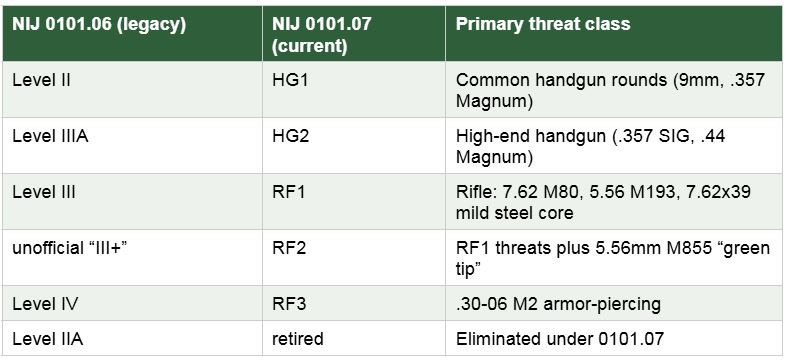
That gap, between a published standard and a certified product, is the current chapter of the same negotiation that has run since the first flak jacket. From a quilted nylon vest built to stop shrapnel to a ceramic plate rated against armor-piercing rifle fire, the through-line was never the material alone. It was the constant push between a threat, the answer to it, and the standard that proves the answer holds. Right now the standard is a step ahead of the products that will carry its name, which is its own kind of progress.
Frequently Asked Questions
What is the difference between a flak jacket and modern body armor?
A flak jacket was built to stop fragments from explosions, not bullets. Modern body armor is threat-rated and split by purpose: soft armor handles handgun rounds, while hard plates are required to stop rifle fire. The two are not interchangeable, even though the term flak jacket is still used loosely.
When was the flak jacket invented?
It was developed during the Second World War for bomber crews, with United States designs adapted from Royal Air Force versions and sample suits arriving in 1943. The name comes from the German word for anti-aircraft fire.
What does RF3 mean in body armor?
RF3 is the highest rifle rating under the current NIJ 0101.07 standard, the successor naming for the legacy Level IV and rated against the .30-06 M2 armor-piercing round. As of 2026 the naming is in use even though no products have yet been certified to the 0101.07 list.
What body armor does the US military use?
The modern lineage runs from the PASGT system of the 1980s to the Interceptor Body Armor of 1999 and on to current plate-carrier systems built around ESAPI plates, which pair a silicon carbide ceramic strike face with an ultra-high-molecular-weight polyethylene backer.