

 iscover
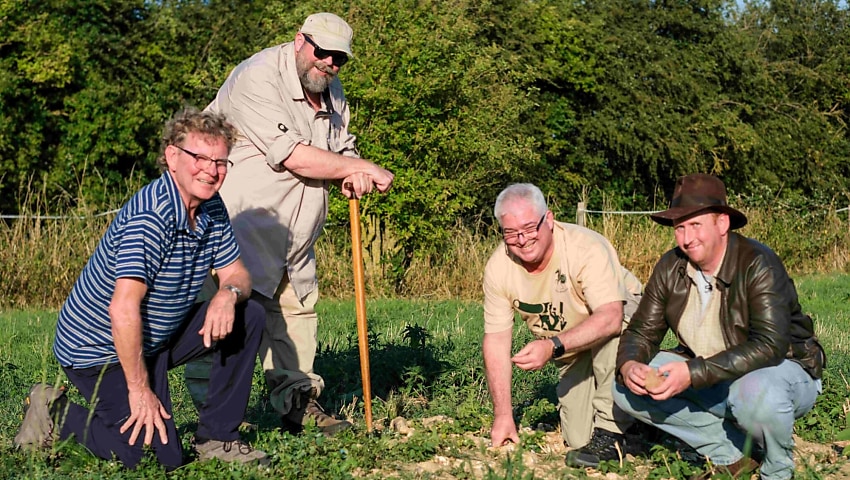
A team of archaeologists and Australian Defence Force veterans have returned from the Western Front with new evidence shedding light on the Battle of Pozières Ridge, more than a century after Australian troops fought there in one of their bloodiest battles.
In July, Flinders University led Project Pozières, a rare archaeological excavation of the Somme battlefield in northern France, marking the 110th anniversary of the 1916 battle.
A 20-person international team from Australia, France, the United Kingdom and New Zealand excavated a German gun battery and trench system at Copse Alley, near Contalmaison, where Australian troops fought during the Battle of Pozières Ridge.
The Battle of Pozières Ridge, fought between 23 July and 5 September 1916 as part of the wider Somme offensive, resulted in more than 23,000 Australian casualties, including 6,700 killed, making it one of the nation’s costliest battles.
The project aimed to reconstruct the first 48 hours of the battle, tracing German gun positions and troop movements during the opening stages of the Australian assault.
It focused on locating the German gun emplacements captured by the 11th, 9th and 1st Battalions in July 1916, including a battery of former Belgian howitzers recorded in the 11th Battalion War Diary, and identifying the position of Copse Alley.
Among the discoveries were 11 live hand grenades, a rifle and some rifle parts, a pickaxe, two shovel heads, a water bottle and a communications cable, alongside large quantities of artillery fragments, iron shrapnel, lead balls and shell debris.
Flinders University archaeologist and Australian armed services veteran Dr Daryl Wesley said the excavation provided a remarkable snapshot of a battlefield frozen in time.

“We identified trench locations with remarkable clarity, confirmed the type of trench system used to rapidly move troops to the front line, and uncovered evidence of German gun emplacements that help us better understand the battle as it unfolded,” according to Dr Wesley from Flinders’ College of Human Sciences and Culture.
“The volume of material recovered was extraordinary… It was truly an iron harvest. The sheer amount of artillery fragments and battlefield debris indicates this was a heavily bombed sector – even more intensely shelled than we anticipated. It speaks to the scale of the fighting and the likely number of casualties in this area.”
Researchers are now hoping to trace a rifle recovered during the excavation to a specific military unit and potentially an individual soldier.
Scientific Director, archaeologist and RAAF veteran Mr Andrew Wilkinson said one of the most significant outcomes was how closely the physical evidence aligned with historical accounts of the battle.
“The excavation supported historical memoirs and modern geospatial mapping of the battlefield, while also revealing features we weren’t expecting, including a previously unidentified trench,” says Mr Wilkinson.
“In many ways, the dig raised more questions than it answered, which is exactly what good archaeology should do. Every discovery helps refine our understanding of what happened.
“Reading diaries and memoirs is one thing, but uncovering physical evidence on the ground gives you an extraordinary sense of the battle.
“It highlights the chaotic nature of combat at the level of small units, with soldiers regrouping under fire and carrying out their objectives in incredibly challenging conditions.”
Project Pozières historian Mr Leon Kelly said the excavation was made possible through strong community support and local partnerships.
“This project has taken place at the invitation of the communities of Pozières and Contalmaison, and reflects a shared commitment to preserve this internationally significant battlefield landscape,” said Mr Kelly, who funded the project.
“It was also a powerful social project, bringing together younger and more experienced archaeologists from Australia and France, working alongside veterans and local communities. There was a real spirit of collaboration and shared learning.”
Dr Wesley said the experience had left a lasting impression on the excavation team.
“The site holds deep historical and emotional significance as a place of Franco-Australian remembrance and shared heritage,” said Dr Wesley.
“For many of us, it was a once-in-a-lifetime experience. We were humbled to work in a place where so many lives were forever changed and to contribute new knowledge to Australia’s wartime story.”
Further excavations are planned for 2027 and beyond through Project Warhorse and Flinders University’s Open Door Initiative.

Want to see more stories from trusted news sources?
Make Defence Connect a preferred news source on Google.
Click here to add Defence Connect as a preferred news source.