

 iscover
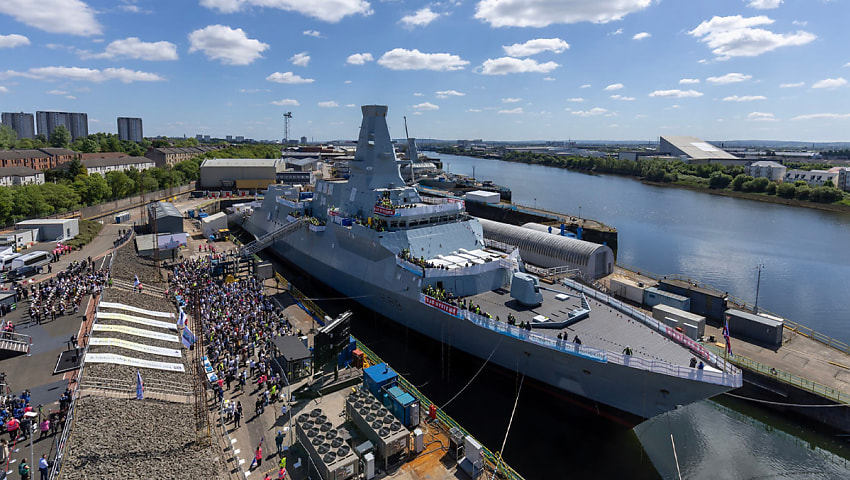
HMS Glasgow, the first of eight advanced Type 26 City Class frigates being constructed by BAE Systems for the Royal Navy, has been officially named by her royal highness the Princess of Wales at a ceremony held in the city that lends the ship her name.
The Princess of Wales, who serves as the ship’s sponsor in an honorary role traditionally meant to confer good luck and divine protection on a vessel, will maintain a lasting connection with the ship and her crew throughout its service life.
The ceremony, hosted at BAE Systems’ Scotstoun shipyard, was attended by a crowd that included his royal highness the Prince of Wales, shipbuilders, members of the ship’s company and their families.
In a nod to Glasgow’s Scottish heritage, a bottle of whisky was ceremonially smashed against the ship’s bow, replacing the traditional champagne.
“This is a historic moment for the Type 26 program, for the city of Glasgow, and for the thousands of people involved in this tremendous effort,” said Simon Lister, managing director of BAE Systems naval ships. “The naming of HMS Glasgow marks a key milestone in the journey towards delivering these powerful new warships to the Royal Navy. We are proud that they will play a critical role in protecting the UK’s interests.”
Vice Admiral Sir Martin Connell, the Royal Navy’s Second Sea Lord, reflected on Glasgow’s distinguished naval heritage, saying, “From the first HMS Glasgow, which sailed under the Royal Navy flag in the late 17th century, to the ship we see today in the 21st century, Glasgow has continuously evolved to meet the operational and warfighting demands of its time.
“With 11 battle honours to its name, the Glasgow legacy is truly remarkable. This ship and her class embody the next chapter of naval innovation, setting the standard for future maritime warfare, safeguarding Britain’s interests and contributing to national prosperity,” VADM Connell added.
The Type 26 City Class frigate program was launched to replace the ageing Type 23 fleet and deliver cutting-edge, versatile warships designed to handle the full spectrum of modern naval operations. Displacing 6,900 tonnes and measuring 149 metres in length, the Type 26 ships will form the backbone of the Royal Navy’s surface fleet.

These highly advanced ships are tailored for anti-submarine warfare, high-intensity combat and humanitarian operations. Designed with modular mission bays, a flight deck capable of supporting a wide range of helicopters and a range of sophisticated weapons and sensors, they represent a step-change in capability.
The Type 26 design has already attracted international attention, with Australia and Canada adopting variants for their own navies as the Hunter and Halifax classes, respectively.
Work is already progressing on Glasgow’s sister ships. HMS Cardiff was transferred to Scotstoun last year for outfitting, while HMS Belfast, HMS Birmingham, and HMS Sheffield are advancing at BAE Systems’ Govan facility.
Steel for HMS Newcastle is scheduled to be cut later this year. All eight vessels are slated to enter service between 2028 and 2035, with the Type 26 fleet expected to serve well into the mid-21st century.
Want to see more stories from trusted news sources?
Make Defence Connect a preferred news source on Google.
Click here to add Defence Connect as a preferred news source.