

 iscover
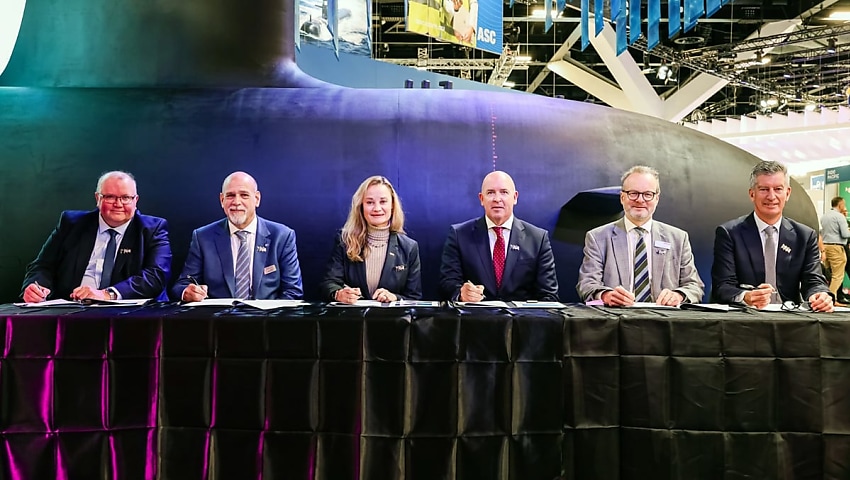
BAE Systems (Australia), Raytheon Australia, General Dynamics Mission Systems and Thales UK have signed a landmark memorandum of understanding to establish a dedicated “AUKUS Combat Systems Collaborative Team”.
Under the MOU, the alliance will lead the design, manufacturing foundations and integration of the combat systems for the forthcoming SSN‑AUKUS conventionally armed nuclear-powered submarines.
The submarine class in question is being developed under the three-nation AUKUS security partnership and will draw on the UK’s next-generation design, with technology inputs from Australia, the UK and the United States.
Collectively, the companies said they bring more than 150 years of combined experience across design, integration and delivery of advanced combat systems in three nations. The MOU emphasised not only capability delivery for the submarine force but also workforce risk mitigation and an accelerated speed to operational readiness.
In particular, the initiative seeks to maximise Australian involvement in combat system design and delivery, ensure transfer of skills, technology and knowledge across the AUKUS nations, and strengthen Australia’s sovereign industrial base.
BAE Systems Australia chief executive officer Craig Lockhart said: “This memorandum of understanding is another strategic step forward to developing the most effective and advanced combat system for SSN-AUKUS, simultaneously strengthening Australia’s operational sovereignty and industrial capability.”
Raytheon Australia managing director Ohad Katz added that his company and its workforce “bring more than 25 years of expertise in design, integration and sustainment … establishing the base for a truly sovereign capability ready to deliver the RAN’s most ambitious naval program”. The General Dynamics and Thales representatives likewise enthused about the international collaboration and industrial scale.
Key technical work under the agreement includes development of a tri-national command system, described as a “shared solution” for Australia and the UK.

This builds on the US-based AN/BYG-1 open-architecture submarine combat control system, which is currently installed on Australia’s existing diesel-electric Collins Class submarines and US Navy submarines. The collaborative team will apply that proven baseline while adapting it to the requirements of SSN-AUKUS.
Laura Hooks, vice president and general manager of Maritime and Strategic Systems at General Dynamics Mission Systems, said, “The MOU acknowledges that the team successfully delivering submarine combat system capability to the three nations via separate efforts today should be entrusted to sustain and integrate combat systems aboard Virginia and AUKUS submarines in the future, ensuring continuity, confidence and low-risk delivery. It sets a standard of teamwork that will allow us to more efficiently explore future business opportunities in the United States, United Kingdom, and Australia.”
The SSN-AUKUS class is intended to become the conventionally armed nuclear-powered attack submarine for both the Australian and UK navies.
The submarines will be built in both the UK and Australia, with work beginning by around 2030 and entry into service towards the end of the 2030s for the UK and early 2040s for Australia.
Steven Lockley, chief operating officer of underwater systems, Defence Mission Systems, Thales UK, added, “Success on international programs such as AUKUS requires strong international partners in order to deliver maximum customer value and sustained capability. Thales is pleased to continue its long-term combat systems relationships with BAES and Raytheon Australia and look forward to also working with a new partner in General Dynamics, Mission Systems. Together, we will deliver a hugely capable and sustainable AUKUS combat system maximising the attributes of our companies across the AUKUS countries.”
By forming this multi-company collaboration now, Australia and its partners aim to anchor the combat system backbone of the SSN-AUKUS class early in the program, secure industrial sovereignty and set a trajectory for the future of Australian submarine manufacturing and sustainment.
The focus on skills transfer and integrity of supply chain reflects the depth of complexity ahead not just in building submarines but sustaining them over decades.
Want to see more stories from trusted news sources?
Make Defence Connect a preferred news source on Google.
Click here to add Defence Connect as a preferred news source.