

 iscover
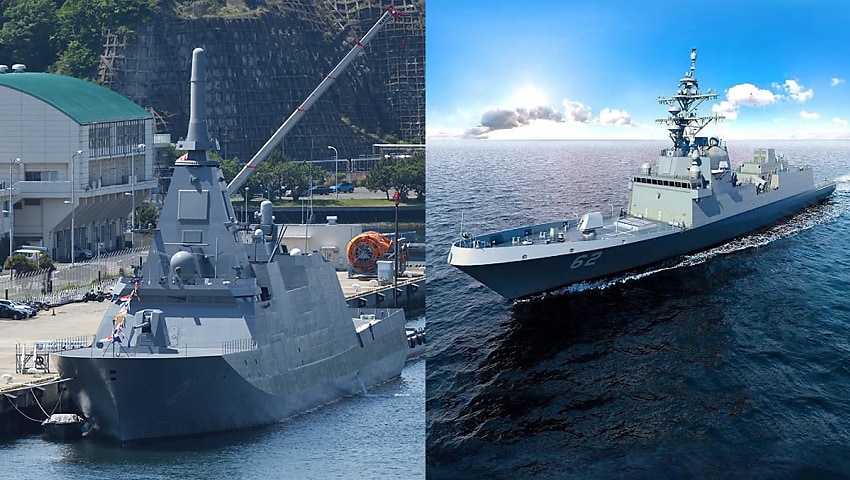
As is always the case, major trade shows like IndoPac are a hive of scuttlebutt, with some theories realistic, some optimistic and some, quite frankly, ridiculous, but one in particular stood out and made a lot of sense.
When Australia announced that it had selected the “upgraded Mogami” Class frigate designed and built by Mitsubishi Heavy Industries (MHI) in August of 2025, few were surprised by the decision.
As a platform, the “upgraded Mogami” will not only serve as the backbone of the Royal Australian Navy but will also serve as the bedrock for future industrial and strategic collaboration between Australia and Japan, as they both grapple with the double-edged sword of a rising and increasingly assertive Beijing and the relative decline of the United States in the Indo-Pacific.
At the time of the announcement, Deputy Prime Minister and Defence Minister Richard Marles and Defence Industry Minister Pat Conroy said, “Following a rigorous and competitive tender process, Mitsubishi Heavy Industries’ Mogami Class frigate was assessed as best able to quickly meet the capability requirements and strategic needs of the Australian Defence Force.
“The upgraded Mogami Class frigate boasts a range of up to 10,000 nautical miles, a 32 cell vertical launch system, and is fitted with surface-to-air missiles and anti-ship missiles,” the pair said in their media release.
From the earliest conceptualisation of the SEA 3000 program, the Australian government was clear, there would be a focus on as little change to the base design as possible. Now that is not to say that there wouldn’t be some “Australianisation” involved, with the Japanese surface-to-surface anti-ship missiles to be replaced by the Naval Strike Missile systems, for example.
This emphasis on minimal changes was done in an effort to avoid costly design changes and delays in the delivery schedule which have continued to plague major defence projects the world over, especially in Australia and the United States, further reinforcing the government’s stated commitment of “speed to capability”.
However, there still remains some questions about the final design and specifications of the final “upgraded Mogami” that will be fielded by both Japan and Australia, and here is where the scuttlebutt I repeatedly heard from IndoPac 2025 comes into play.

So enough tiptoeing, what exactly is this scuttlebutt?
Australia’s decision to go with the Japanese “upgraded Mogami” was at least, in part, influenced by the naval shipbuilding challenges currently being faced by the US Navy’s own troubled, delayed and over-budget Constellation Class program, because the US wants in.
As it stands, the US Navy’s Constellation Class frigate program (designated FFG-62) was initiated in 2017 to deliver a modern, multi-mission small surface combatant to supplement larger vessels and replace some ageing frigates and littoral combat ships.
In April 2020, the Navy awarded a contract to Fincantieri Marinette Marine in Wisconsin to build the lead ship and nine options, based on the Italian-designed FREMM frigate but modified for US Navy systems and requirements.
Construction of the lead ship, USS Constellation (FFG‑62), began on 31 August 2022. The ship is to be equipped with advanced sensors including the AN/SPY-6(V)3 radar, Mk 41 vertical launch system, a 57mm gun, hangar and flight deck for MH-60R and MQ-8C, and a shock-resistant survivability design.
The Navy currently plans for at least 20 ships in the class (with potential for up to 58 depending on a Flight II evolution). Budget documents in 2025 confirm the first six ships remain in the program though no new ship was funded in FY2025–26.
However, the program faces significant challenges.
A Government Accountability Office (GAO) report and other analyses warn of cost growth (now estimated at over US$22 billion [AU$33.5 billion]), design instability, construction beginning before final design approval, and delivery delays – the lead ship now seems unlikely to be delivered until at least April 2029.
Accordingly, the Constellation Class represents a serious effort by the US Navy to field a capable, versatile frigate for distributed maritime operations. It leverages a foreign parent design to reduce risk but has encountered the familiar pitfalls of US shipbuilding: delayed schedules, evolving requirements and cost overruns.
Enter the “upgraded Mogami” and the potential for a trilateral partnership between Australia, Japan and the United States, where each nation operates a common platform, with a common sensor suite based on and centred around the SPY-7 radar platform, leveraging the long-range discrimination radar technologies.
Despite the final details needing to be ironed out on the “upgraded Mogami”, especially around the final sensor configuration and Japan’s existing contract with Lockheed Martin to supply the SPY-7 radar system for the Japanese Maritime Self-Defense Force’s Aegis System Equipped Vessel.
The fielding of the SPY-7 radar would provide a comprehensive overmatch in air and missile defence role without compromising the anti-submarine or surface warfare capabilities of the platform while providing a potent common platform in the Indo-Pacific.
Importantly for the United States and Australia, the design efforts and work done by Japan to meet Australian requirements will serve as a significant risk mitigation bonus, limiting the design and cost risks associated with moving the design to production in local yards.
It is hard to fault the rationale behind the scuttlebutt and it is something I heard consistently from a number of different sources, each from different angles and nations. So maybe, just maybe, there is some legitimacy to it.

Want to see more stories from trusted news sources?
Make Defence Connect a preferred news source on Google.
Click here to add Defence Connect as a preferred news source.