

 iscover
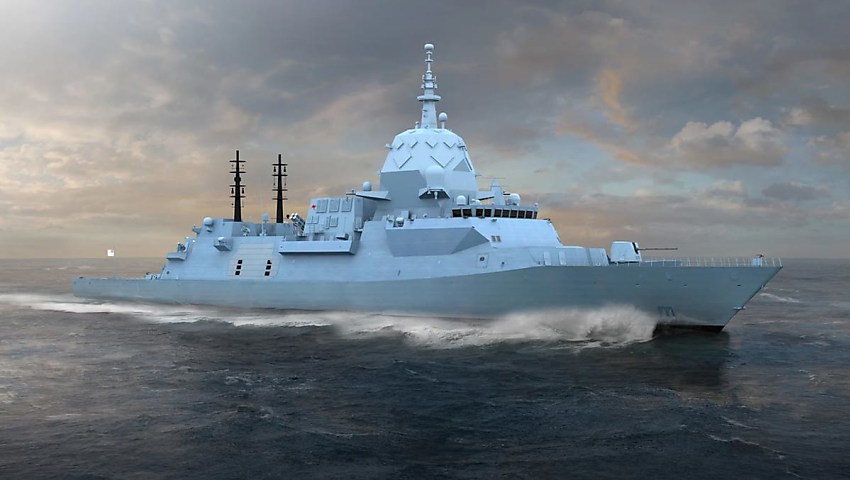
The Royal Australian Navy, Capability Acquisition and Sustainment Group, and Thales have celebrated a milestone for the Hunter Class frigate program with NUSHIP Hunter’s sonar suite formally passing factory acceptance testing.
Conducted at the Thales Defence Mission Systems facility in Brest, France, with representatives from Thales France, Thales UK, Thales Australia and the Royal Australian Navy in attendance, the factory acceptance test marks a major milestone for the continued progress on Australia’s future frigate program.
The testing was conducted on the towed body handling system (TBHS) and towed array handling system (TAHS) for its Sonar 2087 suite which will provide NUSHIP Hunter with the capacity to detect, locate and classify submarines at ranges up to 60 kilometres.
Commander Roy Casson, representing Naval Shipbuilding and Sustainment Group, a division within Defence’s Capability Acquisition and Sustainment Group, celebrated this milestone, saying, “The TBHS and TAHS, in addition to the associated auxiliary systems, performed well in accordance with the detailed test procedures.”
The Sonar 2087, the British-developed variant of the Thales CAPTAS-4 system, combines active and passive sonar arrays, offering 360-degree situational awareness and real-time torpedo alerts, significantly enhancing Navy’s anti-submarine warfare capabilities.
CMDR Casson added, “The multinational Thales teams provided diligent and rigorous oversight to ensure the product met its design intent and is ready to deliver this world-leading capability to Navy for many years to come.”
Integrated into the Royal Australian Navy’s Hunter Class frigates, this next-generation sonar system will form a key element of the ships’ sophisticated sensor and weapons suite.
Together, these systems will provide a highly capable anti-submarine warfare (ASW) platform designed to detect, track and counter advanced submarines, and safeguard Australia’s maritime approaches well into the future.

The Hunter Class, based on the UK’s Type 26 design, will become the Navy’s primary long-range ASW surface combatant, with each vessel intended to combine a quiet hull form, advanced acoustic sensors and the Aegis combat management system (paired with the Australian-developed Saab 9LV).
The project has faced schedule and cost pressure and design evolution as the baseline ship has been adapted to meet Australian requirements, including integration of Australian combat systems, CEAFAR radars and enhanced weapons fit-out.
Nonetheless, the frigate remains central to Defence’s future surface fleet plans, particularly as a dedicated ASW “picket” intended to work alongside AUKUS SSNs, surface combatants and uncrewed systems.
With testing now complete, the sonar systems are scheduled for delivery to Australia in the first quarter of 2026 for integration into the Hunter Class build program.
This milestone marks a substantial step towards the frigate’s planned entry into service in the early 2030s, ensuring the Navy receives a world-class ASW capability aligned with broader fleet modernisation and Australia’s long-term maritime security needs.

Want to see more stories from trusted news sources?
Make Defence Connect a preferred news source on Google.
Click here to add Defence Connect as a preferred news source.