

 iscover
The US Navy has revealed two major surface combatant replacement programs, marking the return of battleships, and some questionable decisions around the fleet’s future frigate program in seemingly contradictory fashion.
As geopolitical competition continues to swirl across the globe, maritime power and the capacity to project tactical and strategic deterrence on scale and sustainably is becoming increasingly important.
While the United States Navy has continued to maintain its position as the world’s premier naval power, first achieved during the height of the Second World War, it faces both singular and a host of challenges, that when in aggregate, serve to fundamentally undermine the position of the US Navy.
Not least of these is the rapid emergence of the People’s Liberation Army Navy of the People’s Republic of China and its vast industrial capacity which has transformed itself from a second rate, “brown-water” navy into the world’s second most powerful and world’s largest (at least by hulls) navy.
Beijing’s efforts to expand its naval capabilities have seen it seek to emulate and, in some cases, exceed the foundational pillars of American, and by extension, Western naval power, with power projection, firepower and at-sea deterrence at the very core of their ambitions.
This has seen the development and fielding of a host of advanced surface combatants, including the Renhai (Type 055) guided missile cruiser, the region’s largest and most heavily-armed surface combatant, the various incarnations of the Luyang Class guided missile destroyers and a small but growing fleet of aircraft carriers and amphibious assault ships.
In response, America’s Navy has recognised that it needs more hulls, firepower and survivability in order for it to maintain its position as the global security guarantor for the maritime commons and reinforce nervous allies across the globe.
As a result, we saw the recent “strategic shift” of the US Navy away from the troubled Constellation Class frigate program, designed to “free up” larger, more capable surface combatants like the venerable Arleigh Burke class to focus on the “high-end” fight against peer and near-peer competitors.

But recent announcements have left us with more questions than answers.
Beginning with the US Navy’s decision to replace the Constellation Class program with a “navalised” variant of the US Coast Guard’s Legend Class cutters. Designed to deliver surface warfare, its ability to carry modular payloads and command unmanned systems enables it to execute a broad spectrum of operations, making it ready for the challenges of the modern maritime environment
John C Phelan, Secretary of the Navy, explained as part of the announcement, “To deliver at speed and scale, I’ve directed the acquisition of a new frigate class based on HII’s Legend Class National Security Cutter design: a proven, American-built ship that has been protecting US interests at home and abroad.”
As part of this strategic pivot, the US Navy stressed that small surface combatants have long been a core part of naval fleets, carrying out a broad range of tasks where deploying a major warship would be unnecessary or inefficient. The FF(X) will carry this role forward, undertaking routine operations and day-to-day missions while improving the fleet’s overall flexibility, adaptability and readiness for operations.
Admiral Daryl Caudle, 34th Chief of Naval Operations, expanded on the comments of the Navy Secretary, adding, “Like the Medium Landing Ship, leveraging a complete design and production baseline approach will allow the Navy and shipbuilders to reduce costs, schedule and technical risk...
“We know this frigate design works, we know it operates with the fleet and, most importantly, we know how to build it now,” ADM Caudle said.
A core driving force behind this decision is clearly the emphasis on the “proven” and “in-service” design base of the Legend Class as a key selling point, with the US Navy stressing, “(the) FF(X) is engineered for rapid, cost-effective production, enabling this vital capability to the fleet faster. This is made possible by basing the new frigate on HII’s proven Legend Class National Security Cutter. This approach leverages a mature design to deliver ships to our sailors without delay”.
However, questions have begun to swirl around the decision, particularly the costs and the “militarisation” of the base Legend Class, particularly the weapons capacity of these vessels or the lack thereof.
The US Navy’s FF(X) frigate program has drawn particular concern over its weapons fit and the trade-offs made to contain cost and size. While the ship carries a capable combat system, critics argue its limited missile capacity constrains its combat power in high-intensity warfare.
The relatively small vertical launch system reduces the number of air defence, strike and anti-submarine weapons that can be embarked at any one time, limiting flexibility and endurance in a contested environment.
This raises questions about the ship’s ability to contribute meaningfully to distributed maritime operations against a peer adversary.
At the same time, the decision to prioritise survivability and sensors over magazine depth risks producing a frigate that is heavily defended but lightly armed.
For routine tasks, the weapons suite may be more than adequate, but in major conflict, the FF(X) could struggle to sustain combat or defend itself and nearby units against massed missile threats, highlighting an ongoing imbalance between firepower, cost and role.
At the other end of the spectrum is US President Donald Trump’s proposed Trump Class of guided missile battleships, announced by the President to much fanfare and consternation at his Florida estate, Mar-a-Largo, in late December.
With a proposed production run of between 10 and 25 of the vessels, the US Navy envisages that these vessels will be “an unambiguous statement of American commitment to maritime superiority with capability to distribute more firepower across the fleet than any other class of ship, for any Navy, in history”.
Designed as a key centrepiece of President Trump’s proposed “Golden Fleet”, these vessels will provide “dominant firepower and a decisive advantage over adversaries by integrating the most advanced deep-strike weapons of today with the revolutionary systems of the years ahead”.
These vessels, expected to have a displacement of between 35,000–40,000 tonnes, will not replace the aircraft carrier as the centrepiece of American naval dominance but will provide another arrow in the quiver, and one that can be actively integrated into the carrier strike groups serving as formidable node and effector within the integrated air and missile defence network of the taskforces.
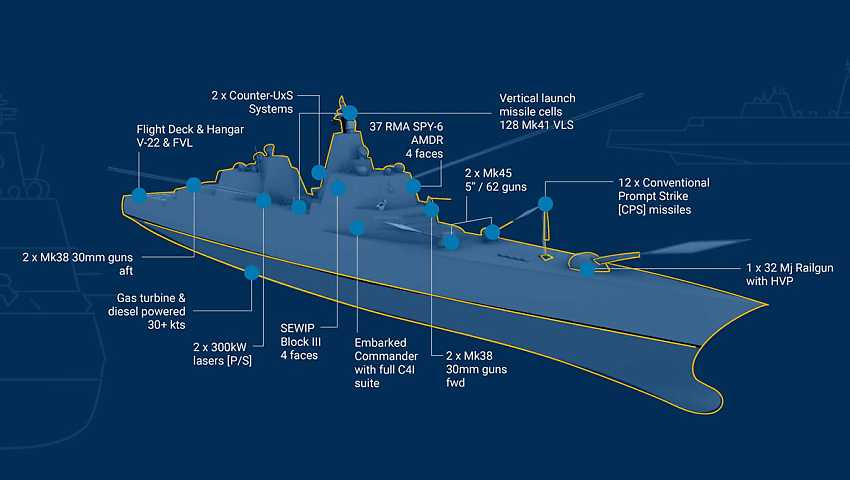
At around three times the displacement of an Arleigh Burke Class destroyer, the ship’s vast hull would enable far greater firepower, substantially larger missile magazines (with an expected MK.41 inventory of 128 cells), and the ability to deploy both Conventional Prompt Strike hypersonic weapons via a dozen CPS missile cells and the nuclear-armed, surface-launched cruise missile.
The ships will also incorporate a hypersonic rail gun, along with two Mk 45 5-inch naval guns, a pair of either 300kw or 600kw offensive, directed energy weapons and a suite of advanced defensive weapons systems, incorporated into an Aegis combat system linked to SPY-6 radar systems.
ADM Caudle said, “As we forge the future of our Navy’s fleet, we need a larger surface combatant and the Trump Class battleships meet that requirement.
“We will ensure continuous improvement, intellectually honest assessments about the requirement to effectively deter and win in the 2030s and beyond, and disciplined execution resulting in a fleet unparalleled in lethality, adaptability and strength.”
Interestingly, the vessels proposed as part of the Trump Class share the same Mk 41 VLS capacity as Japan’s proposed pair of Aegis System Equipped Vessels, at 2.86 times smaller, albeit, they will lack the CPS capabilities and (at least at this stage) rail gun for a significantly more cost-effective package.
Based on these two ships, it is clear that the US Navy is, as it stands, caught in a juxtaposition, seeking to balance overwhelming firepower and exquisite systems, with numerous expendable and deployable platforms.
Japan’s cruiser proposal echoes similar developments and evolutions by South Korea and these trends are only going to continue. It should be clearly stated that while Australia will never field one of President Trump’s new “battleships” or perhaps battlecruiser is a far more apt descriptor, cruisers and adequately equipped destroyers aren’t out of the realm of possibility.
So maybe it’s really past time for Australia to have an open, honest and transparent conversation about our maritime security requirements.

Want to see more stories from trusted news sources?
Make Defence Connect a preferred news source on Google.
Click here to add Defence Connect as a preferred news source.