

 iscover
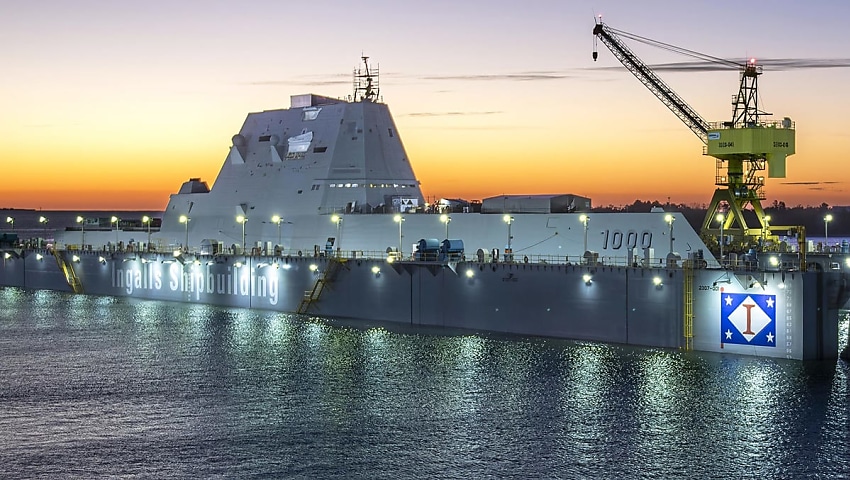
The US Navy’s most futuristic destroyer, USS Zumwalt, has completed a major round of sea trials following an extensive modernisation program that will see it become the Navy’s first operational surface ship armed with hypersonic missiles.
The trials were conducted by HII’s Ingalls Shipbuilding division in Mississippi and mark a critical step in returning the vessel to front-line service after being refitted with the Conventional Prompt Strike (CPS) weapon system, the US military’s flagship long-range hypersonic strike capability.
Ingalls and US Navy crews carried out a comprehensive series of at-sea tests to validate propulsion, combat systems, navigation and overall seaworthiness following more than a year of deep structural and technological upgrades.
HII president of Ingalls Shipbuilding Brian Blanchette said the trials represented a turning point for both the ship and the broader Zumwalt program.
“We have achieved a pivotal milestone with our Navy and industry partners to advance this complex modernisation work that will set a precedent for the Zumwalt Class,” Blanchette said.
“I’m very proud of the team effort and their critical role in delivering the US Navy’s first warship with hypersonic capabilities.”
USS Zumwalt (DDG-1000) is the lead ship of the Zumwalt Class destroyers, originally conceived in the early 2000s as a next-generation stealth surface combatant optimised for land attack and littoral warfare.
The class is famous and controversial for its radar-defeating tumblehome hull, heavy automation and fully electric propulsion system. At 183 metres long and displacing more than 15,000 tonnes, USS Zumwalt is the largest destroyer ever built for the US Navy, closer in size to a World War II cruiser than a modern escort ship.

The original program was meant to deliver 32 ships, but spiralling costs and shifting priorities cut the class down to just three vessels. Its core armament twin 155mm Advanced Gun Systems was later abandoned after the specialised ammunition became prohibitively expensive, leaving the ships without a meaningful main weapon.
Rather than scrap the class, the US Navy chose to redefine the Zumwalts as hypersonic strike platforms, transforming what was widely seen as a failed acquisition into a niche but potentially decisive strategic asset.
USS Zumwalt arrived at Ingalls Shipbuilding in August 2023 for its transformation and was placed on land for one of the most extensive rebuilds ever conducted on a US surface combatant.
The refit included:
- Removing the two 155mm gun turrets.
- Cutting large sections into the hull and deck.
- Installing four large missile tubes for CPS.
- Integrating new combat, power and launch systems.
The CPS weapon uses a Common Hypersonic Glide Body, capable of travelling at more than Mach 5 and striking targets over 2,700 kilometres away with conventional (non-nuclear) warheads. The system is designed to give the US military the ability to hit high-value targets anywhere in the world within minutes, bypassing most existing air and missile defences.
USS Zumwalt was undocked in December 2024 and entered final preparations for sea trials, which have now been successfully completed.
The hypersonic conversion is not limited to USS Zumwalt alone, with the USS Lyndon B Johnson (DDG-1002) currently undergoing CPS integration at Ingalls and USS Michael Monsoor (DDG-1001) scheduled to receive the system during a future maintenance period.
Once complete, the three ships will form a small but extremely high-impact hypersonic strike squadron, able to operate independently or alongside carrier strike groups and nuclear submarines.
Strategically, the rebirth of the Zumwalt Class is also widely seen as a precursor to the US Navy’s next generation of capital surface ships, informally dubbed the “Trump Class” battleships under plans first floated during the Trump administration and now embedded in long-term US naval force structure debates.
While details remain classified and politically sensitive, the Trump Class concept is expected to involve very large surface combatants closer in scale to Cold War cruisers or even historic battleships, designed around:
- Hypersonic missile batteries
- Directed-energy weapons (lasers and railguns)
- Massive electrical power generation
- Advanced AI-enabled combat systems
In this sense, USS Zumwalt is effectively serving as a technology demonstrator, proving the feasibility of electric propulsion, stealth shaping and large-scale hypersonic integration on a surface warship before those concepts are scaled up into true capital ships.
Even by modern standards, the Zumwalt Class remains among the most advanced surface combatants ever built, featuring:
- Integrated electric propulsion, generating enough power for future laser and railgun systems.
- Extensive stealth shaping and materials, dramatically reducing radar cross-section.
- Highly automated systems, enabling a crew of around 150 sailors, roughly half that of an Arleigh Burke Class destroyer.
With hypersonic missiles now replacing its failed gun system, the class is finally aligned with the realities of 21st century great power competition, long-range conventional strike, strategic deterrence and power projection against peer adversaries such as China and Russia.
In effect, USS Zumwalt is no longer just an experimental outlier. It has become the world’s first operational hypersonic surface warship and the conceptual bridge between today’s destroyers and tomorrow’s Trump Class battleships.

Want to see more stories from trusted news sources?
Make Defence Connect a preferred news source on Google.
Click here to add Defence Connect as a preferred news source.