

 iscover
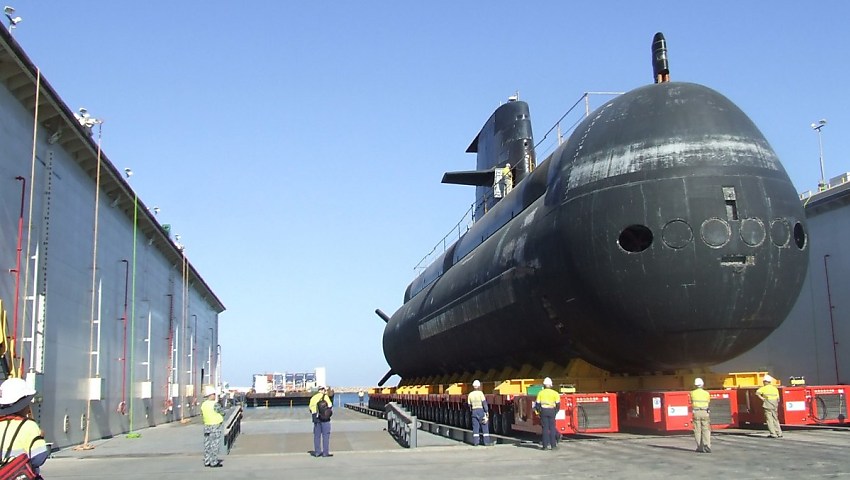
The Albanese government has formally launched the long-awaited life of type extension (LOTE) program for the Royal Australian Navy’s ageing Collins Class submarine fleet.
Defence Connect can confirm that this suite of works will begin with HMAS Farncomb later this month, as Canberra works to preserve Australia’s undersea warfare capability during the transition to the nation’s future AUKUS nuclear-powered submarine force.
The decision marks a major milestone in Australia’s submarine strategy, with the government committing up to $11 billion over the coming decade to sustain, modernise and extend the operational life of all six Collins Class boats well into the 2030s and potentially beyond.
The LOTE program is designed to reduce the risk of a capability gap emerging before Australia begins operating conventionally armed, nuclear-powered submarines under the AUKUS agreement.
Deputy Prime Minister and Defence Minister Richard Marles said the extension program would ensure the Collins Class remained a potent deterrent and strike capability throughout the transition period.
“These decisions reaffirm the Albanese government’s commitment to keeping the Collins Class a potent and highly capable strike and deterrent capability today and for years to come,” Minister Marles said.
“Extending the life of all six Collins Class submarines is critical to maintaining that edge as we transition the Navy from conventional to nuclear-powered submarines.”
The Collins Class has formed the backbone of Australia’s submarine capability since the 1990s, but the ageing fleet has faced increasing sustainment challenges in recent years, including workforce shortages, maintenance delays and declining vessel availability.

In response, the government last year designated the Collins fleet as a “Product of Concern”, increasing ministerial oversight and driving reforms across Defence and industry aimed at improving productivity, sustainment efficiency and operational readiness.
Under the revised sustainment model, Defence and ASC will adopt a conditions-based maintenance approach, replacing earlier plans for a more comprehensive and time-consuming rebuild of each vessel. The approach will focus on restoring and retaining critical baseline systems while continuing targeted upgrades to combat systems, sensors, weapons and survivability.
HMAS Farncomb, one of the oldest and most heavily used submarines in the fleet, will act as the lead platform for the program. Its maintenance period will include an extensive engineering assessment intended to shape future work across the rest of the class.
At the same time, Defence will prioritise sustainment activity on the fleet’s younger submarines, beginning with HMAS Rankin, in an effort to maximise fleet availability during the transition to AUKUS capabilities.
The Collins LOTE effort is increasingly being viewed as one of the most strategically important defence programs currently underway in Australia, with the submarines expected to shoulder the burden of Australia’s undersea deterrence capability until at least the early 2040s.
The Albanese government’s broader submarine pathway under AUKUS will eventually see Australia acquire a fleet of conventionally armed, nuclear-powered submarines based initially on the Virginia Class submarine before transitioning to the future SSN-AUKUS design developed jointly with the United Kingdom.
However, those capabilities remain years away. Australia is not expected to receive its first Virginia Class boat until early to mid-2030s at the earliest, while the first Australian-built SSN-AUKUS submarine is unlikely to enter service until the 2040s.
That timeline has significantly elevated the importance of the Collins fleet, particularly as strategic competition intensifies across the Indo-Pacific and concerns grow about the pace of Chinese naval expansion.
Defence Industry Minister Pat Conroy said the LOTE program was also a major investment in Australia’s sovereign industrial capability.
“The Collins life of type extension is a critical capability decision and a major investment in Australia’s sovereign defence industrial base and submarine supply chain,” Minister Conroy said.
Industry will continue to play a central role in sustaining the fleet, with both Osborne in Adelaide and Henderson in Perth remaining key hubs for submarine maintenance, sustainment and workforce development.
The government has repeatedly argued that maintaining and expanding this industrial base is essential not only for keeping the Collins fleet operational, but also for preparing Australia’s workforce and infrastructure for the vastly more demanding requirements of operating and eventually building nuclear-powered submarines under AUKUS.
Defence officials have also stressed that safety standards will not be compromised throughout the LOTE process, with sustainment investments covering both infrastructure upgrades and the expansion of the highly specialised submarine workforce required to maintain operational availability across the fleet.

Stephen Kuper
Steve has an extensive career across government, defence industry and advocacy, having previously worked for cabinet ministers at both Federal and State levels.
Want to see more stories from trusted news sources?
Make Defence Connect a preferred news source on Google.
Click here to add Defence Connect as a preferred news source.