

 iscover
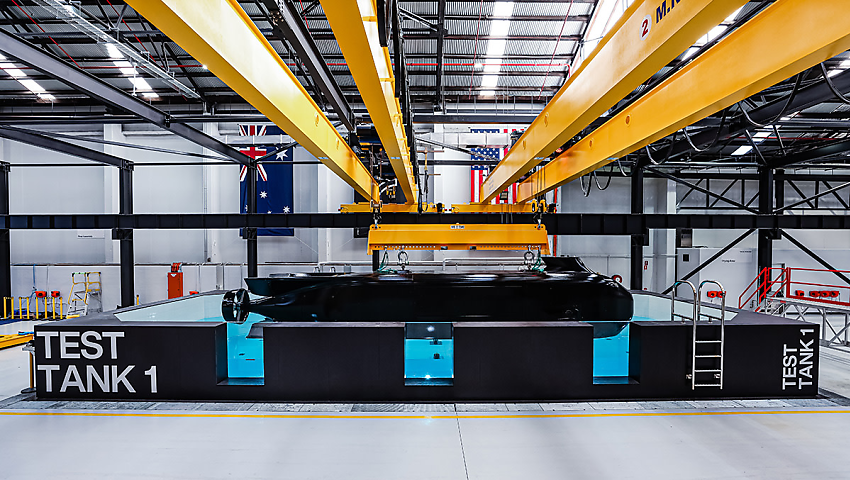
The three AUKUS partners have unveiled their first major Pillar 2 “signature project”, a trilateral effort to develop advanced autonomous undersea warfare systems designed to protect critical seabed infrastructure and strengthen deterrence and interoperability.
Announced on the sidelines of the Shangri-La Dialogue in Singapore, AUKUS defence ministers have unveiled their most significant step yet under Pillar 2 of the trilateral partnership, a joint push into autonomous undersea warfare, advanced sensing and next-generation maritime systems.
The initiative was confirmed following talks between US Secretary of War Pete Hegseth, Australian Deputy Prime Minister and Defence Minister Richard Marles, and UK Secretary of State for Defence John Healey, and signals a decisive shift in focus from long-term ambition to near-term operational capability.
At its core, the program will see Australia, the United Kingdom and the United States jointly develop and integrate advanced payloads, sensors, weapons systems and enabling technologies for deployment on uncrewed undersea vehicles. The aim is to build a shared capability architecture that can operate seamlessly across all three navies, with early systems expected to enter service from 2027.
The announcement lands at a time of growing alarm among Western governments over the security of critical undersea infrastructure, including subsea communications cables, energy pipelines and defence networks that underpin both economic stability and military operations.
Speaking in Singapore, Minister Marles underscored the rapidly changing nature of the strategic environment beneath the waves.
“The seabed is a battlefield,” he said, highlighting increasing threats to infrastructure that is often out of sight but central to national resilience and warfighting capability.
Recent incidents involving damaged subsea cables in Europe and the Indo-Pacific have sharpened allied concern, reinforcing the view that the undersea domain can no longer be treated as a benign support space, but as a contested operational environment in its own right.

The new AUKUS initiative is designed squarely around that reality.
A key feature of the program is interoperability, a central pillar of AUKUS Pillar 2, ensuring Australian, British and American forces can rapidly integrate emerging technologies into combined operations without the delays of separate national development pathways or incompatible systems.
Beyond undersea vehicles, the project is expected to become a foundation for wider collaboration in autonomy, artificial intelligence, electronic warfare, advanced sensing and maritime robotics.
Secretary Hegseth framed the initiative as part of a broader push to accelerate delivery of warfighting capability to front-line forces while strengthening deterrence across the Indo-Pacific. Australian and UK counterparts echoed that assessment, describing the project as a tangible shift from concept to capability within the AUKUS framework.
More broadly, the program reflects a fundamental change in how allied militaries are approaching undersea warfare.
Rather than relying solely on large, crewed platforms, future operations are increasingly expected to be driven by networks of autonomous and semi-autonomous systems, capable of operating at scale, maintaining persistent surveillance and extending the reach of traditional naval forces.
For Australia, the initiative aligns directly with its push to grow sovereign capability in autonomous systems, advanced manufacturing and undersea technologies while tightening integration with its closest allies.
It also builds on several years of experimentation under AUKUS, including joint trials of autonomous maritime systems and undersea surveillance technologies. The new signature project effectively consolidates and accelerates that work into a structured, long-term capability development pathway.
As strategic competition intensifies across the Indo-Pacific, AUKUS leaders are increasingly framing the partnership not just as a submarine program but as a technology alliance designed to maintain an edge across emerging domains of warfare.
With the launch of its first Pillar 2 signature project, AUKUS is now signalling that the future fight beneath the waves will be shaped as much by autonomous systems, artificial intelligence and infrastructure protection as by the nuclear-powered submarines that first defined the partnership.

Want to see more stories from trusted news sources?
Make Defence Connect a preferred news source on Google.
Click here to add Defence Connect as a preferred news source.