

 iscover
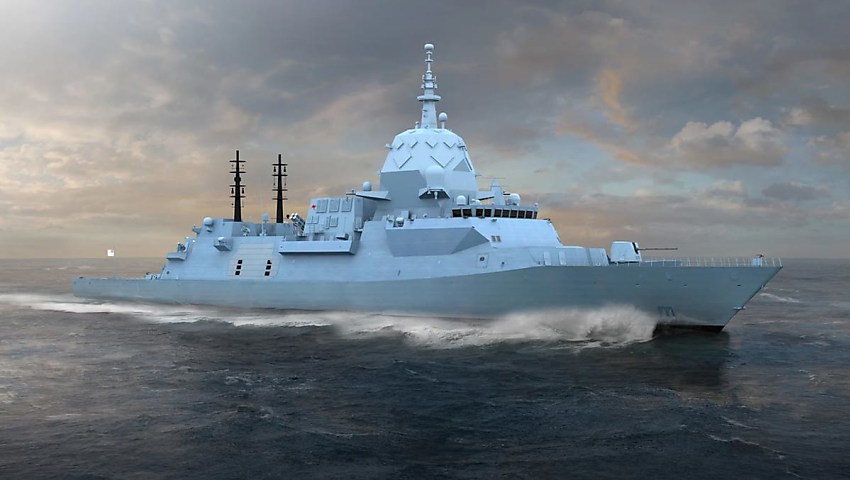
Overnight, the German military has announced the cancellation of its €18 billion ($29.6 billion) next-generation F126 class of specialist anti-submarine frigates due to a cost explosion and projected delivery delays, begging the question: Can Australia at least get serious about the Hunter frigates?
First things first, I don’t want to sound like a broken record nor do I want to call for the cancellation of the Hunter Class program, despite my headline (I had to get you to click somehow!).
Now that we have that awkwardness out of the way, let’s “compare the compare”, as Aleksandr the Meerkat says.
When first proposed in the 2009 Defence White Paper, the Hunter Class was anticipated to originally see a fleet of eight (not nine as would be announced in the 2016 Defence White Paper), delivering a class of ships that would be “larger” than the Anzac Class vessels. The future frigate will be designed and equipped with a strong emphasis on submarine detection and response operations.
“They will be equipped with an integrated sonar suite that includes a long-range active towed-array sonar and be able to embark a combination of naval combat helicopters and maritime unmanned aerial vehicles,” the white paper said at the time.
Fast forward to the 2016 Defence White Paper and the supporting Integrated Investment Program, which called for a slight increase to nine hulls and further clarified the anti-submarine focus of what would eventually become the Hunter Class frigates, highlighting that Australia’s future naval surface combatant fleet would include “nine anti-submarine warfare frigates to replace Australia’s existing
fleet of eight Anzac Class frigates”.
The necessity for this focus was based upon the increasing size, capability and reach of the People’s Liberation Army Navy’s submarine force and the threat it posed to Australia’s critical sea lines of communication and the balance of power across the Indo-Pacific.
However, the 2024 review into the composition of the nation’s surface combatant fleet saw the Hunter Class scaled back to six hulls amid growing concerns and controversy about the costs, delivery schedule and, of course, the broader, multi-role combat capability and capacity of the design, as the Navy and government sought to deliver a larger fleet of more “general purpose” frigates in the form of evolved Mogami Class frigates from Japan.

Bringing us to the German Navy’s F126 frigate program that was conceived as a major step in modernising Germany’s maritime combat capability, replacing the ageing F123 Brandenburg Class frigates with a new generation of large, multi-role warships optimised for anti-submarine warfare, maritime security and NATO operations.
In much the same way as Australia’s Hunter Class frigates, Germany’s F126 was designed as one of Germany’s most ambitious naval projects featuring modular mission spaces, advanced sensors, modern combat systems and the ability to conduct extended deployments. The class was intended to strengthen NATO’s undersea warfare capability in regions such as the North Atlantic and Baltic Sea.
However, in an echo of Australia’s Hunter experience, the program encountered significant delays, rising costs and industrial challenges, resulting in concerns over whether the project could be delivered on schedule, with Germany exploring alternatives to avoid a capability gap in its submarine-hunting fleet.
That was until last night, when the German Ministry of Defence’s budget committee announced it would be acquiring eight MEKO frigates, primarily for anti-submarine warfare roles, incorporating the Atlas Elektronik towed array sonar system originally planned for the F126 frigates, resulting in the cancellation of the program.
Bastian Ernst, the Christian Democratic Union/Christian Social Union parliamentary group’s spokesperson on naval affairs in the Bundestag, said: “The F126 frigate procurement project began long before the Common Era and is no longer appropriate for today’s security situation. Originally designed as a multipurpose combat ship, the frigate was intended to be a jack-of-all-trades, adaptable to various mission modules for different purposes.”
“The project was so ambitious that problems and delays arose very early on. Delivery of the first ship was – according to the current schedule – not expected until 2032 instead of 2028. That’s time we don’t have. We have committed ourselves to our NATO allies to make significant contributions to defence against enemy submarines. It is therefore only logical that Defense Minister Pistorius has now pulled the plug. Better an end with horror than a horror without end,” Ernst said.
Echoing this, Deputy Prime Minister and Defence Minister Richard Marles said in 2024: “Our strategic circumstances require a larger and more lethal surface combatant fleet, complemented by a conventionally armed, nuclear-powered submarine fleet”, with many believing that the combination of the nuclear-powered submarine fleet and the anti-submarine centric Hunter Class would result in a skewed fleet structure, leaving Australia exposed.
But what do we learn from the German cancellation of the F126 frigate program and its strategic pivot?
Again, I’m not advocating for the cancellation of the Hunter program, but I am advocating for a shake-up AND an injection of urgency, reality and, above all, transparency around the program, the capability and the threat environment they will be operating in.
Because with those, we will be able to deliver a ship that is not an expensive, bloated, undergunned, over-engineered system that is being shoehorned into doing too many things, with not enough in the toolkit.
Don’t believe me? Just have a look at the myriad of roles the Navy’s own website expects the ships to fulfil (humanitarian and disaster relief, anyone?) and tell me if we have got the balance right.
So maybe a little injection of fear into the ecosystem might be just what the doctor ordered.

Want to see more stories from trusted news sources?
Make Defence Connect a preferred news source on Google.
Click here to add Defence Connect as a preferred news source.