

 iscover
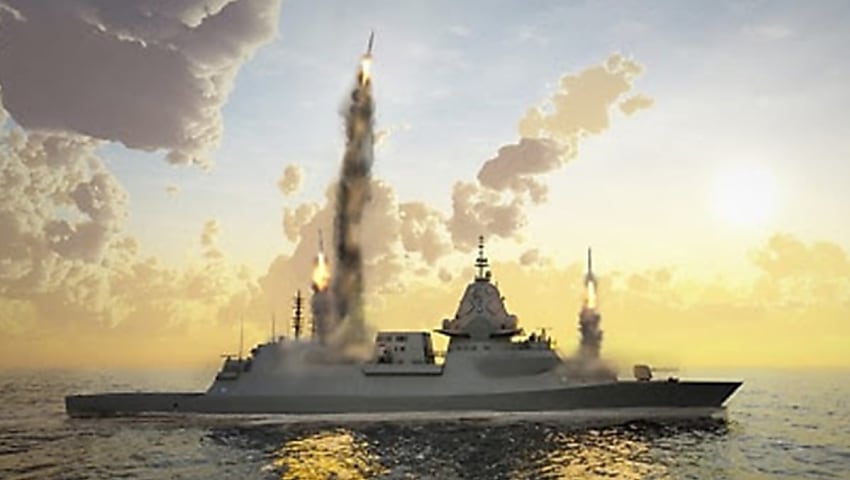
Britain’s decision to commit to at least six Common Combat Vessels under its Defence Investment Plan is drawing fresh attention to Australia’s own unresolved questions about the future of the Royal Australian Navy’s Tier 1 surface combatant fleet.
The Royal Navy’s Common Combat Vessel (CCV), confirmed this week as the replacement for the six ageing Type 45 destroyers, will deliver the United Kingdom’s most advanced maritime air defence capability from the early 2030s.
Designed from the outset as a control hub for uncrewed systems, extending the Navy’s reach and firepower without a proportional increase in crew or cost, the CCV represents a fundamental shift in how Western navies are approaching high-end air and missile defence at sea.
It will operate alongside eight Type 26 frigates, five Type 31 frigates, and a new family of uncrewed surface and underwater platforms, forming the backbone of what London is calling its hybrid navy.
New British Defence Secretary Dan Jarvis MBE said: “These Common Combat Vessels will provide our dedicated sailors with hybrid ships that are designed and built for the increasing threats we face.”
For Australia, watching this unfold carries particular resonance. The Hunter Class frigate, Australia’s sovereign adaptation of the Type 26 and the single-largest surface shipbuilding program in the nation’s history, shares the same hull lineage as the RN’s Type 26 fleet.
Construction of the lead Hunter Class frigate began at the Osborne Naval Shipyard in South Australia in January 2025, with commissioning expected by 2032. Yet even as steel is being cut, the question of what sits above and below the Hunter in the RAN’s Tier 1 order of battle remains only partially resolved.
Bringing us to revelations from BAE Systems Maritime Australia at the 2023 IndoPac Maritime Exhibition, where they unveiled a significantly up-gunned variant of the Hunter Class, replacing much of the flexible mission bay and elements of its anti-submarine warfare capability with a 64-cell Mk 41 VLS module, taking the total to 96 Mk 41 cells and doubling the Naval Strike Missile fit from eight to 16.

These developments would see the Royal Australian Navy field a destroyer equal to a US Navy Arleigh Burke Class destroyer, with a significantly more advanced and capable air and missile defence radar suite, and the much-needed magazine depth to affect surface, air and subsurface threats.
More recently, reports in May 2026 confirmed that the SeaRAM close-in weapon system has been selected for the Hunter Class in place of the Phalanx system, further enhancing the platform’s self-defence capability, bringing the platform up-to-date with the latest generation of close-in weapon system capabilities.
While it may seem pre-emptive, such a platform had long been considered a viable option for both the Royal Navy’s Type 45 replacement in the Type 83 program, more commonly referred to as the Future Air Dominance System program, and Australia’s own replacement for its three Hobart Class destroyers.
Under current planning, the reduction in Tier 1 surface combatants from 12 to nine, following the decision to reduce Hunter Class numbers from nine to six in 2024, necessitates the acceleration of a replacement destroyer program, with initial requirements setting and design work required to commence by mid-2027.
Nevertheless, the three Hobart Class destroyers are currently undergoing a significant combat system upgrade under SEA 4000 Phase 6, transitioning from Aegis Baseline 8 to the more advanced Baseline 9 configuration, integrating the Tomahawk land-attack cruise missile and enhanced air defence capabilities, but the class itself remains a finite capability, with its long-term replacement yet to be determined.
Indeed, the Australian Strategic Policy Institute’s 2026 Cost of Defence brief has identified integrated air and missile defence as the Australian Defence Force’s most critical capability gap, with only $850 million in approved funding against up to $30 billion planned across the decade.
That gap sits precisely in the space the Hobart Class currently fills and which a future destroyer will need to occupy.
The UK’s CCV program also carries an important industrial signal for Australia. The Type 26 has already been selected by Australia, Canada and Norway, demonstrating the global appetite for the platform family and the industrial partnerships it anchors.
“Developed with exceptional British innovators, the new ships will be British-built, supporting jobs across the nation and giving the Royal Navy a capability built for modern warfare,” Secretary Jarvis said.
Australia’s Hunter Class frigates will be built at Osborne in South Australia, with planning underway to follow the Hunter build with a Hobart Class replacement at the same yard, sustaining continuous naval shipbuilding and the sovereign skills base that underpins it.
What London’s CCV decision makes clear is that next-generation maritime air defence is not simply a question of replacing old hulls with new ones, it is about rethinking the entire architecture of how surface fleets generate, distribute and sustain firepower.
Canberra would do well to absorb that lesson before the design work for Australia’s future destroyer begins in earnest.

Want to see more stories from trusted news sources?
Make Defence Connect a preferred news source on Google.
Click here to add Defence Connect as a preferred news source.