

 iscover
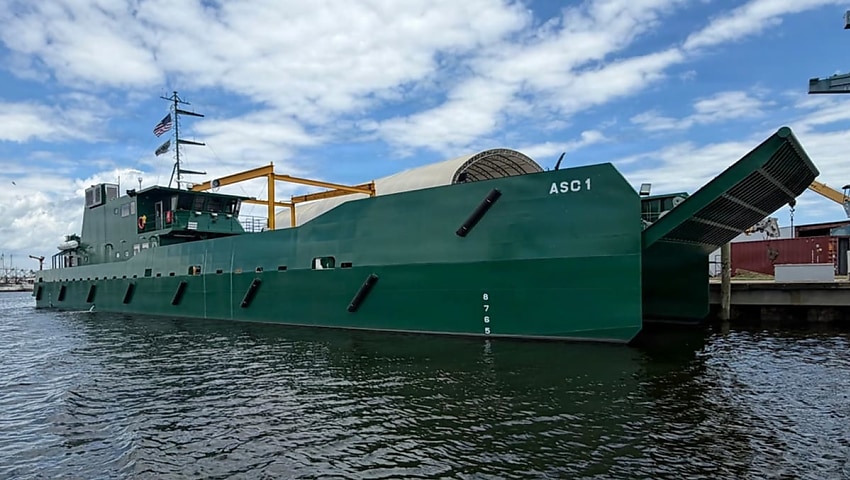
The US Marine Corps has accepted the first prototype of an Australian-designed Ancillary Surface Craft, developed through US-Australian industry cooperation to deliver troops, vehicles, and supplies to difficult shorelines across the Indo-Pacific.
The US Marine Corps has formally accepted the first Ancillary Surface Craft (ASC) prototype, marking a major milestone for a program aimed at strengthening amphibious logistics and littoral manoeuvre in contested environments.
Designed through US-Australian industry collaboration and built by Birdon America, the approximately 46-metre roll-on/roll-off craft is intended to carry personnel, equipment, and fuel over the “last tactical mile”, including to unimproved and unsurveyed beaches beyond the reach of larger amphibious vessels.
The ASC can carry up to 46 tonnes of cargo or 40 combat-loaded Marines and is designed to operate in Sea State 5, with survivability in conditions up to Sea State 7. A forward-looking sonar system is intended to support navigation through shallow and uncharted littoral waters.
The Marine Corps Warfighting Laboratory (MCWL) accepted the prototype after technical validation, with the program now moving into limited technical assessments and further tactical experimentation.
Australian Army personnel will support the next phase alongside Birdon America crews and US Marine Corps personnel, providing another practical example of growing Australian-US cooperation in littoral warfare and expeditionary operations.
Aaron Hatfield, maritime program manager, Science and Technology Division, US Marine Corps Warfighting Laboratory, said: “This validation assures that the craft’s advanced systems and robust design are ready for MCWL to begin hands-on technical experimentation, ensuring we can meet the extreme operational demands of the Indo-Pacific theater.”
The ASC is intended to complement rather than replace the Marine Corps’ larger medium landing ship. Its shallow draft and beaching capability are designed to allow supplies and equipment to move from intermediate staging areas directly onto shore without requiring ports, piers, or causeways.

The capability is particularly relevant to the Marine Corps’ Expeditionary Advanced Base Operations concept, which envisages small, dispersed forces operating across contested archipelagic environments and sustaining themselves without relying on vulnerable fixed infrastructure.
Marine Corps Warfighting Laboratory Science and Technology Division director Colonel Kenny Jones said the prototype would allow Marines to rapidly test concepts and reduce risk ahead of future fleet requirements.
“This prototype allows MCWL to immediately execute hands-on experimentation, test tactical concepts, and put real hardware in the hands of Marines. By exploring the ASC’s traditional bow-first beaching physics alongside other experimental platforms, we are actively reducing programmatic risk and perfecting the requirements for the future naval fleet,” COL Jones said.
The ASC’s primary role is logistics and manoeuvre rather than direct combat, although upcoming testing will examine potential force-protection and self-defence configurations for operations in contested maritime environments.
For Australia, the program provides an important demonstration of the country’s ability to contribute designs and industrial expertise to allied amphibious capabilities.
For the US Marine Corps, the ASC offers a relatively small, flexible platform capable of bridging the gap between offshore staging vessels and dispersed forces operating ashore – a capability likely to become increasingly important as the US and its allies prepare for sustained operations across the Indo-Pacific littorals.

Want to see more stories from trusted news sources?
Make Defence Connect a preferred news source on Google.
Click here to add Defence Connect as a preferred news source.