

 iscover
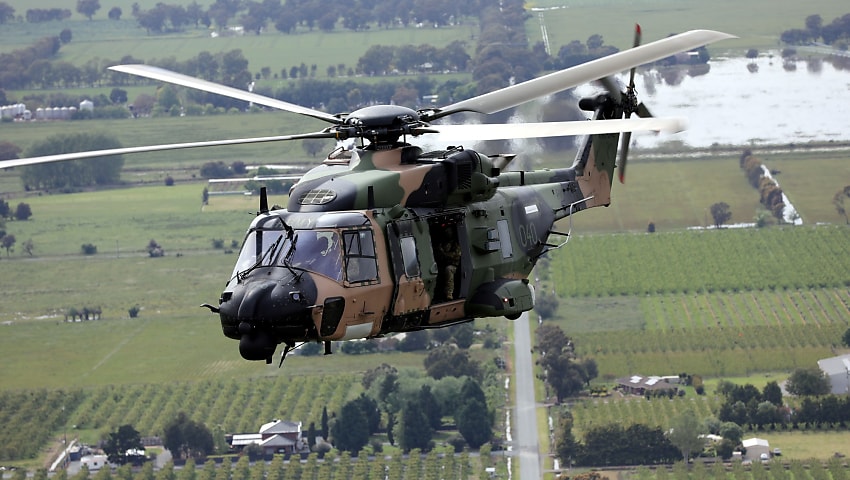
Stand-up comedian and actor Jim Jefferies has shared his grief and frustration at the loss of nephew and Australian Defence Force pilot Maxwell Nugent during an MRH-90 Taipan helicopter crash in 2023.
Jefferies described the fatal crash and grounding of the Australian Defence Force fleet of MRH-90 Taipan helicopters as “terrible”, “intentionally-drawn out” and a “government cover-up”, while appearing on the “This Past Weekend” podcast with American comedian Theo Von in late August.
Jefferies’ nephew, Lieutenant Maxwell Nugent, along with Captain Danniel Lyon, Warrant Officer Class 2 Joseph “Phillip” Laycock and Corporal Alexander Naggs lost their lives when their Australian Army MRH-90 Taipan helicopter impacted waters near Lindeman Island, Queensland, on 28 July 2023.
The helicopter and its crew of four Australian Defence Force members from the 6th Aviation Regiment were part of a night training activity during Exercise Talisman Sabre 2023.
“My nephew died in a helicopter accident … I want to talk about it a little bit because there’s been a cover-up by, what I believe, the Australian government,” Jefferies said during the podcast in August.
“My nephew, Lieutenant Max Nugent, was in a helicopter … He was on military war games, flying a Taipan helicopter. They were in a group of four. America was there as well; 30,000 soldiers from all our allies around the world. And the helicopter crashes.
“These were war games, a competition. Four Taipan helicopters in formation. The helicopter hits the water and the four men on board die instantly.
“Within weeks, Australia decommissioned the helicopters, took them apart, and buried them in the desert. Ukraine offered to take them, but Australia refused.”

A now-released aviation safety investigation sought the details surrounding the incident and detailed that the Taipan helicopter, callsign Bushman 83, had been flying third in a four-helicopter formation when it impacted ocean in the vicinity of the Whitsunday Islands.
The investigation concluded that the primary cause of the accident was an unrecognised loss of spatial orientation, commonly referred to as spatial disorientation (where a pilot is unaware of their actual orientation in relation to the surrounding environment).
During the recent podcast, Jefferies referenced alleged issues with the Taipan’s helmet-mounted sight display, image intensifier with the night vision, and forward-looking infrared, which had been stated during a Senate committee meeting in Canberra on 25 October 2023.
“My brother, my niece, and my sister-in-law had to sit through an inquiry that lasted almost two years,” Jefferies said.
“During that inquiry, a test pilot stood up and said those helmets were defective and amounted to industrial manslaughter. It was documented. The weather that day was also terrible; other countries didn’t even fly. Soldiers were too tired. One pilot said he was too tired to fly, so my nephew stepped in.
“And then, after dragging the inquiry out, the government ended it with only five days left for my family to launch a civil suit before the statute of limitations expired. Who has five days to sue the government? They dragged it out on purpose.
“I get that the military doesn’t want to pay out every time a soldier dies. But this wasn’t war, this was training. There were clear failings, and now those helicopters are literally buried. If you want to find an Australian Taipan helicopter, you need a treasure map.
“The only reason I’m bringing this up here, Theo, is because you have such a big platform. I just want to get the information out. I think I’m doing it right now (to get an investigation). That’s all I can do.
“At the very least, I want my nephew’s death not to be forgotten. I want him to be remembered. What I’ve seen my brother go through; you wouldn’t wish that on any parent.”
Visibility and situation awareness were considered a concern during the flight and the post-crash report found that a decision was made to close the cabin doors of the Taipan (usually left open and able to contribute to aircraft visibility) due to anticipated rain showers and wind chill factor.
Jefferies also highlighted other findings from the post-crash report such as sleep deprivation. The report had previously found that personnel on the aircraft had been awake for 15.5 hours and 14 hours at the time of the accident.
Report interviewees described the sleep environment of the crew as stretchers in tents of up to 18 people, located in an active civilian aerodrome. In addition, the accommodation was not air-conditioned and multiple interviewees reported interruptions to their sleep due to movements of other people in the tents who were on different sleep schedules, aircraft movements.
“The inquiry ended up calling it ‘pilot error’. But the weather wasn’t right, the helmets were defective, and the soldiers weren’t rested,” Jefferies said.
“My family had to listen to the black box recordings a year later. My nephew’s final words were just fear; ‘It’s looking a bit dodgy. Pull up.’ That’s all.
“My brother and his family had to spend holidays and leave days sitting through that inquiry. And at the end, the government said: ‘Pilot error. No payouts. If you want to sue, you’ve got five days.’
“There’s nothing you can say when someone’s child dies. You just show up, hug them, be there. I flew straight home. My brothers, who don’t always get along, came together immediately.
“Honestly, I’m glad my mother wasn’t alive for it, she didn’t have to see her grandson die. Watching my family go through it has been terrible.
“Max worked so hard to get into Duntroon; Australia’s West Point. He didn’t get in the first time, worked as a bartender, tried again, and graduated near the top of his class. Even though he was my nephew, I looked up to him. He was committed, impressive, and kind.
“He was living his dream. The last time they saw him, he slung his machinegun over his shoulder, jumped into the helicopter, gave a smile and thumbs up. He was over the moon to be doing the job he always wanted. So, while it’s a tragedy, I take solace in knowing it wasn’t senseless; he died being a hero.”

Want to see more stories from trusted news sources?
Make Defence Connect a preferred news source on Google.
Click here to add Defence Connect as a preferred news source.