

 iscover
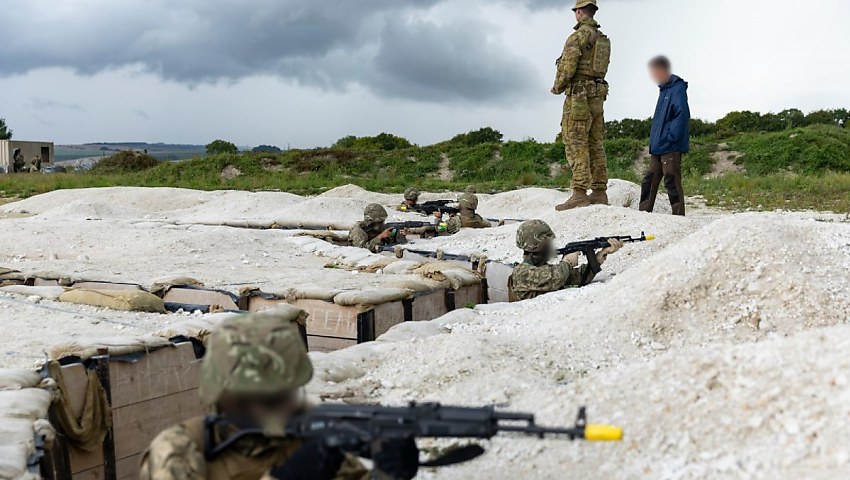
The Prime Minister says we should consider it, while the Coalition wants to use “boots on the ground” as a political wedge … But there’s more than one advantage to be found in siding with Europe.
At the beginning of March, Prime Minister Anthony Albanese took a step forward in Australia’s support for the embattled nation of Ukraine.
Australia is already the largest non-NATO supporter of Ukraine in terms of materiel, but in the wake of Europe’s drive to become Ukraine’s prime security partner – now that the United States has entered what appears to be a four-year-long period of unreliability – Albanese went a step further.
“Well, our position on Ukraine is very clear. We stand with the people of Ukraine and we stand with President Zelenskyy,” Albanese said on 4 March.
“There’s discussion at the moment about potential peacekeeping. And from my government’s perspective, we’re open to consideration of any proposals going forward.”
As Albanese pointed out at the time, historically, Australia has not shied away from peacekeeping operations, with deployments as far afield as Africa and Cypress. Australia, of course, has many regional responsibilities and has deployed to Cambodia, Bougainville, East Timor and the Solomon Islands in recent years.
However, since 1947, Australian forces have been deployed all around the world in a peacekeeping capacity and in support of our United Nations obligations to places like Korea in 1950, Lebanon in 1958, Yemen in 1963, Iran and Iraq in 1988, and the former Yugoslavia in 1992 and again in 1995.
As a good global citizen, Australia recognises the importance of maintaining peace between aggressive neighbours and upholding the broader rules-based international system.

“The brave struggle of the people of Ukraine to defend their natural sovereignty,” Albanese said. “Australia stands ready to assist.”
Albanese added that Vladimir Putin’s “imperialistic” aims must not be “rewarded or encouraged”.
Dutton and Co say no
Of course, sensing another chance to play wedge politics, the leader of the opposition came out against any such deployment.
“We should continue to provide support to Ukraine. We have been involved in training and providing support to Ukraine soldiers and I think that should continue,” Dutton said when questioned on the Prime Minister’s comments.
But he soon poured cold water on any Coalition support for going further.
“In terms of if we should have boots on the ground in Ukraine, I don’t see that.”
Almost a week later, the shadow minister for home affairs, notable China hawk James Paterson, continued on a similar line. According to Paterson, any international deployment without US support would risk the lives of Australian personnel.
“It should be something which is done with very careful consideration and planning. And the Prime Minister hasn’t given that,” Paterson told ABC radio on 12 March.
“And he’s proposing to deploy them to what is right now an active war zone, potentially without any American support, any security guarantees, from our most important ally in a way that would risk their lives. And it’s done so flippantly in a press conference, not the normal way that this is done through very careful consideration by the National Security Committee of cabinet.”
This is simply hyperbole – no one is proposing to send troops to an active war zone. Australia’s support for Ukraine and the international rule of law is not flippant – it’s an established fact.
And given Australia’s history of foreign deployments, it should not at all be surprising that – if asked – we would give serious consideration to joining this modern Coalition of the Willing.
Finally, the idea that any deployment without support from the United States is somehow riskier is laughable at best and insulting at worst. If Australia were to deploy it would be beside nations such as the United Kingdom and France, and possibly other NATO countries, nations that are no slouches when it comes to peacekeeping experience themselves.
Dutton has continued to double down in his resistance to the Prime Minister’s suggestion that Australia may contribute to a peacekeeping force. Answering questions following a speech at the Lowy Institute this week, Dutton warned that Australia should not be “out ahead of where the Europeans are in relation to a border presence with Russia, where there is no United States assurance about providing an overlay”.
The bigger picture
The fact is, Australia needs to come to terms with the fact that “our most important ally” is no longer a reliable one. Deploying peacekeepers to Ukraine not only shows that we, as a nation, can conduct ourselves without the looming shadow of the United States standing over us, but also that we remain committed to the ideals that our apparent ally once espoused – freedom, liberty, and sovereignty.
Perhaps more importantly, such a deployment is not only morally correct, but it could also be an excellent way to build closer ties to a Europe that is edging ever closer to a far more direct role in world affairs. The Trump administration has shown the new reality of an isolationist America that is looking only for advantage, and that is highly transactional in its so-called diplomacy. The “art of the deal” matters more now than traditional dialogue and cooperation – a situation that could easily bite into Australia’s own domestic and international interests.
If Trump is willing to call off military support for a nation already under attack by an aggressive neighbour, what might it do when the stakes are lower? What might he think he can get away with when the wolves aren’t at the door and the eyes of the world aren’t fixed upon the Oval Office? Australian researchers are already seeing their funding curtailed for being too “woke”, while even our world-class Pharmaceutical Benefits Scheme may soon earn the ire – and tariffs – of the Trump White House.
But it’s not just about how unreliable the Trump administration is, it’s about how much more reliable Europe may be as a closer friend to Australia. Some observers are already suggesting that French nuclear submarines could be an excellent alternative to US-built boats that may never arrive.
And while there are doubtless still some wrinkles to be ironed out regarding a certain prime minister’s dealings with France over a similar submarine deal under the previous Coalition government, a simple sign of solidarity, of standing shoulder to shoulder to secure peace on Ukrainian soil, may well go a long way to smoothing the way should Trump pull the rug out from under AUKUS.
There is a certain element of risk to any peacekeeping mission, but to suggest Australian Defence Force personnel are not up to the challenge without US assistance is absurd, while the possible rewards of any deployment seem well worth the effort.
Want to see more stories from trusted news sources?
Make Defence Connect a preferred news source on Google.
Click here to add Defence Connect as a preferred news source.