

 iscover
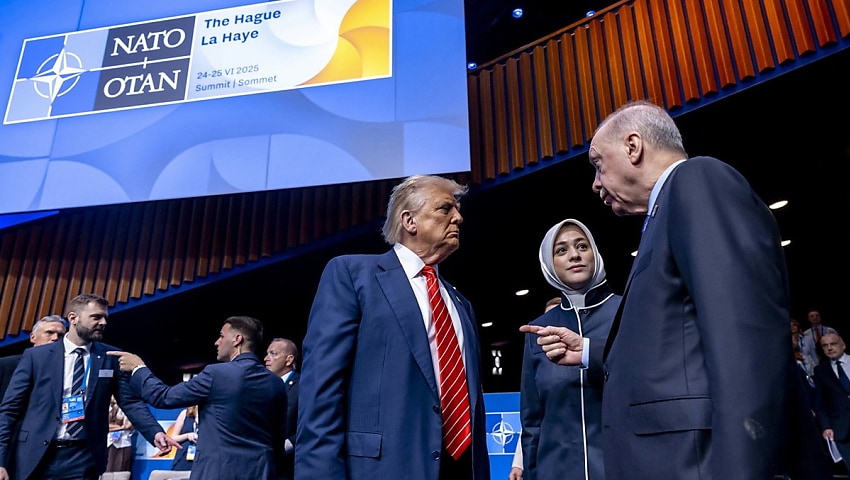
North Atlantic Treaty Organization leaders have been hailed around the democratic world for raising their defence GDP spend target to 5 per cent.
The move is being celebrated as a “big win for courage, ironclad unity” of alliance defence; however, it’s far more likely that NATO has simply moved the imaginary goalposts forward yet again.
NATO’s heads of state announced the “major changes” at the meeting of the North Atlantic Council in The Hague last week.
Leaders reaffirmed their commitment to collective defence enshrined in Article 5 of the Washington Treaty – that an attack on one is an attack on all.
In addition, they declared that the long-term threat posed by Russia to Euro-Atlantic security was adequate reason to commit NATO members to invest 5 per cent of gross domestic product (GDP) annually on core defence requirements as well as defence and security-related spending by 2035.
The funding is expected to be split into at least 3.5 per cent of GDP annually to resource core defence requirements, with the other 1.5 per cent annually into infrastructure, civil preparedness and defence industrial base. The trajectory and balance of the announced spending will also be reviewed in 2029.
NATO Secretary General Mark Rutte, speaking at the NATO Summit Defence Industry Forum on 24 June, said the increase was required because NATO’s military edge is being aggressively challenged.
“There’s an ancient Roman saying, ‘If you want peace, prepare for war’. It’s a simple idea. Make your defences so strong, that no one dares to attack you,” he said.

“Today, NATO’s military edge is being aggressively challenged. By a rapidly rearming Russia, backed by Chinese technology and armed with Iranian and North Korean weapons.
“We need to unite, innovate and deliver. That’s exactly what this forum is all about.
“Across the alliance, we have opened hundreds of new production lines and expanded existing ones. We are now on course to produce more ships, planes and ammunition than we have done in decades.
“And NATO is using its unique power to drive demand, increase cooperation and enhance innovation.
“We must spend more, to prevent war. We must win this new war of production. That’s what this summit is all about.
“Allies have agreed an unprecedented uplift in our capability targets. We know exactly what forces, resources and capabilities each ally needs to provide.
“This will require a quantum leap in our collective defence. But I know that when there’s a will, our world-class industries and entrepreneurs will find a way.
“With an ambitious new Defence Investment Plan to spend 5 per cent of GDP for defence. This will mean a huge defence dividend, an engine of growth for our economies, driving millions of jobs on both sides of the Atlantic.
“NATO’s leaders are about to take an historic step to provide the resources necessary for strong defence. Now it’s up to industry to deliver, to deliver, and yes, to deliver. So let’s get to work.”
Speaking after the summit, US President Donald Trump was rightfully wary of another potentially-empty “NATO defence promise”.
“It’s vital that this additional money be spent on very serious military hardware, not bureaucracy, and hopefully that hardware is going to be made in America because we have the best hardware in the world,” he said.
NATO includes 31 member states such as Belgium, Bulgaria, Canada, Croatia, Albania, Finland, France, Germany, the United Kingdom, Turkiye, Spain, Slovenia, Romania, Portugal, Poland, Norway, North Macedonia, the Netherlands, Montenegro, Luxembourg, Latvia, Lithuania, Italy, Iceland, Hungary, Greece, Estonia, Denmark, and Czechia.
Some of these countries have already attempted to pull an exemption card with Belgian Prime Minister Bart De Wever reportedly asking the alliance to “let us make our investments at our own pace, as a sovereign state”. Obviously, De Wever would be well-aware that Russia has to get through several countries before it gets to Belgium’s far-off borders.
Before the summit had even begun, Spanish Prime Minister Pedro Sanchez declared that its current defence spend of 2 per cent of GDP was “sufficient, realistic and compatible”, as the new 5 per cent target was “unreasonable, counterproductive”. The country paid out a measly 1.24 per cent of GDP spend on defence last year and has now received an exemption from the new target.
We’ve seen this theatre production before, haven’t we?
NATO previously committed to achieve a minimum of 2 per cent of GDP to defence spending to ensure the alliance’s military readiness by 2024 – and that move failed badly.
Countries that were closest to the warpath of Russia, such as Poland, moved quickly to reach the target.
However, more than nine members quietly decided that it wasn’t their responsibility to meet the defence investment goals. Spain, Belgium, Luxembourg, Slovenia, Canada, Portugal, Italy, Montenegro and Croatia all failed to meet that existing target of 2 per cent of GDP on defence.
In addition, even major NATO powers including France, Germany, Canada, Spain, the Netherlands, Norway and Italy took their sweet time and were consistently below that 2 per cent target by 2023.
It took an international cat-among-the-pigeons incident in which US President Donald Trump threatened to abandon underpaying NATO allies against Russia, to squeeze even a modest increase out of the alliance in early 2024.
“They (NATO) asked, ‘If we don’t pay, are you still going to protect us?’ and I said absolutely not. You never saw more money pour in,” he said during a political rally held in Conway, South Carolina, on 11 February 2024.
“One of the presidents of a big country stood up, he said, ‘Well sir, if we don’t pay and we’re attacked by Russia. Will you protect us?’
“I said, you didn’t pay; you’re delinquent. No, I would not protect you, and in fact, I would encourage them (Russia) to do whatever the hell they want.
“And the money came flowing in. You don’t pay your bills, you don’t get protection ... We are not going to be the stupid country of the world any longer.”
Make no mistake, the NATO defence shirking has probably already begun and we are only just on the road to adequate war-time funding to fight a future conflict against Russia, China and the opposing world order.
It’s more likely that NATO will talk a big game about defence spending targets now and gradually show its hand by defaulting later.
What about the land down under?
At least Australia is being upfront and forthright in its growing reputation as an AUKUS alliance deadweight.
Prime Minister Anthony Albanese, when confronted recently during a Sky News television interview about the new NATO 5 per cent GDP spend goal, confirmed that Australia is happy to mooch off the US and UK defence budgets for at least a few more years.
“Our approach … is very clear, which is we will ensure that Australia has the capability that we need,” he said.
“What we won’t do is do something that the Coalition gave an example of, the alternative approach, during the campaign. Announcing in excess of $20 billion additional spending. Couldn’t say where the money was coming from or what it was for.
“What we’ve done is provide for additional investment, some $57 billion of additional investment over the medium term. With in addition to $10 billion of additional investment over the forward estimates.
“In addition to that, of course, we’re continuing to invest in our relationships. So, investing in our capability, investing in our relationships, prioritising our national security.”
Defence spending choices … and consequences
In an ominous warning for Australia’s stubbornness in regard to defence spending, US Chief Pentagon spokesperson Sean Parnell recently confirmed that NATO’s 5 per cent GDP spend is the “new standard for allied defence spending”.
“Our European allies are now setting the global standard for our alliances, especially in Asia, which is 5 per cent of GDP spending on defence,” he said, answering a recent question from South Korea’s Yonhap News Agency.
“Given the enormous military build-up of China as well as North Korea’s ongoing nuclear and missile developments, it is only common sense for Asia-Pacific allies to move rapidly to match Europe’s pace and level of defence spending.
“It is common sense because it is in our Asia-Pacific allies’ own security interests, and in that of the American people to have more balanced and fairer alliance burden-sharing with our Asian allies. And common sense is what President Trump’s approach is all about.”
Sounds like we’re in for a rough ride if Australia sticks to its guns at 2.5 per cent of GDP on defence by 2030.

Want to see more stories from trusted news sources?
Make Defence Connect a preferred news source on Google.
Click here to add Defence Connect as a preferred news source.