

 iscover
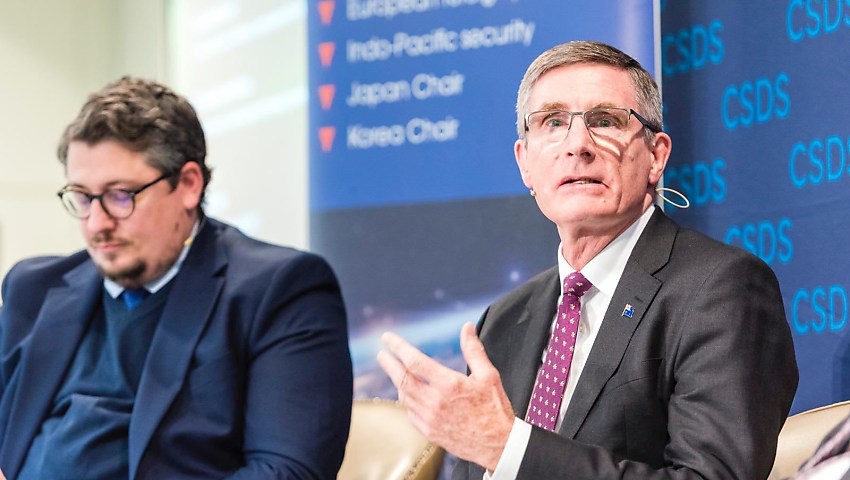
The global power struggle between the United States and China is not a repeat of the Cold War, according to recent comments made by former Australian Defence Force Chief of the Defence Force General (Ret’d) Angus Campbell AO.
Campbell, now appointed as the Australian ambassador to Belgium, Luxembourg, the EU and NATO, recently made the comments during the fourth edition of the “Brussels Indo-Pacific Dialogue” panel discussion hosted by the Centre for Security, Diplomacy and Strategy (CSDS) at Vrije Universiteit Brussel earlier this month.
The dialogue brings together experts and policymakers from Asia, Europe and North America to address regional security considerations between European and Indo-Pacific countries. The former CDF was accompanied by Saurabh Kumar (Indian ambassador to Belgium, Luxembourg and the EU), Oriana Skylar Mastro (Stanford University) and Daniel Fiott (head of CSDS’s Defence and Statecraft Programme).
“Historically I think there are many more periods in which the world is both multipolar and multilateral. International trading system and the great powers that dove into the catastrophe of World War I were living in a multipolar and multilateral world. We had this wonderful multilateral moment at the collapse of the Soviet Union for about 10 to 15 years. Multipolarity has been quietly returning,” ambassador Campbell said regarding a question asking how countries can support multilateralism and the United Nations system when both the US and the China are not necessarily investing in such frameworks.
“I don’t think it should be something that we are surprised at, but any small or middle-sized power will always welcome multilateral rules-based systems that either through the voluntary goodwill of the great power or through the collective constraint of the international community create a moderating effect on the expression of power.
“Why should we be interested in bilateral, minilateral, multilateral, plurilateral mechanisms in diplomacy, in economics, in communication, in military and so forth?
“It’s because every single modality that can help us be a little bit more multilateral, if the truly global multilateral system is somewhat atrophied at the moment, is something that we should pursue while at the same time recognising that multipolarity can win every day it seeks to bring out the club.
“A great power who stays at the top of the tree often expresses restraint. And I think where that circumstance isn’t the case, typically you find a motley collection of other powers seeking to generate constraint.

“When we are talking about preserving a dominance or talking about preventing the emergence of an alternate dominance. I think those two words are the wrong words to use… To preserve or prevent, are fairly black and white. It’s going to be a careful management of power relations; the presence and expression of power in a world in which the consequences of misunderstanding, misapplication and misappreciation can be disastrous.
“I’m not convinced of the Cold War world of simplicity and I’ll offer this reason … In the days of COVID, Australia closed its borders for two years. In 2019 every international leader, every significant player in the world could be connected either through different forms of telecommunication or video conferencing, every single person that you wanted to connect with.
“Go back 10 years to 2009, it would have been by telephone, but you’d be able to connect with everyone.
“Go back another 10 years, 1999. If you were lucky, it was a scratchy time-delayed single telephone line that would drop out … (In 1999) you’re living in the world that we now would regard as the communications dark ages.
“And so I just think the context in which the more simple structure was being lived means that we should perhaps have a little bit of respect for our Cold War predecessors.
“I was not living in the world of the Cold War. I was a young platoon commander back then and all those things were way beyond me. But I think today’s world is complex and we’re living through it rather than reflecting upon it. That the challenge for us is to work a sensible way that accommodates enough for everybody for this planet to get along.”
Campbell has previously served as senior officer in the Australian Army and as the Chief of the Defence Force from 2018 until 2024. He was previously posted as Commander Operation Sovereign Borders from September 2013 until he was appointed Chief of Army in May 2015.
Campbell was appointed as Australian ambassador to Belgium, Luxembourg, the EU and NATO in January this year.
“From an Australian perspective, we do see a deteriorating security environment in the Indo-Pacific region and more generally globally. We’re a nation that believes in rules, in relationships, and in being committed to our region, not exclusively to the Indo-Pacific, but focusing on the Indo-Pacific as part of a wider interconnected world in which we’re more broadly active,” former CDF Campbell said when asked about how Australia sees the shaping of the US–China rivalry and the evolution of the security architecture in the Indo-Pacific.
“As a national aspiration (of Australia), a peaceful stable prosperous environment is something that we would desire and I think it’s a pretty broadly common aspiration and in a setting in which no country in our region dominates and no country in our region feels dominated. Now that’s an environment in which rules are operating to manage constrain to moderate power.
“We are part of a foundational community at the creation of the United Nations and more broadly at the post-World War international system that we understand today is under great strain. It was also acknowledged this morning and I agree with it that the rate of military development and the rate of nuclear weapon capability development is unprecedented in our region and is of broadly concern to all of the countries of the region.
“If you look at the question of US–China relations … In recent years it has been a relationship characterised by competition, now there’s a lot of cooperation as well. So any simplistic characterisation, I think, is flawed but as two great powers in the Indo-Pacific there’s competition as well in terms of aspiration and in perhaps in terms of the sense of the preferences towards which the international system defers.
“Australia doesn’t see a single view of what is defence and security and if you’re thinking of the idea of how to live in that peaceful stable prosperous world then from a historical perspective, we have been a long consistent and committed ally of the United States.
“In terms of hard power, our ally has extraordinary hard power and that hard power exists both to deter and if necessary to defend. Everybody would prefer it to be to deter. But I want to emphasise the real point I want to make here is that thinking of how to deter or if necessary defend in fighting in an international security structure is now but one part of a much wider conversation about how to realise security when your aspiration is peace, stability, prosperity in a world that defers to preferences the international system can accommodate.
“My point being here that the sense of security that emerges from what we now describe as economic security or the supply chains that generate the confidence of living in a high technology world or the narratives that define or influence our perceptions of what kind of world we wish to live in or indeed simply the sense of physical existential security.
“Some Pacific Island nations feel very directly about the question of their climate security. All of these need to be taken into consideration because you can always think in the worst case of security emerging from winning by fighting. But there’s also the security that is now enabled in a modern world by concepts and approaches about winning without fighting and I think a much more comprehensive view has to be taken.
“Australia has an alliance relationship now with three countries: the United States, with New Zealand and most recently with Papua New Guinea. But we’re also a long member of many international bodies and institutions, I note the United Nations.
“We see building a network that can support, that can collaborate, that potentially can be of assistance to create those wider forms of security and perhaps in certain circumstances or with certain partners also the traditional hard form of security.
“(However) if we’re not thinking broadly and we’re not accommodating the needs, aspirations and desires of the breadth of the Indo-Pacific to live in peace, stability and prosperity in what we would prefer as a rules-based order that sees the moderation of power for the benefit of all.”
In closing, ambassador Campbell speculated that the forecast for the future year could see Australia establish a free trade agreement with the European Union as well as security and defence partnership with the European Union.
“I would like Australia to be one of a number of countries moving along a pathway with partners like the European Union to realise, eventually actually, a market for critical minerals and raw materials rather than the current somewhat monopolistically dominated market that enables high-tech. But that’s a long-term view,” he said.
“I would like between now and then no unilateral action in any direction with regard to the Taiwan Strait either next year or any year into the long future.
“And I would like the great powers of the world to engage in a constructive dialogue that will be to the benefit of all. And if I could have the cherry on top, I would prefer any power that is supporting and enabling Russia’s unlawful and immoral invasion of Ukraine to cease that support.”

Want to see more stories from trusted news sources?
Make Defence Connect a preferred news source on Google.
Click here to add Defence Connect as a preferred news source.