

 iscover
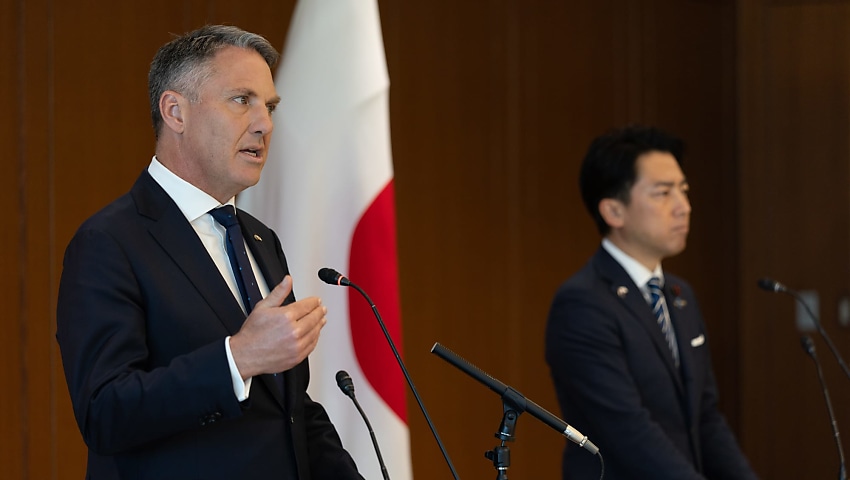
Australian and Japanese strategic interests are progressively converging in the new era of Indo-Pacific strategic anxiety.
Japan is rapidly moving ahead with a massive planned modernisation and expansion of its military direction, funding and capability, while Australia picks and chooses major projects to spend its limited defence budget on.
These topics were covered in a recent address delivered by Australia’s ambassador to Japan, Justin Hayhurst, at the Japan National Press Club on 8 December this year.
The Department of Foreign Affairs and Trade senior career officer and Australia’s senior Quad official provided a snapshot of how rapidly the Australia–Japan relationship has evolved from a primarily economic partnership into an established strategic alignment during a deteriorating regional security environment.
“Both governments are active in responding to a deteriorating security environment. We are building a serious defence partnership, with growing interoperability, unprecedented defence industry cooperation and robust intelligence and information exchanges,” Hayhurst said earlier this month.
“Australia has selected the Mogami Class frigate for the Royal Australian Navy. We have this year completed our first trilateral air force combat exercises with the United States in Japan. Record numbers of Japanese personnel travelled to Australia for Exercise Talisman Sabre, which included the first live-fire of Japan’s Type-12 Surface to Ship Missile.
“This year, the first Australian warship was repaired and maintained in Japan under our groundbreaking Reciprocal Access Agreement. Across the defence agenda, we are training together at increased scale, tempo and complexity … Our defence ministers [have] announced a new Framework for Strategic Defence Coordination to deepen our security cooperation.
“We are also working together in cyber security, space cooperation and in strengthening the resilience of our supply chains, especially critical minerals.

“We want to be a model partner in Japan’s defence and security transformation as well as energy transition. This is important because for Australia, a strong and secure Japan is a vital interest.
“We need an effective partnership with Japan to maintain strategic balance, to secure supply chains, to deter conflict and to solve some of our respective national challenges.
“We have long welcomed Japan’s positive contributions to regional and global peace and stability… Reliable and consistent opinion polling in Australia shows Australians trust Japan. Australia and Japan are each building our national power through enhanced defence, diplomatic and cyber capabilities.
“And we are promoting rules and international law not only to defend and deter but also as ways to promote cooperation and persuade.”
The critical ‘2027’ juncture
Australia and Japan are responding to shared threat perceptions, such as military coercion and supply-chain vulnerability, resulting from increased anxiety around the massive People’s Liberation Army build-up and potential invasion by the People’s Republic of China against Taiwan in 2027.
Australia and Japan are positioning themselves to respond more coherently to crises. Importantly, this framework complements rather than competes with the US alliance system. As highlighted during the most recent Australia and Japan “2+2” meeting, the bilateral partnership is intended to act as a pillar of coordination among like-minded states, firmly anchored to the United States while remaining open to cooperation with other regional partners.
Commitments echoed by Japan’s ambassador extraordinary and plenipotentiary to Australia, Kazuhiro Suzuki, speaking at the Japan National Press Club address recently.
“Thank you, Justin Hayhurst, for your outstanding contribution over the past three years to advancing Japan and Australia relations, and for your consistent support for Japan, particularly during challenging times,” he said.
“I would also like to pay tribute to your final major address as Australia’s ambassador to Japan.
“I look forward to working with you again in Canberra in your new role as deputy secretary at the Australian Government Department of the Prime Minister and Cabinet.”
Convergence of trade and investment
Trade and investment links are reportedly at record levels between the two countries, with Australia being a critical energy and food security partner for Japan.
Australia supplies about 40 per cent of Japan’s liquid natural gas and 65 per cent of Japan’s coal. Australia also reliably supplies red meat, wheat, sugar, and cheese to Japan’s market, most of it for further processing; around 12 per cent of the calories consumed in Japan are reportedly supplied by Australia.
Across the trade partnership, Japanese foreign direct investment into Australia has reportedly reached a record $141.1 billion in 2024, making Japan the only foreign investor to have increased its investment every year for more than a decade.
Major investments in iron ore, semiconductors, and real estate signal long-term confidence in Australia’s economic and legal environment. At the same time, Australian institutional investors are increasingly active in Japan with the goal of achieving symmetry.
“In October this year, Japan received its first shipment of heavy rare earths from Lynas; the first heavy rare earth supply chain outside China,” said Hayhurst.
“Gallium, fluorite and zirconium are next, with a number of joint projects in Australia moving toward production.
“Next year, we celebrate the 50th anniversary of our Basic Treaty of Friendship and Cooperation. That agreement shows our partnership is based on interdependence and trust; and has been for decades.”
Final thoughts
In strategic terms, the message is clear. Peace and stability in the Indo-Pacific can no longer be assumed. Open economic systems are under pressure, and the risk of conflict is rising.
In response, Australia and Japan are deliberately building national power across defence, diplomacy, cyber, and economic resilience. The partnership aims not only to deter aggression but also to shape an environment where cooperation remains possible.
As the regional balance continues to shift, the relationship between Australia and Japan stands out as a model of how middle powers can work together, anchored to alliances, grounded in trust, and integrated across military and civilian domains, to contribute meaningfully to Indo-Pacific stability.

Want to see more stories from trusted news sources?
Make Defence Connect a preferred news source on Google.
Click here to add Defence Connect as a preferred news source.