

 iscover
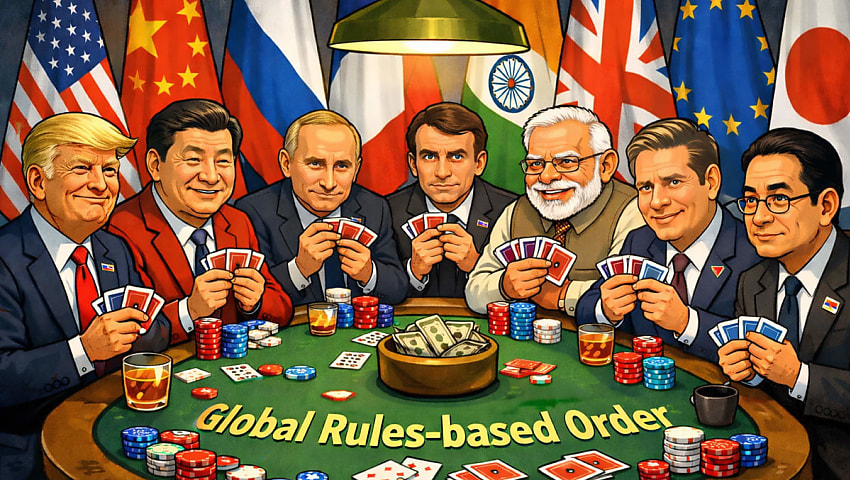
Over the course of my weekend reading, it suddenly hit me ... maybe, just maybe, the “global rules-based order” is little more than a comforting fairy tale we’ve told ourselves and the current geopolitical shifts are actually just normal?
Across the length and breadth of the human story, there has been a few of what you may charitably call “universal norms”, and like gravity, entropy and biology, they are inescapable “laws of nature”.
The most primal, influential and universal of which is undoubtedly the total and final nature of “hard power”, particularly military power which has served throughout history as the absolute arbiter of disputes, maintainer of peace and the balance of power.
Whether it was the Pax Romana, the Pax Britannia or more recently, the Pax Americana, military power has been pivotal to building and maintaining the respective “global rules based order” of their epochs.
For the modern world, it is this latest incarnation, the Pax Americana first established in the dying days of the Second World War, which has served as their sole frame of reference, even for some of the nation’s and world’s most influential policymakers and strategic thinkers.
Yet even by the standards of the previous embodiments of a “global rules-based order”, the one built and maintained by the United States for the better part of a century is an aberration.
The creation of multilateral institutions like the United Nations and World Bank, alongside impartial, judicial and arbitration bodies like the International Court of Justice, International Criminal Court and the like all served to establish a sense of “consent amongst the governed” in the international community.
As a result, nations the world over bought into the promise of this “New World Order” shielded by the threat of hostile, external aggression by the consensus of the “international community of nations” and undeniably, if somewhat overtly enforced by the might of the United States.

However, despite historians, political leaders and analysts, this period was not devoid of nations effectively wielding military force to achieve their regional or global designs.
Whether it was the Soviet Union or People’s Republic of China in Korea, Vietnam and Afghanistan, the South China Sea, the United States in Panama, Afghanistan and Iraq, Argentina seeking to “reclaim” the Falklands/Malvinas, France in Mali and a host of other examples, the reality is: might makes right.
Bringing us to the events of recent months, in particular, the successful American raid and arrest of Venezuelan dictator Nicolás Maduro under drug trafficking and narco-terrorism charges, along with the increasingly assertive and bombastic claims of President Donald Trump regarding the American “acquisition” of Greenland.
Now while shocking, particularly for those so invested in the continuance of the post-war liberal world order, the reality is, the liberal, rules-based order championed by so many “establishment” figures is broken irreparably and will only continue to fray.
America’s departure is a symptom, not the cause
While many policymakers, strategic analysts and diplomats have been quick to articulate a belief that it is America’s recent actions which have broken the status quo and the benevolence of the “global rules-based order”, that reality is far from the truth.
Rather, it is a symptom of an already broken and fraying international order, but one that has been bleeding out slowly and before our eyes, driven in large part by the metastasisation of great power grey zone competition undermining the efficacy, impartiality and legitimacy of the order.
This is on display, whether it is the stacking of the United Nations Human Rights Council or the World Health Organisation with totalitarian representatives, the active ignoring of decisions relating to the United Nations Law of the Sea, particularly in south-east Asia, along with the weaponisation of international aid and non-governmental organisations.
Yet for whatever reason, nations across the world, including Australia, remain firmly committed to a fairy tale nicety that is completely divorced from the reality of the world in which we now live.
In contrast, the recent decisions and actions taken by the United States, disruptive, uncouth and confronting as they might be, are in fact the rational conclusion for any nation that has conducted a thorough and dispassionate assessment of the international climate.
Are they ideal? Certainly not. Are the justified from the American perspective? Without a doubt.
Want proof?
Look at the way Australia reacts every time it looks like China may develop a deep water port in the South Pacific.
So maybe it is time for us to snap out of our fairy tale and accept the world for what it is, not how we would like it to be.
Final thoughts
I have said it many times before, but Australia needs a hard wake-up call, and we need it now.
This is not an academic argument about defence budgets or foreign policy doctrine. It is about the country we will leave to our children and grandchildren, and whether it will remain secure, prosperous, and genuinely able to make its own choices in a harsher, less forgiving world.
That reality demands a fundamental rethink of how Australia understands itself, its interests, and its responsibilities in the region it actually lives in.
The Indo-Pacific is no longer a peripheral concern or a future problem. It is now the centre of global power, and it is becoming more crowded, more militarised, and more contested with each passing year.
China’s strategic weight continues to expand. India is asserting itself as a major power. Regional middle powers, from Vietnam to Thailand, are hardening their positions and investing accordingly.
Meanwhile, Japan and South Korea, long constrained by history and alliance structures, are re-entering the strategic arena with renewed intent and growing autonomy.
This is not a hypothetical future. It is our new operating environment, and Australia is already struggling to navigate.
In this context, incrementalism is not prudence, it is a path to strategic marginalisation. Without sustained investment, serious long-term planning, and a willingness to confront uncomfortable trade-offs, Australia will not simply fall behind. It will be overtaken.
The trend line is unmistakable. States with larger populations, deeper industrial bases and clearer strategic ambition are moving faster and thinking harder than we are. If Australia continues to drift, the next generation will inherit a country with less influence, fewer choices and a diminished ability to act independently in its own region.
For too long, Canberra has relied on short-term fixes: patchwork funding increases, headline-driven announcements, and the comforting assumption that strategic warning time would always be ample, and that the United States would always be there to fill the gaps.
That era is ending. Washington is increasingly explicit about its America-first priorities, and its expectations of allies are changing accordingly. US support will remain vital, but it will be more conditional, more transactional and more focused on American interests, not Australian ones.
At the same time, the pace of strategic change has accelerated and the margin for error has narrowed. Business as usual is no longer defensible when the regional balance of power is shifting in real time.
The challenge is not diagnosing the risks. They are already visible.
The real test is whether Australia’s political leadership is prepared to articulate a clear national strategy, one that prioritises sovereign economic, political and military capacity, and to back it with the resources, structural reform and public honesty required to make it real.
Industry cannot invest at scale without clear direction. The public cannot be asked to carry greater burdens without a credible explanation of why they matter. Strategy without substance is just rhetoric.
Australia now faces a stark choice. As the United States recalibrates and China presses its advantage, we can remain a passive consumer of security, dependent on decisions made elsewhere, or we can invest deliberately in the capabilities, resilience and confidence needed to shape our own strategic environment.
The decisions taken this decade will reverberate for generations. The question is whether Australia chooses to meet the moment or once again hopes that someone else will do it for us.
Get involved with the discussion and let us know your thoughts on Australia’s future role and position in the Indo-Pacific region and what you would like to see from Australia’s political leaders in terms of partisan and bipartisan agenda setting in the comments section below, or get in touch at

Want to see more stories from trusted news sources?
Make Defence Connect a preferred news source on Google.
Click here to add Defence Connect as a preferred news source.