

 iscover
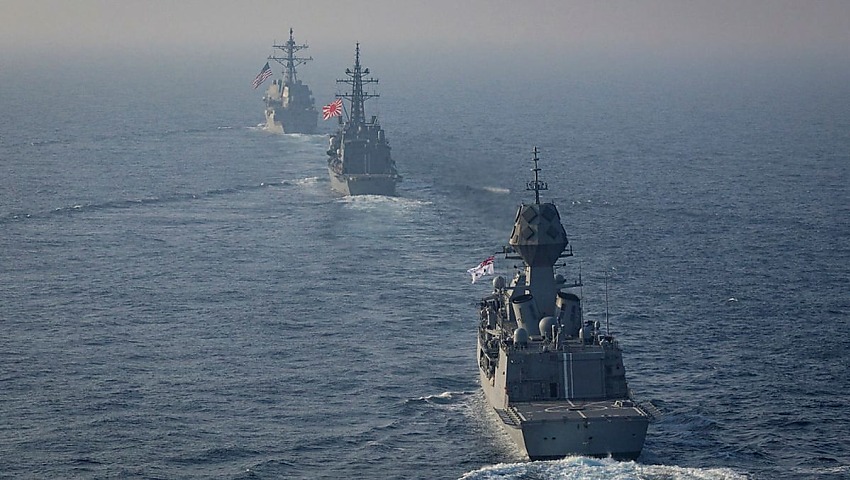
It is an uncomfortable reality Australia may be forced to confront: an Indo-Pacific without US primacy and associated leadership which will place increased emphasis on Australia moving from the “kids’ table” to finally take a seat at the “big table”.
We all undoubtedly have those memories of big family gatherings, whether a wedding, Christmas, birthday or anniversary event of being relegated to the “kids’ table”, paired with cousins we didn’t really know (or like) or the weird uncle who thought he was cool hanging out with the kids.
The international community is increasingly no different to these sorts of awkward family gatherings, where in internal family dynamics, politics play out, particularly as the world’s larger powers continue to discard the consensus-based “rules-based” order, most notably of which has been a gradually more disruptive United States.
For the “rules following” middle powers of Australia, Canada, the United Kingdom, Japan, Germany and others, this disruptive break with the norm from the United States is serving to dramatically reshape how they view the world, their position and role within it.
While these nations are used to being important and influential members of the international community, they have increasingly been relegated to the kids’ table as was often the case during the Cold War and has once again become increasingly normal.
This reality was echoed by Canadian Prime Minister Mark Carney recently in Davos when he said, “For decades, countries like Canada prospered under what we called the rules-based international order. We joined its institutions, we praised its principles, we benefited from its predictability. And because of that, we could pursue values-based foreign policies under its protection.
“We knew the story of the international rules-based order was partially false that the strongest would exempt themselves when convenient, that trade rules were enforced asymmetrically. And we knew that international law applied with varying rigour depending on the identity of the accused or the victim," Prime Minister Carney added.
Expanding on this further and perhaps most strikingly, he said, “This fiction was useful, and American hegemony, in particular, helped provide public goods, open sea lanes, a stable financial system, collective security and support for frameworks for resolving disputes … We largely avoided calling out the gaps between rhetoric and reality.”

Now while Australia continues to bumble along believing that the post-war order remains largely intact and unchanged, the reality is, Australia is going to be required to step up and take a seat at the “big table”.
First and foremost, that doesn’t mean trying to compete directly against a great power, rather it means we need to plan for a world where once immutable laws of the family dynamic are all up for debate and necessitates planning for the worst possible outcome.
In the case of Australia and our other, similarly sized national siblings and relatives, the worst possible outcome is a world in which the United States either retreats completely into neo-isolationism, embraces pseudo-isolationism through concord with other great power competitors establishing agreed upon spheres of influence, or actively continues to dismantle the system it effectively built.
Highlighting this is Australian National University professor Alexander Lee, writing for the Australian Strategic Policy Institute in a piece titled Just in case: Australia needs to prepare for a world without US leadership, in which he said, “Canberra can no longer assume that Washington will underpin regional stability or the rules-based order, the foundational premise of modern Australian strategic planning. Australian policymakers must grapple with the prospect that the destabilising behaviour of US President Donald Trump’s administration is not temporary.”
Failing to plan is planning to fail
In the immortal words of American Founding Father Benjamin Franklin, “Failing to plan is planning to fail” and this principle lies at the core of Lee’s thesis, particularly as Australia and other (comparatively declining) middle powers continue to grapple with a world in a state of increasing flux.
Lee argues off the back of this, “It is prudent to start considering the unthinkable sooner rather than later and plan for a possible world where the anchor of our security architecture continues rewriting that architecture in unexpected ways.”
“Over the past 12 months, a scenario once deemed implausible has materialised: three great powers – Russia, China and the United States – are simultaneously challenging the rules-based order,” Lee added.
In the face of this deteriorating global and regional environment, it is becoming clearer by the day that the existing planning structures and systems within the Australian context (and to be fair like virtually all other counterparts) are unfit for purpose, particularly when their key findings are often ignored, minimised or only partially responded to.
This only becomes more poignant when one considers the unexpected shift in the United States under Donald Trump, but one that has, particularly if you have been watching domestic American, and one could certainly argue, more broadly, Western domestic politics in general – a growing malaise and disinterest in global adventurism.
Lee hinted at these factors stating, “Australia’s strategic guidance documents produced over the past decade – including the 2016 Defence white paper, 2020 Defence Strategic Update and 2024 National Security Strategy – anticipated and grappled with Moscow and Beijing’s revisionism. However, Washington’s ongoing transformation from guarantor to disruptor represents a fundamental break in Australian strategic planning.”
“Trump’s threats towards NATO allies including Denmark have undermined trust. The imposition of visa processing pauses on security partners such as Thailand has perturbed long-term partners. And senior US officials embracing a might-is-right doctrine demonstrates the US has moved beyond rhetoric and is operationalising a policy of dismantling the rules-based order,” Lee added.
Returning to the famous statement by Franklin, Lee emphasised that continuing to believe (without evidence) that the United States will, in a post-Trump era, return to its de facto position as the unrivaled, unilateral defender of the global “rules-based” order is misguided; naivety at best and criminally negligent at worst.
Either way, in Australia’s case, this presents significant challenges and implications for the way the nation plans to confront the future global and regional dynamics where it will increasingly be forced to confront a competitive world without the ability to readily and reliably call upon the protection and assistance of a great power “security benefactor” as we have done traditionally.
For Lee, it is important that Australia continue to work with the United States “as far as it can”; however, it does “need to consider strategic planning without reliable US leadership”, which requires a fundamental rethink of the way the nation thinks, believes and acts within the Indo-Pacific and this new global paradigm.
Three key focal points to move on from the ‘kids’ table’
In order to respond to these challenges, Lee articulated the need for Australia to prioritise three areas of “immediate attention and must be considered seriously” to once again be considered a serious nation, irregardless of whether what he deems a “more normal” US administration returning to the Oval Office in 2028.
Lee identified these three key areas, providing some policy prescriptions, beginning with the need for Australia to “accelerate domestic defence industrial capability, despite associated costs”. This serves as a key component of “Effective deterrence and resilience require both operational and industrial sovereignty. This means hard choices about domestic production. The March 2025 announcement of a guided weapons manufacturing facility in Newcastle represents a start, but the scale must increase dramatically.”
Going further, Lee placed significant emphasis on Australia maximising its regional partnerships both through direct bilateral relations and under the auspices of existing multilateral organisation like ANZUS, the Quad and within ASEAN in order to aggregate material deterrence, economic and political influence and heft.
Lee said, “Second, Australia needs to deepen regional partnerships to hedge against US unreliability. Japan and key south-east Asian states must become genuine strategic alternatives, not supplements to the ANZUS alliance. This means expanding intelligence-sharing beyond Five Eyes frameworks, conducting more frequent military exercises without US participation, and developing independent deterrence architectures.
He further said, “Australia needs partnerships that can function when Washington is absent or actively hostile to regional stability. Fortunately, Australia is not alone, and many if not most of Washington’s historic allies are looking to deepen cooperation with like-minded partners.”
Finally, Lee added that “most importantly, Australian defence planning must develop genuine strategic ambiguity and contingency plans for scenarios where Washington’s interests diverge from Australian interests”.
Fundamentally, this means a major rethink of the way in which the nation conceives of itself, identifies and defines its national interests and acts to protect and promote them, both at home and abroad, which alone serves as a major departure for the nation’s status quo. It also requires some additional uncomfortable questions.
Lee hinted at this, saying, “Strategic guidance in the 2010s and early 2020s assumed alignment with Washington. A realistic 2026 assessment cannot. This requires uncomfortable conversations about circumstances where Australia might need to act independently or even contrary to Washington’s preferences. What happens if Washington strikes a grand bargain with Beijing that sacrifices Australian interests? What if the US demands Australian participation in operations that destabilise rather than stabilise the region? Scenarios that may have seemed farfetched in 2016 or 2024 don’t in 2026.”
Final thoughts
Australia and Australians urgently need to wake up, we owe it to our children and grandchildren.
This requires a seismic rethink about the nation, our people, our way of life and how we both see ourselves and fit within the evolving global and regional struggle for dominance and prominence.
The Indo-Pacific has become the hottest contested region in the world. China, India, Pakistan, Thailand and Vietnam are all asserting new influence, while Japan and South Korea are returning to a more prominent regional role. This isn’t competition on the horizon; it has already arrived, and it’s not going anywhere. Our national strategy needs a fundamental reset to reflect this reality.
Without meaningful, sustained investment and long-term planning, we won’t simply fall behind – we’ll be overtaken by the accelerating momentum of our neighbours. If we fail to act, the next generation will inherit a nation overshadowed by wealthier, more powerful and more influential states.
For too long, successive governments have chased short-term gains and reactive fixes. But the strategic landscape is shifting rapidly. Business as usual is no longer an option. We need to look ahead, capitalise on emerging opportunities and blunt potential threats before they gather pace.
The issue isn’t whether these challenges will materialise; they’re already here. The real question is, when will Canberra finally put forward a bold, detailed plan capable of rallying industry and the public around a clear national vision?
With China continuing to press its advantage, Australia faces a stark choice: remain a passenger in our own region or step up as a genuine shaper of the Indo-Pacific’s future. The decisions we make now will determine whether we prosper in this new era or find ourselves swept aside by it.
Get involved with the discussion and let us know your thoughts on Australia’s future role and position in the Indo-Pacific region and what you would like to see from Australia’s political leaders in terms of partisan and bipartisan agenda setting in the comments section below, or get in touch at

Want to see more stories from trusted news sources?
Make Defence Connect a preferred news source on Google.
Click here to add Defence Connect as a preferred news source.