

 iscover
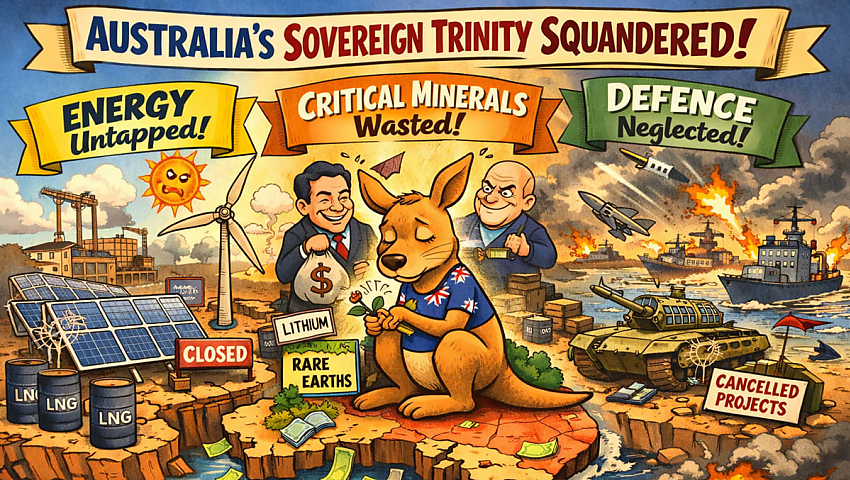
Opinion: Australia must shift its sovereignty focus from labelling industries to strengthening interconnected systems like energy security, critical minerals access, and defence capabilities for true national resilience, explains Mike Kalms, partner at KordaMentha.
In recent years, conversations around sovereignty have shifted from theory to practicality.
Supply chain disruptions, energy volatility and rising geopolitical tension have made it clear that national resilience is not just about defence capability alone, but the systems that sustain it.
For Australia, reliable energy, secure access to critical minerals and credible defence capability are deeply interconnected foundations of resilience. The issue is less about which industries are labelled “sovereign” and more about how the underlying systems that support national capability are built, maintained and strengthened.
Australia has struggled for a decade to define sovereign industry. Since the 2016 Defence white paper and defence industry policy statement, we’ve invested time and money defining and redefining what elements of our national supply base deserve to be titled “sovereign”.
We’ve spent comparatively little time intelligently investing in the 16+ highly defined industries that did achieve sovereign or priority status. Maybe we’ve got it wrong, maybe it’s not the “What” but the “How” that should be the focus of a new wave of sovereign thinking.
How you retain sovereignty isn’t a function of, for example, aircraft maintenance capability or missile manufacture. Though important, they can be seen as midway outputs, themselves a collection of vast, important sovereign inputs.
Alternatively, the “How” asks us to talk to the underpinning characteristics of an economy that give a nation choice, that underpin resilience and enable agility – the character of a nation that helps a population see a problem then respond to it in a strategically acceptable fashion.

Energy
Much of the “How” resides in intangibles. Political aptitude, community engagement, public sentiment – they all feed into the equation. So does energy – how much can the nation call on from renewable and non-renewable sources, can infrastructure repair and adjust when disrupted, and can markets act to prioritise the needs of a nation as circumstances change?
In this sense, robust energy markets, utilities and distribution networks are not merely enablers of sovereignty, they are sovereign capability in their own right.
It’s a widely held view in defence circles that Australia’s reserves of liquid fuels are critically low. With estimates stating only 28 days of petrol, 24 days of diesel, and 20 days of jet fuel are available under normal conditions, the reality is that Australia’s fuel reserves wouldn’t be sufficient to withstand a global supply disruption.
Guy Chandler is a 20-year veteran and deep expert in Australia’s energy systems. He said, “Energy is the first and last line of sovereignty. You can have the smartest plans and the toughest rhetoric, but if your grid can’t absorb shocks, repair itself, or scale on demand, then your nation’s power is limited to whatever the market feels like giving you.
“Countries don’t lose strategic advantage because of ideology – they lose it because their lights flicker, their supply chains stall, and their infrastructure buckles under pressure. If Australia wants real sovereignty, it must treat energy security as a national weapon system: reliable, redundant and relentlessly modernised.”
Critical minerals
Feeding globally scarce commodities into a nation’s industrial base is similarly sovereign. Can business access enough rare earths and other scarce commodities to ensure the nation can operate over the medium and long term?
Recent conflicts have shown that decisive capabilities are often improvised rather than pre-defined. It’s unlikely that a nation like Ukraine listed uncrewed autonomous systems as its vital industry pre-2020. Yet it’s access to rare critical inputs that enabled the nation to (a) identify the technology that could most impact the direction of kinetic operations, then (b) operationalise the industrial supply chains to build that technology at scale, which we would now describe as their most sovereign capability.
Sometimes a nation doesn’t know which specific industrial capability will be the war winner. But it can make an accurate assessment of the inputs that are most common to all industries – critical minerals fit that assessment.
Jon Chadwick, who has expertise in nuclear, said, “Critical minerals aren’t just an economic opportunity – they’re the hard reality check of sovereignty. Without them, a nation is strategically paralysed. You can have brilliant engineers, visionary strategies, and world-class ambition, but if you don’t control the minerals that feed your industrial base, you’re playing defence in a game you can’t win. Nations don’t lose sovereignty all at once – they lose it one missing input at a time. Secure the minerals or surrender the future.”
Defence
Captain Beatty in Fahrenheit 451 said “…there are those that make bombs, and those that throw them…” inferring all others in the chain are superfluous.
Similarly, it’s tempting to look at the complex middle of the defence industry system to find a sovereign core, when in fact it’s the fundamental inputs – generating “How” – that enliven the national ecosystem.
No energy = no aircraft maintenance. No energy = no submarine docking. No energy = reducing support from community for the operational effort of our Australian Defence Force.
No minerals = no enduring parts manufacture. No minerals = little hope of an industrial pivot to generate new or missing defence capability.
Building and improving Australia’s energy and minerals systems will bulk up our defence capability – that much is clear. For governments, investors and operators across energy, resources and infrastructure, this reframes sovereignty as a practical systems challenge, not a matter of designation.
Perhaps that should be the focus of our sovereign agenda, not just in theory but in practice.
This piece was written by Mike Kalms, partner, KordaMentha, with contributions from Jon Chadwick and Guy Chandler, energy transition partners at KordaMentha.
Mike Kalms is a partner in KordaMentha’s Public Sector team, specialising in defence and national security. He has more than 30 years of experience in commercial and defence roles, focusing on strategy, program design and stakeholder management, and has contributed significantly to the strategic development of the Australian Defence Force.
He has been involved in high-level consultations and policy development, including his role as a member of the Defence White Paper Expert Panel. His insights have shaped national defence strategies and policies, ensuring they align with contemporary needs and future challenges.
Want to see more stories from trusted news sources?
Make Defence Connect a preferred news source on Google.
Click here to add Defence Connect as a preferred news source.