

 iscover
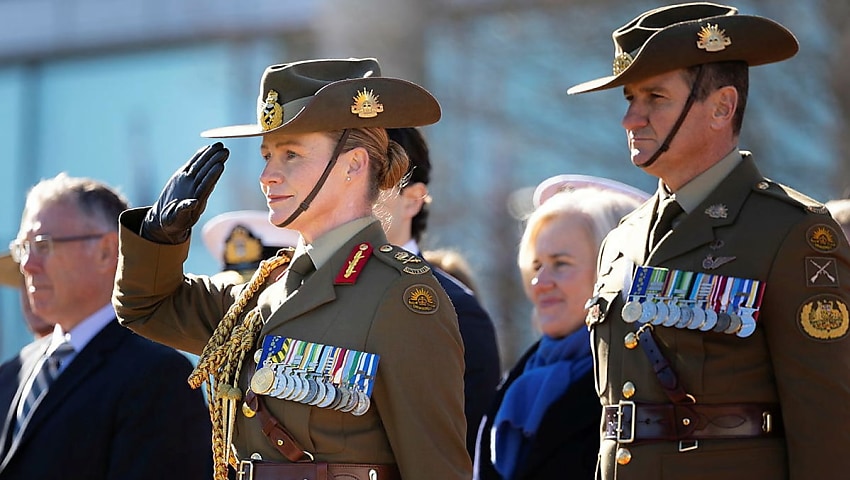
Right now, women in defence are under-represented, but new leadership changes might inspire the next generation of Australian women to protect our nation as warfighters, technicians, and defence leaders.
Earlier this month, the Australian Defence Force made history with the appointment of Lieutenant General Susan Coyle as the new chief of the Australian Army.
She is the first woman to hold the position.
When her appointment was first announced in April by Prime Minister Anthony Albanese and Deputy Prime Minister and Defence Minister Richard Marles, the milestone moment was instantly recognised, with Deputy Prime Minister Marles saying it “should be noted”.
“Susan’s achievement will be deeply significant to women who are serving in the Australian Defence Force today and women who are thinking about serving in the Australian Defence Force in the future,” the Deputy PM said.
“As Susan said to me, ‘You cannot be what you cannot see’.”
And she’s right. If women and girls across the country are not used to seeing women working in defence (especially in defence leadership positions), then they might not know it is a possibility for them now or in the future.
But it can still feel impossible when the number of women in the Australian Defence Force sits at only 20.9 per cent, according to the Defence Annual Report 2024–25.

Women in the ADF
Recruitment and retention for women across the defence force remains on the lower side and systemic issues continue to arise when attempting to break the barriers of entry: whether it be intentional or unintentional bias, institutional culture or a reluctance to apply.
The Australian Human Rights Commission’s report, Review into the Treatment of Women in the Australian Defence Force (2013), supports this perspective in saying that typically, and often unintentionally, leadership roles are far less likely to be granted to women.
“Occupational segregation has a significant impact on women’s career progression and their ability to reach leadership positions in the ADF,” the report reads.
“Traditionally, senior leadership is drawn from categories that have no women or where there are very small numbers of women, particularly in Army and Air Force.
“There are many likely factors accounting for women’s absence from several roles [including] the impact of social norms relating to ‘appropriate’ employment for men and women, opportunities offered to women, women’s reluctance to enter and previous exclusion from categories dominated by men, women’s choice around occupations that offer more locational stability and flexibility.”
While of course senior roles within the Department of Defence and the Australian Defence Force (and all jobs for that matter) should be merit and skill-based, the concern lies in the fact that women are typically provided with less direct or indirect opportunities to hone essential skills that may eventually qualify them for more such positions.
“The actual occupations women pursue within the three Services [Army, Navy, Air Force] are starkly segregated, with most women serving in support roles, particularly administrative, clerical, logistical or health service roles,” the report added.
Social views
However, it is important to note that these issues do not entirely fall onto the Department of Defence/Australian Defence Force.
There are a number of programs, pathways and outreach opportunities to support women’s recruitment into the Australian Defence Force.
Social attitudes and omnipresent views on women’s roles and abilities play a major role in what is possibly holding women back from serving in a defence role.
“Despite ambitious multi-year government programs aimed at boosting women’s participation in national security, and thousands of pages of reports and reviews on the issue, results have been limited and inconsistent,” researchers from The University of Melbourne said.
“When women hear comments reinforcing the idea national security is primarily a male field, they may simply not see a future for themselves or their daughters in it.”
Ensuring the Defence workforce has a diverse range of skills, expertise and experiences to support their decision making and operational effectiveness is paramount.
The more women specialising in combat, decision making, intelligence, technical and administration, health, and logistics, the more varied and strategic Defence thinking can become.
What this means is that the workforce can become more representative of the people it seeks to serve and protect.
As Arpitha Ummanath wrote for the Australian Strategic Policy Institute: “This isn’t about diversity quotas. This is about operational readiness.”
Final thoughts
It is great to see that Defence is continuing to work towards increasing equality for women in the field and the appointment of LTGEN Susan Coyle as the new chief of Army after decades of incredible service is a timely mark of institutional change.
While there is still a fair way to go until the defence personnel’s target for women meets the proposed 25 per cent goal, the visibility of such a clear historical leadership changeover is sure to inspire hundreds, if not thousands, of Australian women to play a role in protecting our nation.
Want to see more stories from trusted news sources?
Make Defence Connect a preferred news source on Google.
Click here to add Defence Connect as a preferred news source.