

 iscover
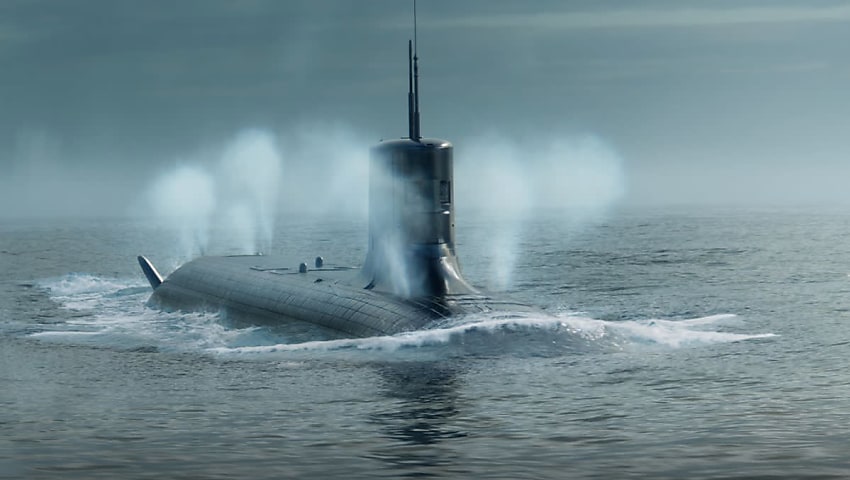
Opinion: Former Australian diplomat Russell Rollason AM, in responding to Assistant Minister for Defence Peter Khalil MP, argues that the government has yet to make a convincing strategic, economic or sovereignty case for the nation’s largest-ever defence investment, warning the project risks locking Australia into an outdated capability at enormous long-term cost.
The case for the AUKUS submarine agreement as outlined by Assistant Minister for Defence Peter Khalil in Defence Connect (22 June) is a useful contribution to the current debate.
While he raises a number of questions that need further clarification, Khalil is right when he said: “It is important that the government clearly articulate the case for AUKUS and why this is an efficient use of taxpayers’ money.”
This is especially critical when the total cost is estimated in excess of $368 billion over 30 years, leaving our children and grandchildren with a very costly debt to inherit, let alone a high-level nuclear waste dump.
The key problem with AUKUS Pillar 1, the nuclear-powered submarines, is not just the eye-watering cost but the fact that it is a strategy and a ship for a bygone era.
Rules-based order
Khalil is right that “the rules-based order that has served us so well over decades is today under severe strain”, but he ignored the elephant in the room! The United States, our closest ally, has rejected the rules-based order it did so much to establish after World War II and undermined the UN Charter at every opportunity.
As the US and Israel launched their illegal attack on Iran, US Secretary of Defense Pete Hegseth said that they would fight this war “without mercy”, unbound by “stupid rules of engagement”.

Former Labor foreign minister Gareth Evans has expressed his concern that the US had “zero respect” for international law or the interests of its allies. One of his successors, former foreign minister Bob Carr, told The Guardian that “this is an utterly different America than the one that generated our rhetoric about shared values, rules-based order and seeing the world through that lens”.
There has been a similar shift in Australian attitudes towards the United States. Recently, the United States Studies Centre found that only 16 per cent of Australians think that Donald Trump’s second term has been good for Australia. The world of today is different to what it was when then prime minister Scott Morrison secretly negotiated the AUKUS agreement. Canada and European countries have realised that they need to think and plan differently in the light of the US commitment to “America First”.
Our government needs to recalibrate Australia’s commitment to the US alliance, spearheaded by an urgent review of AUKUS.
Following the US rejection of the rules-based order, China has taken a lead in promoting multilateralism and restoration of the rules-based order, something Australia should actively support.
Cooperating with China to protect vital sea lanes
The need to protect the trade and security architecture that underpins our prosperity is clearly important. Khalil does not say who threatens our trade and security architecture, but the implication is China. China is the world’s largest trading nation and our largest trading partner. China has the same interest as Australia to protect trade routes and communications.
The unanswered question is why the Australian government and our national security establishment has opted in no uncertain terms to characterise China’s rise as a serious security threat to Australia. This China threat narrative has been driven by US interests and the arms industry. It developed during the first Trump administration when the policy to “contain China” was developed.
Foreign Minister Penny Wong has achieved much in repairing Australia–China relations. With the emergence of China as the pre-eminent power in east Asia, Australia needs to build a broader cooperative relationship, especially in trade, renewable energy and food security. But first, Australia must disabuse itself of the “China threat” discourse lest it hamper possibilities for diplomacy and cooperation in the region.
The argument that the AUKUS nuclear submarines will protect our trade routes strains credulity. By the mid-2030s to mid-2040s, Australia may have three to five submarines if the second-hand ones are eventually released by the then US president (who must decide if they are surplus to US needs). If we do have five then we would be very lucky to have two operational at any time. The UK has eight nuclear submarines and all of them are currently in dock for maintenance.
How can two submarines, no matter how fast they can travel, monitor thousands of kilometres of sea lanes in the Pacific and Indian oceans? The US has 41 nuclear submarines and the US Navy could still not keep open the major global trading route through the Strait of Hormuz.
Australia’s goal to keep the major trading routes open is more likely to be achieved through diplomacy and cooperation with China and other countries in the region. The old approach of sailing an attack class submarine through the region is more likely to provoke a tit-for-tat response.
Obsolescence
The AUKUS submarines may not survive against even the anti-submarine capabilities currently deployed in our region, including the rapid advances in detection using quantum computing.
AUKUS Pillar 2 focuses on emerging technology like the use of AI, drones, uncrewed vehicles, autonomous weapons and cyber war, but the Pillar 1 submarines are unlikely to be fit for purpose when they eventually arrive. The Virginia Class of submarines were designed in the early 1990s and while their technology has been upgraded over time, remote sensing technology has developed at a startling pace.
The recent emergence of drone warfare on the battlefield and the capacity of cheap remotely controlled vehicles and speed boats to destroy extremely expensive ships, like the Russian guided missile cruiser the Moskva destroyed by Ukrainian drones, has changed the way wars are fought.
By the time the full fleet of AUKUS submarines is acquired, we will be living in different geopolitical circumstances and technology will have advanced remarkably. The ocean depths will no longer be opaque and large attack submarines will become detectable and have lost their stealth. The AUKUS submarines will be redundant but we will still have to safely store and protect the high-level nuclear waste for thousands of years.
Sovereignty and self-reliance
The argument that AUKUS submarines will increase our self-reliance needs a vivid imagination. Former foreign minister Evans pointed out in his submission to the current AUKUS public inquiry that US Deputy Secretary of State Kurt Campbell gave the game away in his comment at the time of the announcement, “that we have them locked in for the next 40 years”. Similarly, Elbridge Colby, current US Under Secretary of War for Policy, commented just before he was appointed to a senior role in the Pentagon that the “delivery of any Virginia Class submarines to Australia would be highly imprudent without an ironclad guarantee they can be deployed at the will of the United States”.
In 1981, then prime minister Malcolm Fraser said: “The Australian government has a firm policy that aircraft carrying nuclear weapons will not be allowed to fly over or stage through Australia without its prior knowledge and agreement. Nothing less than this would be consistent with the maintenance of our national sovereignty.” Today, the Australian government has a policy of “Don’t ask, don’t tell” for aircraft and submarines carrying nuclear weapons.
Defence Minister Richard Marles has regularly asserted that the submarines will be under Australian command but the experience of Australian special forces in Afghanistan and the deployment in Iraq suggest otherwise. In reality, our submarines will operate under US command and control system and be a major part of the Australian Defence Force’s future “interoperability” with the US.
Our security and intelligence partnership with the US is a critical element of Australia’s national security, according to Khalil. Far from assuring our security, AUKUS bases and US military/joint facilities in Australia will be directly targeted in a war with China, resulting in significant civilian collateral damage.
Any belief that the US will defend Australia is flawed and dangerous. America will only ever do what is in its best interests.
Over 75 per cent of Australians now have an unfavourable opinion of the US and do not consider it a reliable partner. Like Canada and several European countries, it’s time for Australia to develop a comprehensive and independent peace and security strategy. This is not an argument to scrap the alliance with the US but rather to evaluate it and decide what is best for Australia.
No guarantees and no refunds
There are so many questions about Australia’s largest defence expenditure ever yet so little information in the public arena, as Khalil agreed. How could the government commit so much taxpayer’s money to a project for which there are no guarantees on delivery, let alone a delivery date, and no refund if the submarines are not delivered? How can the government paint a nuclear(?) target on the backs of five or more Australian communities without any public discussion or consultation?
This is why the crowd-funded AUKUS public inquiry, conducted under the auspices of the Australian Peace and Security Forum, is gaining such traction. The public want answers. The inquiry is headed by five distinguished community leaders, headed by Peter Garrett, who was lead singer of Midnight Oil before becoming a cabinet minister and includes former chief of the Defence Force Admiral (Ret’d) Chris Barrie and former state premier Dr Carmen Lawrence. The key question is: "Will AUKUS keep us safe? At what cost?”
Russell Rollason AM is Secretary (honorary) for the Australian Peace and Security Forum. A former diplomat (14 years) with the Department of Foreign Affairs, including a three-year posting in India, he has 25 years’ experience in NGOs, including 12 years as executive director for the now Australian Council for International Development (ACFID). He is a science honours graduate from the University of Queensland.
Want to see more stories from trusted news sources?
Make Defence Connect a preferred news source on Google.
Click here to add Defence Connect as a preferred news source.