

 iscover
Queensland’s AEP Engineering owner, Mick McMillan, is a very public face for many small-to-medium defence suppliers across Australia.
Across a 30-year career with the Australian Army, he’s seen the internal wants and needs of the Australian Defence Force first hand.
In the corporate world, he’s seen the ebb and flow of the domestic defence industry with AEP Engineering, providing mechanical engineering and manufacturing services for defence, mining and energy sectors in North Queensland.
Now, that defence component is being struck out.
“There’s a genuine desire to get involved and to do business at that local level with someone in Townsville, personnel with the Australian Army. However, on a holistic level, the Defence procurement is broken,” he declared. “It’s so disjointed, it’s not coordinated. The procurement rules are complex and very much focused on risk.
“The government is not accepting any risk and that’s one of the aspects that I feel was, and still is, the most dangerous issue with having more Australian industry content. The government, rightly or wrongly, feels that it has to have zero risk in projects.
“The impact of that issue is that the only people that can absorb risk (and costs of investing in new innovation) are the bigger primes, because they have multiple tendrils that they can cut one off and still make money on another one.
“So, as far as innovation goes, it’s very difficult to innovate in Australia because there’s no incentive to do that innovation … That’s the lack of foresight by several successive governments.”

McMillan’s personal journey to improve the ADF originally began when Australia acquired more than 2,000 Mercedes-Benz G-Wagon vehicles under LAND 121 Phase 3 (Project Overlander) in the mid-2010s.
The former infantryman, who holds a master’s degree in vehicle design, was inspired to find a better 4WD solution for Australian troops after realising the “G Wagon wasn’t the right vehicle for what troops wanted”.
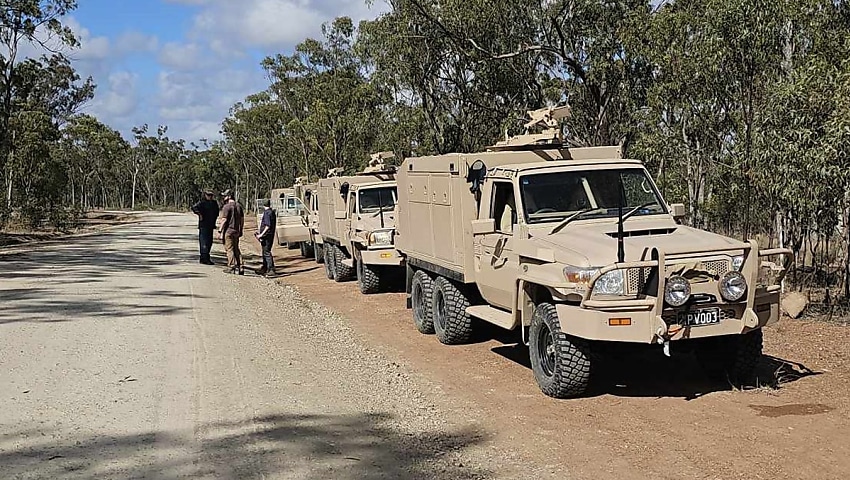
Joining forces with a former SAS soldier (who had been part of the Long Range Patrol Vehicle program in 1970s–80s), the pair designed and built their own 6x6 military light reconnaissance vehicles using the base of a Toyota Land Cruiser 70 Series in Townsville. They then had them assessed by the ADF and Australian Army under LAND Trial 063 in 2020.
The vehicles, designed for reconnaissance and logistics missions, received initial success and were spurred onward with sponsorship from the Queensland Government and an appearance at the Land Forces International Land Defence Exposition in 2020.
Unknowingly, they were about to face their greatest and ultimately fatal challenge, the Department of Defence procurement process.
“At the end of the day, the whole project was more just to showcase the engineering required, the logistics support of the vehicle and what we could achieve in Australia. That was the intent,” McMillian said.
“The first two vehicles were self-funded, then we got in front of the then-Minister for Defence Industry Melissa Price and we got a sovereign industrial priority grant to build two and buy the equipment.
“We delivered the first two under LAND Trial 063 and the vehicles were handed over just before the change of government in 2023–24.
“The vehicles were handed back about a week later with no kilometres on them, (we found out that the trial was one day) … The funding for the trial was pulled very quickly by government.
“I remember a lot of stuff got cut around that time (with the Defence Strategic Review), whole businesses were gutted overnight, and at the end of it, the vehicles were handed back.
“Over the last year, we still had organisations within the ADF still reaching out, saying, ‘Yeah, we’re interested. We would like to do that.’
“I hung on, and then it came through during the second week of May this year that there was no money in the budget, and I said, ‘It’s time to get rid of these things’.
“Once the politics got explained to me by a very good friend, it was realised very quickly it’s not a level playing field. I needed to extract my business away from Defence, even though we have been very successful as an engineering company within Queensland.”
McMillian has now confirmed that the defence dream is over. The remaining military light reconnaissance vehicles and 6x6 remote area ambulances will be put up for public auction. He described the now-scrapped project’s research and development as a “significant loss” akin to “running away with tail behind your legs”.
Domestic defence industry companies, he says, cannot afford to absorb the losses of no risk, no investment approved then declined Defence contracts in the same way that international defence primes can.
“There’s a disconnect between the government’s definition of ‘sovereign capability’ and domestic defence industry production,” McMillan said.
“I’m not anti-Defence. I’m just a little bit disappointed that the government still continues to think about the primes as the only solution, and they invest a lot in them.
“From a defence procurement perspective, the focus on the primes is really the main effort from government. All the big primes have an Australian industry content (percentage) built into the contracts but they go just to the number. If they have got to have 20 per cent, then they’ll get exactly 20 per cent.
“If you’ve been around defence (industry) for a long time, you see that they use a lot of weasel words … You see a lot of primes calling themselves a sovereign capability.
“(In reality) these are overseas companies, where the intellectual property is owned by them and they’re only letting us buy it. We’re not allowed to sell it.
“So, it’s an interesting scenario that we can’t support our own defence industry. We can support other countries defence industries with the primes, but we can’t do our own.”

Want to see more stories from trusted news sources?
Make Defence Connect a preferred news source on Google.
Click here to add Defence Connect as a preferred news source.