

 iscover
Opinion: I travelled to Poland and Ukraine late in 2025. These are the lessons I learnt there, and the potential for the future.
While the Russian invasion of Ukraine has led to a protracted continental land war, there are many lessons that are relevant to littoral operations that the Australian Army would encounter.
First, we were one of the Australian companies exhibiting at the Polish land systems exhibition, MSPO, in Kielce, in the south-east of the country, in late August.
Similar in size and scope to Land Forces, it was all about “big iron”, i.e. tanks, artillery, and other heavy weapons.
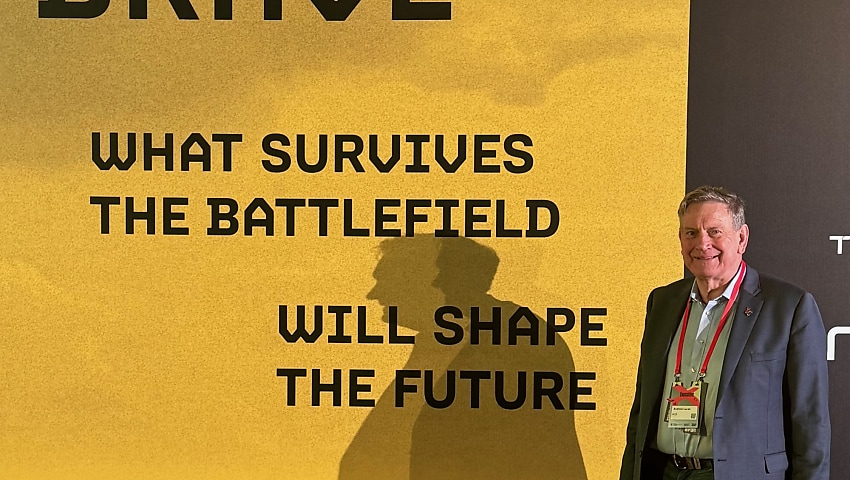
I then attended the Brave1 “Tech Valley” event in Lviv. Tech Valley was entirely focused on drones, uncrewed ground vehicles (UGV), and electronic warfare. The difference was striking. There wasn’t a drone or UGV larger than three metres across at Tech Valley.
There were no Australian, US, or UK companies formally exhibiting, although there were a number of foreigners attending.
The other notable difference was that at 9am every morning, the traffic in Lviv stopped, and people stood for a minute in silence to remember the Ukrainians who had lost their lives.
My travel during my five weeks in Ukraine was mainly by train, and the rail system was efficient, punctual, and inexpensive. I travelled first to Kyiv and the frontline in the Pokrovsk area, then to Lviv.

Ukraine impressions
You enter Ukraine from the Polish town of Przemyśl, where you go through immigration.
Overall, my impression of Ukraine and the Ukrainian people is very positive. Having travelled across the Trans-Siberian railway to Moscow, when it was still the USSR, I was expecting a dour population and one suffering under wartime conditions.
I was pleasantly surprised by the Ukrainians, who were open, friendly, and very determined. I have learnt to refer to the situation as the “Russian invasion”, not the war in Ukraine. Many Ukrainians openly thanked me for visiting and for my support.
On arrival at Kyiv’s main railway station, I was greeted by the sight of a high-rise building that had been hit by a Russian Shahed (or Geran) drone.
I stayed in a serviced apartment near the city centre. This proved to be safe, economical, and convenient. While the apartment buildings appear somewhat shabby on the outside, they have been renovated and are comparable to serviced apartments elsewhere.
Food and meals in Kyiv are good, and about half the price of a restaurant meal in Australia. The streets are full of people until the 10pm curfew.
The next day, we visited the site of a fatal Shahed attack, for me to get an understanding of the degree of damage.
Air alert
At the time I was in Kyiv, there were air attacks around every other night. Sometimes there were multiple attacks on the same night.
The “Air Alert!” iPhone app provides a convenient way to receive alerts, though the air-raid sirens were clearly audible in the apartment.
The Ukrainians are very digitally advanced. I was able to obtain travel insurance for Ukraine online in Australia in three hours, with the policy confirmation appearing in my iPhone wallet during that time. This emphasises the innovative nature of the Ukrainians; they get on with life and don’t let the invasion distract them.
Drone usage
Ukraine’s usage of drones is well known, but the scale is breathtaking: last month, the President (Volodymyr Zelenskyy) announced that the country was now producing and consuming more than 10 million units annually, with plans to double that number to 20 million by this time next year.
When I arrived in Ukraine, I’d expected the Armed Forces of Ukraine to have a few experimental UGVs on trial. I was very surprised to learn that they already had thousands operational, and that the Ukrainians are expecting around 50,000 UGVs in service this year.
Of note, I saw a typical, medium-sized UGV with a payload of around 0.5 tonnes; a Ratel H, ready to commence a mission. Noting the Starlink antenna, it’s primary means of communication due to the prevalence of Russian communications jamming.
Currently, all operational UGVs in Ukraine are remotely controlled; the vehicles do not rely on GPS, which is widely jammed and spoofed; consequently, they are entirely dependent on Starlink for the remote pilot’s vision and control signals.
The six-by-six wheeled Ratel H and the tracked TenCore TerMIT 2.0 are typical of the state of the art for systems in Ukraine at present: remotely controlled rather than autonomous.
Another key feature of Ukrainian UGVs is their price to the Ukrainian Armed Forces: around $110,000 (Australian dollars). This is very much cheaper than comparable European or US vehicles, which are designed to Mil Specs for a 20-year service life.
The Ukrainian approach to equipment is cheap, easy to manufacture, maintain and repair; expected to last for months rather than years.
Reality of war
I was fortunate to travel to the frontline in the Pokrovsk area with the Armed Forces of Ukraine to understand how autonomy can be used in the conflict and the combat environment in which autonomous systems must operate.
Of note, a day-by-day view of the frontline, grey zone and immediate situation was provided by the website Deep State.
I spent one day with a brigade intel team, which was engaged in combat in one of the most contested areas. I sat with the tactical commander, viewing multiple screens displaying first-person view of the battlefield.
A reconnaissance drone would show a Russian soldier moving up a ditch through the grey zone. Within minutes, an FPV kamikaze drone would be called up, and the FPV drone would strike. I spent several hours watching this brutal combat in real time.
On another occasion, two Russians were surprised in a field, and the FPV drone exploded near them, not close enough for a kill. They fled into a farm building, which apparently was the hiding place for a number of Russians. The commander called up a bomber drone, and 10 minutes later, we viewed the scene from its downward-facing camera. A bomb, visible under the drone, was then released and struck the roof of the building, penetrating and exploding.
The short lesson: nothing survives in the 20-kilometre-wide grey zone; anyone or any vehicle, armoured or light-skinned, is attacked within minutes. FPV drones target the tank’s weakest points, e.g., the tracks. Once immobilised, the crew is trapped inside, making it a large item to recover.
In illustration, the recently released film, 2000 Meters to Andriivka, provides an unvarnished view of the conditions.
I then travelled to a UGV platoon’s staging area, where a vehicle was being readied for a supply mission. Typically carrying up to 0.5 tonnes, the UGVs are a means of resupplying the front line without risking lives. The Ukrainian soldiers were brave, full of humour and uncomplaining. I was humbled by their humility and their determination.
However, the missions take several hours and are at risk of attack from FPV drones or mines. Their primary missions are resupply and casualty evacuation. Of note, there was a particularly informative video by “Cossack”, the training commander of the Ukrainian Army’s 10th Corps UGV Training School.
The commander’s explanation of the UAF’s usage of UGVs, covering the risk of FPV drone attack and confirming that there is no practical defence against these drones for UGVs. It runs for about 45 minutes, but it is a very good summary.
I have omitted any crucial operational details, but the lesson was clear. Either stay camouflaged and under cover, or operate at night (even then, FPV drones now have infrared cameras), or risk a fatal attack from an FPV drone within minutes.
Final thoughts
The Ukrainians are short of soldiers, whereas I saw that the Russians are careless of loss of life – their soldiers are regarded as entirely expendable, in contrast with the Ukrainians’ objective of protecting their own.
Consequently, the Ukrainians have to be smart to win. With a 1:4 difference in national populations and the accepted 3:1 superiority in arms as a rule of thumb for success, the Ukrainians need a 12:1 productivity advantage over the Russians if they are to win.
This 12:1 ratio drives the need for autonomous systems, whether in the air, on the ground, or at sea.
I was evacuated early from the frontline, due to intense Russian activity, just ahead of their dropping CABs (glide bombs) on the village where the UGV team were based.
As a final note, if you have the opportunity to visit Ukraine, then do so.
Even more so, if you can contribute to their success, the Ukrainians are very grateful. While Ukraine has a reputation for corruption that discourages some, the courage and determination of the vast majority of its population inspire any visitor.
***Dr Andrew Lucas is the managing director of AOS Group.***
Want to see more stories from trusted news sources?
Make Defence Connect a preferred news source on Google.
Click here to add Defence Connect as a preferred news source.