

 iscover
It’s an important question, knowing that FPV explosive impact drones have arguably been the single most impactful military technology development that has been revealed globally in recent memory.
These expendable, commercially-available and ideally ambush-suited drones were originally fielded to drop grenades and other explosives from height by both Ukrainian and Russian forces in early 2022.
Through the crucible of combat, the FPV kamikaze-style model quickly modernised to carry a rocket-propelled grenade warhead, ram itself into a target and activate by crushing a forward-facing electric circuit.
The modern manually guided FPV drone has become a staple of the Ukraine–Russian conflict, ideal for picking off advancing personnel crossing open terrain and even better suited for lying in wait behind enemy lines for lightly armoured and fully laden logistics vehicles.
It’s rumoured that as much as 70 per cent of all battlefield casualties in the Russo-Ukrainian War are now caused by these buzzing aerial menaces.
In a strong step forward for lethality, Defence recently revealed that the Australian Defence Force is trialling the technology during Exercise Talisman Sabre.
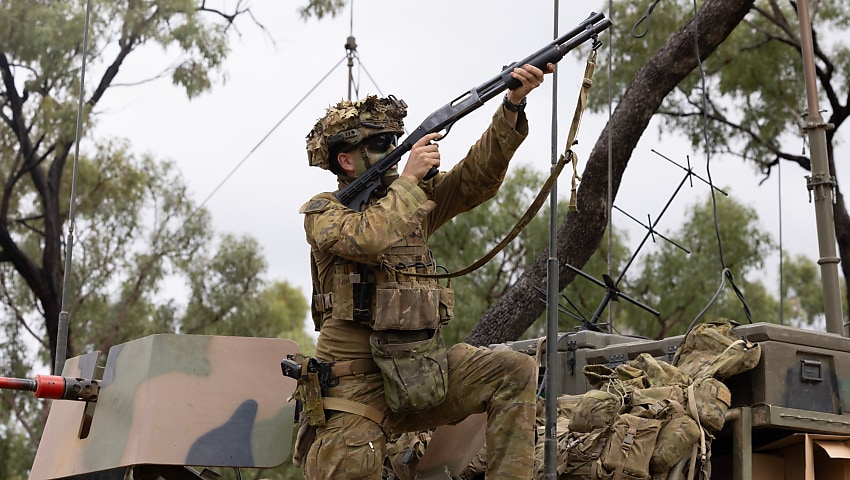
Very casually, FPV drone use was confirmed in an explanation detailing the efforts of 3rd Battalion, the Royal Australian Regiment operating at Townsville Field Training Area during the exercise.
“They cleared enemy positions at Objective Emerald using indirect fire, armoured manoeuvre and breach teams to take key ground by night, before shifting focus to a brigade assault on Line Creek Junction,” according to a Defence statement.

“They worked closely with Battle Group Eagle, a reconnaissance unit providing vital intelligence to support planning and targeting decisions.
“This coordination ensured teams had real-time information, enabling faster decisions and more effective actions on the battlefield.
“To sharpen their edge, they also trialled new technology, including first-person view drones and optionally crewed M113s, remotely operated vehicles fitted with mini-guns or 50-calibre machine guns.
“The drones provided speed, agility and short-range strike capability, while the M113s delivered firepower without risking soldiers’ lives.”
Should Australia fast-track trials for FPV drones?
At this point, FPV drone technology itself is relatively combat-proven, with Ukraine’s production of FPV drones equating to around 200,000 units per month in January this year, according to estimates published by Forbes.
Commercial quality drones are cheap to manufacture and easy to customise, even for non-front-line units as seen in Ukraine. The drones themselves are able to “reheat” combat areas that enemy forces may consider safe after already clearing the zone of other obstacles such as mines, personnel and vehicles. There has also been successful use of FPV drones in Ukraine to immobilise armoured convoys and follow up destruction with other weapons systems.
In some cases, FPV drones have outclassed far more expensive anti-tank systems through the drone’s ability to manoeuvre and immediately re-engage fast moving or hiding targets. Additionally, they are adept at targeting specific areas of armoured targets through open hatches and building entry points (windows, doors).
In addition, there is certainly a market for export potential which the Ministry of Defense of Ukraine has publicly confirmed that it will aim to purchase around 4.5 million first-person view drones in 2025.
University of NSW senior lecturer Dr Oleksandra Molloy, an expert in advanced air mobility and uncrewed systems, said the world is moving quickly to adopt the lessons learned in Ukraine, including the strategic advantages delivered by FPV drones.
“Australia has started experimentations (with drones), but definitely not to the scale that is needed … We just need to speed up that implementation and testing,” she said during a recent podcast with Defence Connect.
“Every commander needs to be aware or know what to do with these systems and how to defend from these systems. It’s training, it’s strategy and it’s investment.
“Returning from a recent western conference, NATO countries are thinking about the uncrewed systems as an important element in the future wars.
“They are thinking about scalability, how to integrate, how to sustain, how to do it quickly and learn with Ukraine.
“I think in Australia we are still figuring out whether or not the systems may contribute and which systems will be important.”
The pros and cons
The Australian Defence Force has already theorised what the benefits and detriments of FPV drones might add to our national military capability.
Australian Army Infantry Officer Major Travis Peet, in a Cove Comp 24 submission titled How the Australian Army would adapt if it introduced explosive FPV drones – Cove Comp ’24, confirmed that the ADF is aware of the accelerated the use of technology in warfare in Ukraine and how eFPV drones are changing the character of war.
“The effectiveness and asymmetric advantage provided by eFPV drones in Ukraine suggests this capability will be adopted by other militaries, including Australia,” he said.
“In response to eFPV drones changing the character of war, the Australian Army needs to consider how to protect itself from this threat and prepare to operate them.
“In line with how eFPV drones are utilised in the Russo-Ukraine War, they must be treated as a weapon rather than an aircraft. Capability programs must cater for keeping stock at a required level, rather than simply buying a finite number. The capability program for eFPV must be agile, able to adapt to countermeasures as they emerge.
“Finally, eFPV will need bespoke training facilities. If eFPV drones are to reach their full potential, suitable targetry that simulate fast moving and precise targets will be required. Where possible, simulation and training will need to expose operators to the realities of utilising eFPV drones against enemy combatants.
“The application of machine learning and image recognition may make eFPV drones even simpler to operate, potentially overcoming emerging countermeasures.”
In contrast to their effectiveness, MAJ Peet also outlined several legal and ethical consideration regarding FPV drones. These include legal issues relating to a drone target attempting to surrender to the drone and also the ethical and psychological implications for ADF operators using traumatically-lethal FPV drones against visually “defenceless” enemy combatants.
“If the Australian Army is to develop an eFPV capability, it must make capability, psychological, legal, and ethical adaptations,” he said in the submission.
“Acquiring and training with eFPV drones will be the easier part of the equation; addressing the psychological, legal, and ethical challenges they present will be the true test of the Australian Army's readiness for this new era of warfare.”

Want to see more stories from trusted news sources?
Make Defence Connect a preferred news source on Google.
Click here to add Defence Connect as a preferred news source.