

 iscover



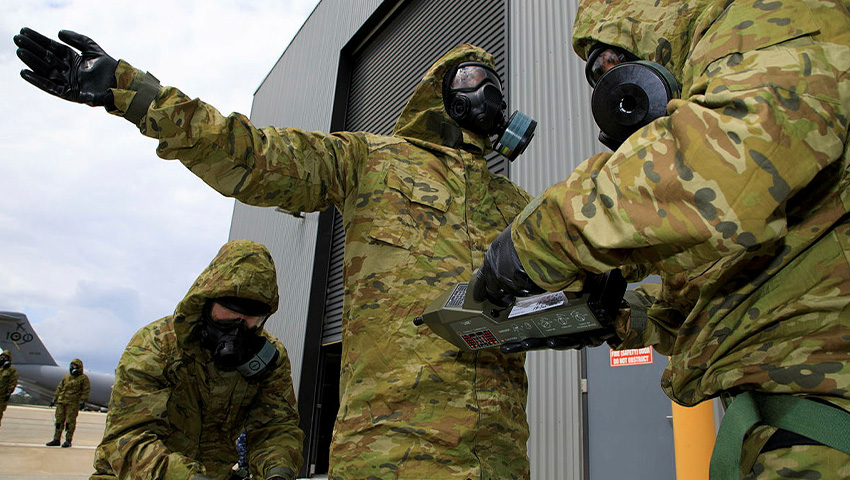
Personnel have engaged in training activities aimed at preparing ADF personnel for encounters with toxins in the battlespace.
RAAF Base Amberley recently hosted Exercise Toxic Safari 22 – a collective training activity focused on improving preparedness of personnel for contaminated chemical, biological, radiological and nuclear defence (CBRND) warfighting environment.
Specifically, the exercise – which involved RAAF participants from Combat Support Group, Air Mobility Group and Army Headquarters – aimed to enhance overall capability to “survive to manoeuvre” in a CBRND environment.
Training involved processing of chemically contaminated personnel at an exchange airfield, including decontamination operations.
Flight Sergeant Anthony Hartley, from Headquarters Combat Support Group, described the training.
“A method of achieving this is with a phased step-by-step process of removing contaminated equipment and effects utilising a personnel decontamination station (PDS),” FSGT Hartley said.
“The purpose of the PDS is to remove contamination from personnel as soon as possible to avoid spreading the contamination agent.
“When the person reaches the end of the PDS, they should be free of any contamination. Every effort to minimise the spread of further contamination must be taken throughout the PDS.”
Exercise Toxic Safari 22 also sought to familiarise personnel with protective equipment, supplied under project LAND 2110.
Exercise Toxic Safari also involved role-players to assist in shaping realistic warfighting activities.
“It’s been great to see another side to Air Force that I wouldn’t normally see,” Pilot Officer Benjamin Sherry, from No. 6 Squadron.
“Being a role-player has also allowed me to work together with members from other units which has been really interesting.”
Exercise Toxic Safari 22 is one of a number of RAAF exercises to take place this year.
The RAAF’s Exercise Diamond Storm 22 has kicked off in the Northern Territory from RAAF Bases Darwin and Tindal, and at Timber Creek, Douglas Daly region and the Delamere Air Weapons Range.
The month-long exercise is the last of three activities which form part of the air warfare instructor course (AWIC), following Exercise Diamond Seas and Diamond Shield.
Over 1,400 Defence personnel are expected to participate alongside US counterparts based in the Top End, operating more than 60 aircraft.
The 2022 iteration is also set to involve trainee air warfare instructors from the F-35A Lightning II, P-8A Poseidon and combat controller communities.
[Related: RAAF F-35A trainees gear up for Exercise Diamond Storm]

Want to see more stories from trusted news sources?
Make Defence Connect a preferred news source on Google.
Click here to add Defence Connect as a preferred news source.