iscover
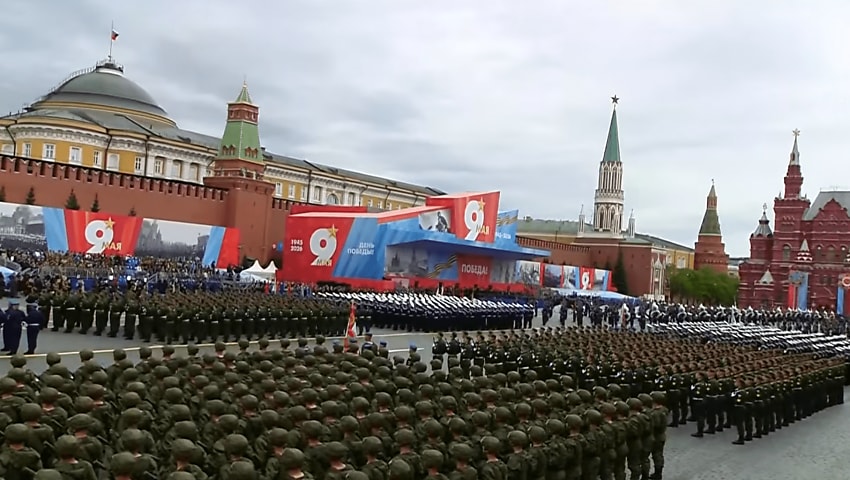
Russia’s imposing array of military hardware and visiting foreign officials were thin on the ground during the country’s recent Victory Day, both groups likely spooked by modern drone threats.
The commemorative 81st anniversary Victory Day military parade held on 9 May celebrated the country’s victory against Nazi Germany in World War II, as well as acting as Russia’s largest and most public showcase of military might.
The parade was reviewed by Defence Minister Andrei Belousov and commanded by Colonel General Andrei Mordvichyov, Commander-in-Chief of the Ground Forces. Music for the ceremony was performed by the combined orchestra of the Moscow Garrison.
“I’ve been on Red Square on Victory Day many times before, but this year feels and looks very different,” said BBC’s Russia editor, Steve Rosenberg, who attended the parade.
“There are no tanks, no missiles. None of the military hardware that Russia normally showcases on this day, to project power to the world.
Rosenberg also noted the absence of media on the day.
“There were far fewer journalists at the event. Many international media organisations had not been granted access,” he said.
“As well as fewer journalists, there were fewer guests in the stands, and fewer world leaders had flown in for the spectacle.”

The leaders and the troops
A smaller contingent of personnel was featured in the parade than previous years. This year featuring only Russian and North Korean soldiers.
Foreign dignitaries were also thinner on the ground this year than previous iterations, with leaders attending from Kazakhstan, Belarus, Uzbekistan, Laos, Slovakia and potentially Malaysia.
Ukrainian President Volodymyr Zelenskyy released a statement on 8 May ahead of the event recommending representatives not to attend.
“They (Russia) want permission from Ukraine to hold their parade, to go out to the square safely for an hour once a year and then continue to kill our people and fight again. The Russians are already talking about strikes after May 9. The logic of the Russian leadership is strange and definitely inadequate,” President Zelensky said in a social media post on 8 May (translated).
“We also have appeals from some states close to Russia that their representatives are going to be in Moscow. A strange desire ... in these days. We do not recommend it.”
Where is the hardware
In a change from the annual parade, televised coverage was shown during the event, including examples of trench warfare, armoured warfare with assistance from Terminator tank support vehicles, 152mm Giatsint-K and 152mm Malva artillery, loitering munitions and Molniya-2 attack drones, launch of long-range aerial drones, firings of Tornado S and Uragan multiple missile launchers.
Other coverage included direct addresses from Russian units in Ukraine, anti-aircraft missile crews, those using uncrewed aerial systems and a demonstration of infantry advances using ATVS relating to Russia’s “special military operation” in Ukraine.
Of most interest perhaps to industry was a televised coverage of a new Peresvet combat laser system reportedly capable of disabling satellites, aircraft and cruise missiles; as well as a televised take-off of an SU-57 and Tu-160 strategic bomber aircraft; details of the S-500 Prometheus anti-aircraft missile system for high-altitude interception of ballistic targets; and showing of the Russian Avangard hypersonic glide vehicle.
A televised coverage was also shown of a Russian Navy Admiral Gorshkov Class frigate, the nuclear-powered Oscar Class cruise missile submarine Arkhangelsk and Borei Class nuclear-powered ballistic missile submarine Knyaz Vladimir.
Remembering the Soviet Union and Putin’s call for unity
In his annual parade speech, Russian President Vladimir Putin drew attention to the heroism of the Soviet people and the losses they had suffered during World War II, while calling for unity among the public for the future.
“We will always remember the heroism of the Soviet people and the fact that it was their decisive contribution that made the defeat of Nazism possible. They saved their country and the entire world, put an end to total and merciless evil, and restored sovereignty to the nations that had capitulated to Nazi Germany and become obedient accomplices to its crimes,” he said.
“Our soldiers suffered colossal losses and made enormous sacrifices in the name of the freedom and dignity of the peoples of Europe. They became the embodiment of courage and nobility, fortitude and humanity, and crowned themselves with the great glory of a monumental Victory.”
He asked citizens to remember their ancestors “uniting to stand like wall”.
“Our people stood against the enemy like a wall and proved that devotion to the motherland is the highest moral truth, capable of uniting millions of people,” he said.
“The front and the rear were united. Genuine patriotism, courage and self-sacrifice of the people elevated them above the enemy, gave them strength, and reinforced their faith in Victory.
“All of this lives on in family histories, in the hearts of our children, grandchildren and great-grandchildren. In the memory of each and every one of us.
“The great feat of the victorious generation inspires the soldiers carrying out the tasks of the special military operation today. They are confronting an aggressive force armed and supported by the entire NATO bloc. Despite this, our heroes are advancing.
“Alongside Russian soldiers are workers, designers, engineers, scientists and inventors. They continue the traditions of their predecessors, and drawing on modern combat experience, create advanced and unique models of weapons, and launch their mass production.
“The fate of the country is determined by its people; soldiers and factory workers, agricultural labourers, weapons designers and war correspondents, doctors and teachers, cultural figures and clergy, volunteers, entrepreneurs and philanthropists. All citizens of Russia.
“The key to success is our moral strength, courage and valour, our unity and ability to withstand everything and overcome all challenges.”
Final thoughts
The overall trend this year was a more subdued and sombre Russian Victory Day parade on 9 May.
Clearly, the Russian government and securities forces are concerned enough not to present a large military capability target, such as the traditional parade, for Ukrainian drones to attack. This is probably wise, as attacking an event similar to the large-scale parades of yesteryear would have been too strong a temptation to resist. In addition, Ukraine’s explosive drones have previously penetrated far into Russian countryside and clearly there are still significant concerns about the ability to protect military targets from such attacks.
Similarly, in a show of concern, the overall time dedicated to the parade was reduced from more than an hour down to a compact 45 minutes – short and sharp. There was quick overhead aerial display from SU-30, SU-25 and MIG-29 aircraft this year.
Of most interest was the clear absence of high-value armoured vehicles, including T-90 and Armata main battle tanks, Terminator support vehicles and missiles systems, like the Yars ICBM family.
This year’s parade certainly raises further questions around the Cold War global power’s military vehicle production, defence systems or procedures and whether the invasion of Ukraine has already depleted reserves of usable tanks, armoured vehicles and missile systems.

Robert Dougherty
Want to see more stories from trusted news sources?
Make Defence Connect a preferred news source on Google.
Click here to add Defence Connect as a preferred news source.