

 iscover
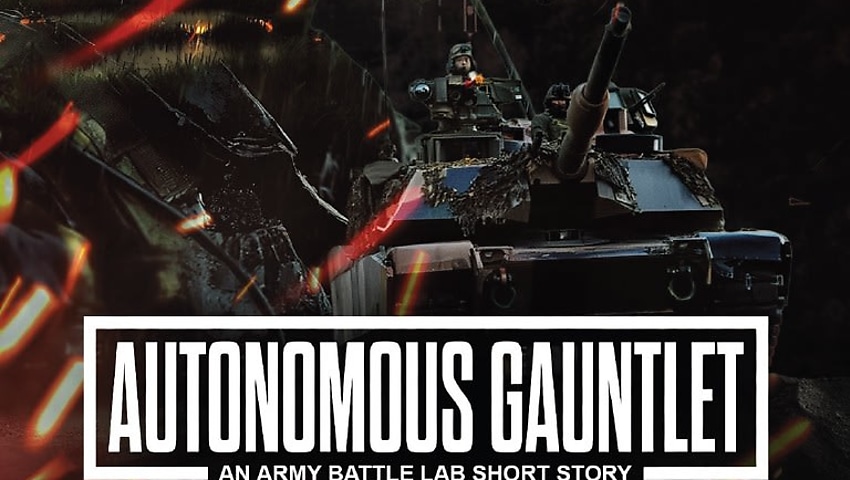
Members of the public have been given a brief glimpse into what modern robotics combat might look like under the newly published Autonomous Gauntlet short story.
The written piece by author Jack Silkstone and published by the Australian Army Battle Lab explored highly autonomous, drone and robotics-saturated warfare with interspersed sections discussing pervasive sensing, contested logistics and command chain procedures.
The story is structured around an Australian Army force holding the line in the fictional country of South Torbia against a military invasion from a fictional North Torbian military force.
The story itself is told in majority from the perspective of Lieutenant Amelia “AM” Mooney, commanding a robotics and autonomous systems platoon within a sustainment brigade, attempting to aide front-line armoured troops as well as ambushed logistics columns.
What’s on show
The story features key Australian Army mainstay platforms such as the Abrams main battle tank, Bushmaster and Hawkei armoured vehciles, Boxer armoured reconnaissance cars, Polaris all-terrain vehicles and F-35A Lightning II fighter jets.
AM’s platoon, specifically, combined various uncrewed ground vehicles, uncrewed aerial systems as well as artificial intelligence-enabled surveillance and intelligence, although others are seen.
Systems on show include a tethered surveillance drone using AI for base defence and wide area surveillance, AI-enabled tube-launched explosive “Hornet” kamikaze aerial drones (used against armour and as interceptors, described as a flying claymore mine), autonomous HW trucks used for logistics and resupply missions, “Ugg” wheeled uncrewed ground vehicles (armed with 40mm grenade launcher and 7.62mm machinegun, and controlled by headset or voice command), thermally shrouded four-legged “Mules” armed with AT-4 launcher (operated by headset), autonomous U-Hawk casualty evacuation helicopters and MQ-28C “Ghost Bat Evolved” uncrewed combat aircraft as close air support (armed with GBU-39 small-diameter glide bombs and tasked by an F-35 or datalink network).

Also mentioned was a small uncrewed aerial surveillance system comically referred to as a “Predatoddler”, in a reference to the iconic Predator drone.
Of particular interest, the troops also use an AI enable search of social media and Defence intelligence to map out potential targets and/or persons expected to be sympathetic to assist their efforts.
On the opposing North Torbian force there was an array of utes fitted with tray-mounted machineguns, BMP infantry fighting vehicles and speculated Eastern European main battle tanks. Hardly a near-peer force in my opinion.
What’s being taught here?
Although I can only speculate on the intended lessons being discussed in the short story, it’s clear that the Australian Army is envisioning robotics and drones in general as an expendable possibly front-line asset.
Technology that can be used to absorb attacks, push counter-attacks and, crucially, be used as an expendable distraction to recover or shield military personnel from harm.
For example: “For the lone Mule, it was a suicide mission. Isolated and exposed, the rocket firing had revealed its position. Militia fighters blasted it with small arms fire as it turned and made to withdraw. Heavy calibre rounds smashed into its composite body, destroying electrical components. It trudged onwards, wearing blow after blow, until it collapsed on its side, power pack smouldering.
“The Mule’s sacrifice was not in vain. Not only had it destroyed the BMP, but by drawing fire, it had given the QRF time to consolidate.”
This kind of thinking is not just about using drones or uncrewed systems as ammunition to procure and then throw at an adversary. Instead, autonomous warfare could require fundamental change to the way the Australian Defence Force is organised.
For example, the following passage of ground personnel requesting immediate close air support.
“Thirty-five kilometres south-west of Fort Magsaysay, a flight of two USAF F-35As was heading north in support of the 1st Division’s attempt to counter-attack the North Torbian forces. A pair of Loyal Wingmen supported each aircraft.”
The MQ-28C, or Ghost Bat Evolved, was an autonomous aircraft designed to augment the capabilities of its partnered manned jet. In this case, the four drones were laden with GBU-39 small-diameter glide bombs to provide close air support (CAS) to the beleaguered ground forces.
“‘Shazam, you getting this CAS request?’ the lead pilot asked.”
“‘Yeah, Boomer. Off to the east. Call sign isn’t a JTAC, looks like a UAS operator. They’ve dropped a nine-liner directly into MADL.’”
He referred to the Multifunction Advanced Datalink, the network through which the F35s shared threat and situational awareness data. He glanced at the touch screen interface used to issue commands to his loyal wingman. A new option had appeared, allowing him to assign one of his drones to the UAS call sign.
“‘Lightning, this is Alpha Sierra, request immediate CAS, we are under attack from North Torbian heavy armour.’”
“‘Roger, Alpha Sierra, I am assigning you control of MQ-28 Lightning One Four Two. Please play nice with my toy and return it as you borrowed it.’ Boomer took his hand off the stick and tapped the relevant command button on his touch screen. Glancing over his right, he watched as one of his loyal wingmen peeled off.”
Logistics and command still winning wars
Keeping logistics running is a major theme of the story, although this would likely be the case for almost any warfare scenario.
However, the response to logistics lines being cut in the story is new. Military personnel are shown to use artificial intelligence to identify threats and assists targeting but also monitor logistics as it happens while maintaining responsibility for decision making.
Final Thoughts
Technology is demonstrated to compress decision time but ultimately human decision making centres around how to allocate UAS, when to accept risk, where to position sensors, how to employ limited assets and, importantly, when to withdraw or counter-attack.

Want to see more stories from trusted news sources?
Make Defence Connect a preferred news source on Google.
Click here to add Defence Connect as a preferred news source.