

 iscover



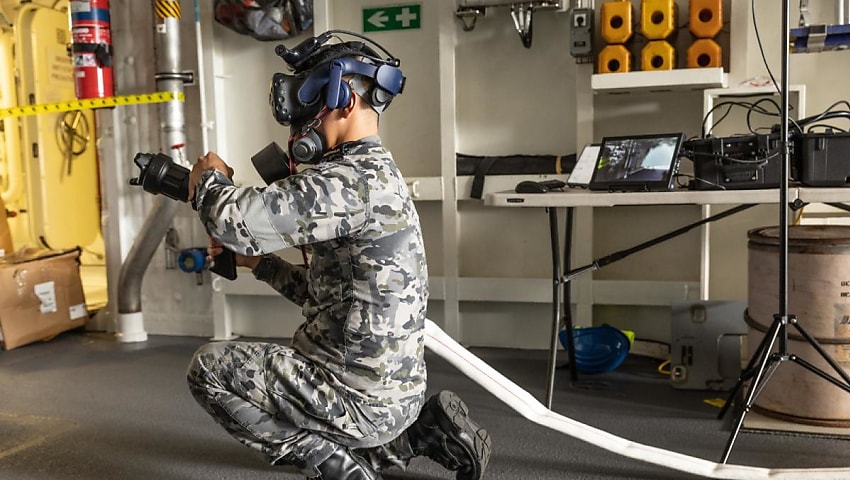
The Royal Australian Navy is trialling virtual and augmented reality technology in a new firefighting training system.
Personnel wear an oxygen mask, heat vest, and hold a water usage-measuring, 3D-printed fire hose nozzle during training in the RAN School of Survivability and Ship Safety.
The nozzle connects to a recoiling and reactive hose reel, simulating real hose forces. The equipment also measures the breathing rate, body temperature, and heart rate of the trainee.
Training is being undertaken aboard HMA Ships Brisbane, Gascoyne, Warramunga, Arunta, and at the RAN fleet innovation section on Garden Island under a joint initiative between the RAN, Defence Innovation Hub, and Deakin University.
Stores operator Able Seaman Kevin Tran, who used the technology on the flight deck, said it was practical training in his everyday space.
“I liked that it was on the ship in a space we are familiar with,” AB Tran said.
“I thought it was pretty realistic, being able to feel the hose kicking back at me.
“You can feel the heat through the vest and see the water and how your technique is.”
Deakin University Professor Saeid Nahavandi said the technology was designed to assist with the training and maintenance of firefighting skillsets.
“The technology we are using combines virtual reality, augmented reality, and haptics,” Professor Nahavandi said.
“The idea was to create a hot fire trainer that Navy personnel can take on board to create a virtual fire in a real environment.
“We are trying to help the Navy get future ready. The way we have designed and built the system in terms of its processing capability is actually ready for the next two to three years.”
Trials on the technology are expected to finish in late 2023.

Want to see more stories from trusted news sources?
Make Defence Connect a preferred news source on Google.
Click here to add Defence Connect as a preferred news source.