

 iscover




Australia’s next-generation Antarctic Supply and Research Vessel (ASRV) is currently under construction by Damen in Romania, but more opportunities in the Antarctic region have been raised at an event in Tasmania this week.
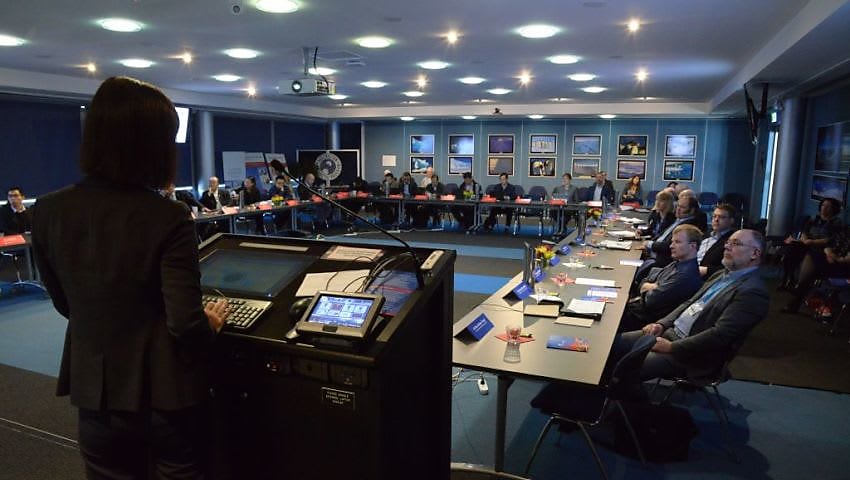
More than 30 scientists attended a two-day workshop in Hobart, the first to be held since the memorandum of understanding was signed during Chinese President Xi Jinping’s visit to Hobart in 2014.
Australian Antarctic Division's (AAD) chief scientist Dr Gwen Fenton said the workshop gave scientists an opportunity to exchange ideas and identify possible collaborative projects.
"Antarctic science is logistically complex and all nations working in the region look for ways to collaborate when trying to answer the big science questions," Dr Fenton said.
The AAD said the workshop included discussions on the search for the million-year-old ice core, sea ice and ice shelves, and atmospheric science as well as environmental management in Antarctica.
Australia and China both operate in East Antarctica and already collaborate on a number of complex science projects.
"Both countries are part of the ICECAP international consortium undertaking ongoing surveys of the ice sheet, bedrock and ice shelves in East Antarctica," said Dr Fenton.
"A shared interest in ice coring has also seen research exchanges and shared sample analysis projects in recent years."
Australia's ice-breaking ASRV is a multi-mission vessel that has been designed to undertake a variety of roles. In terms of supply, the 160-metre long vessel will provide Australia’s three permanent research stations on the Antarctic continent and its research station on Macquarie Island with cargo, equipment and personnel. This will be facilitated by the ability to stow more than 100 TEU.
The ASRV is a result of the Australian government’s commitment to a long-term scientific program focused on the understanding and stewardship of the Southern Ocean. With laboratory and office spaces totalling 500 square metres, up to 116 scientific staff will be able to perform a huge range of cross-disciplinary studies of the biological, physical, chemical and geological systems of the region.
An official keel laying ceremony for the vessel was held in August, and since then Damen has selected a custom-designed ballast water management system (BWMS) Trojan Marinex BWT 250 to be used on the vessel.
The vessel is expected to be operational in 2020.

Want to see more stories from trusted news sources?
Make Defence Connect a preferred news source on Google.
Click here to add Defence Connect as a preferred news source.