

 iscover
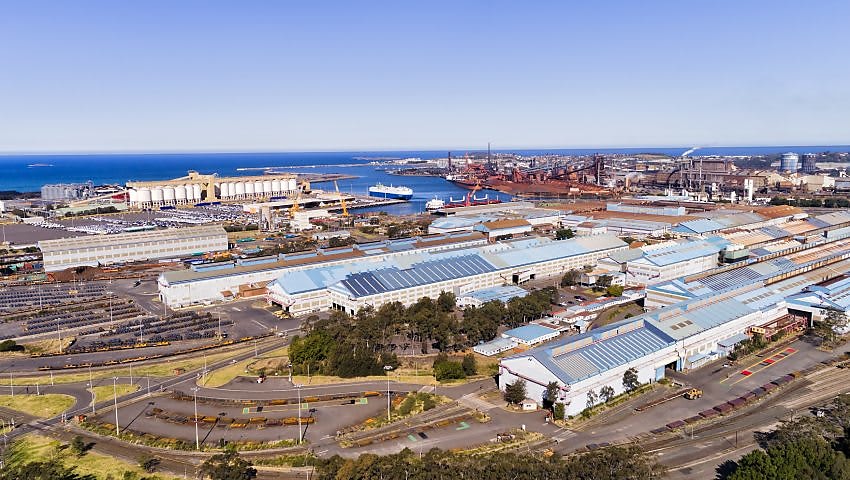
A group of concerned local special interests groups have launched their latest attack on the potential use of Port Kembla on the NSW South Coast as the proposed east coast submarine base, but true to form they miss the forest for the trees, blinded by their own special interests.
Full disclosure, this piece will have strong elements of impassioned opinion.
By now, most regular readers of Defence Connect and listeners of our podcasts over the years will know that I am a proud son of one of the nation’s last remaining steel cities: Wollongong.
I had the privilege of growing up close to the beach, building lasting friendships that continue to this day. I enjoyed a quality of life that was frankly unbeatable. I could complete my entire academic life close to home. On weekends out in the rapidly developing and cosmopolitan city, I knew virtually everyone. It was a community and one that continues to hold a massive part of my heart.
My family migrated to the region from the ashes of post-war Europe, took to the Australian life with gusto and built a lasting life (spawning three children, nine grandchildren and 14 great-grandchildren), becoming leading members in the local Australian–Croatian community, working at the old MM copper smelter and BHP, now BlueScope Steel Works and now the coal mines that dotted the escarpment.
Meanwhile, for me, my first jobs were in support of local small businesses and a national retail business. Many of my friends continue to live in the area and to this day have started to raise their children there, and I hope (wife permitting) to eventually return home to raise my young family there.
So why then would people be opposed to providing future generations the same opportunities? Because that is precisely what the signatories of the “Port Kembla Declaration” want to force on the community.
And that is why I decided to respond to the misguided, naive and frankly selfish view of the South Coast Labour Council, local branches of the Teachers Union, elements of the Socialist Left and the organisation Wollongong Against War and Nukes (WAWAN) who have launched the “Port Kembla Declaration” in opposition to the potential development of Port Kembla as the nation’s east coast submarine base.

True to form, emotion is at the core of their push-back, as is naivety and self-interest. So it’s time to pull apart the declaration and the narrative being spun.
The declaration stated, “We, the undersigned organisations, are deeply concerned by the potential siting of a nuclear submarine base in Port Kembla, on the traditional lands and waters of the Dharawal people.
“We recognise the unique health and safety risks that come with nuclear-fuelled submarines, and the potential impact of a major or minor incident on the broader community and the environment we all enjoy. The port is an important part of the Illawarra and we oppose its transformation into a military base, to the exclusion of the general community. It would put steel jobs at risk and crowd out local renewable energy industries.”
Let’s address the first concern, the safety issues. For more than 60 years, the United States and the United Kingdom have operated a combined nuclear fleet of more than 500 nuclear-powered submarines, without a single radiological incident that has adversely affected human health or the environment.
Indeed, the Australian Submarine Agency stated, “UK and US SSNs (nuclear-powered submarines) have never experienced a reactor accident, or release of radioactive material, that has had an adverse effect on human health or the quality of the environment.”
That comes on top of the safety record of the US nuclear-powered fleet of aircraft carriers (still in operation) and large surface combatants, namely the Cold War-era USS Long Beach, a nuclear-powered guided missile cruiser.
Where US or UK nuclear submarines have sunk, the reactors had nothing to do with the incidents and were the result of other system failures. Now, unless the opponents want to compare Australian safety standards and operating standards to those of the Soviet Union, their concerns need to be focused more on managing what risk exists, rather than catastrophising reality.
Now yes, I can already hear the “what aboutism” around Three Mile Island or Fukushima, the reality is no one died as a direct result of radiation exposure at either incident.
Moving now to the next point, impact on steel jobs and “crowding out” local renewable energy industries.
It is inescapable that Australia’s locally built nuclear submarines will incorporate Australian steel, with local company (and frequent target of WAWAN pickets, I might add) Bisalloy actively participating in the US submarine supply chain through contracts with Huntington Ingalls Industries-owned Newport News Shipbuilding, and will accordingly be integrated into the build, maintenance and sustainment pipelines for SSN-AUKUS.
Even Labor Minister for Defence Industry Pat Conroy said, as part of a media release in April 2024, “This order of Aussie steel from a global leader in shipbuilding is not only testament to the efforts of the hardworking women and men at Bisalloy but also underscores the Albanese government’s commitment to supporting local industry.
“This is a wonderful early example of opportunities for Australian companies to be part of the supply chains for the much larger submarine programs of our AUKUS partners. The Australian government is committed to developing Australia’s industrial base to not just build and sustain our nuclear-powered submarine program but to strengthen the AUKUS trilateral supply chains.”
So what steel jobs are they concerned about exactly? If anything, it looks like there will be more steel jobs!
Equally likely is the thousands of direct jobs to be created through the construction phase of the base, let alone the jobs related to the ongoing maintenance, sustainment and operation of the submarines. Then there is the jobs created at the University of Wollongong in support of the necessary workforce and the indirect jobs across the Illawarra in order to support the infrastructure, the base services, the personnel etc.
Regarding the “crowding out” of renewable energy jobs, the Illawarra community was vehemently opposed to the development of offshore windfarms (in direct opposition to the signatory organisations, who didn’t seem to care about their concerns at the time). Further to this, the Andrew “Twiggy” Forrest-linked Squadron Energy withdrew its application to build a AU$1.3 billion hydrogen terminal in August 2023.
This failure to launch has effectively killed the NSW state government’s AU$3 billion ambition for a state-funded hydrogen hub.
While global energy giant Shell has withdrawn from its deal with BlueScope to develop an on-site 10 megawatt renewable hydrogen electrolyser plant, and of course, let’s not forget the wave power generator that washes up on MM or City Beach after every major storm dislodges it.
Moving to the next point, the declaration stated, “We are concerned that the presence of nuclear submarines would make the Illawarra a high priority target for conventional or nuclear attack from an adversary. Building a new base, whether for Australian, US or UK nuclear submarines in Port Kembla would further escalate regional tensions.”
Regional tensions are already on the rise, Beijing’s overt and unprecedented military modernisation and build-up is the largest in history and is responsible for transforming the once second-rate military into one, capable of global power projection en masse.
You would have thought that the provocative live-fire exercises conducted by a powerful flotilla of the People’s Liberation Army Navy off the east coast of Australia in April this year would be enough to wake them up to this fact, but I guess you can never let the truth get in the way of a good story.
As for the nuclear submarine base making Wollongong and Port Kembla a greater conventional or nuclear target in the event of regional hostilities, Port Kembla is home to one of the nation’s largest steel mills, it is already a military and economic target, adding a nuclear submarine base to the equation wouldn’t make much if any difference when it comes to the targeting calculations of an adversary.
The declaration’s next point is interesting, with the group articulating, “Nuclear submarines and a new military base to host them in Port Kembla would cost billions, which should be invested in pressing community needs such as health, housing, clean energy and education.”
My rebuttal to this is relatively short, sharp and easy: each of those policy areas is the principle responsibility of the state and territory governments respectively, therefore they have little to no bearing on the conversation.
The declaration’s final point stated, “We are concerned by the lack of community consultation and fear the federal government will override local dissent to impose a nuclear submarine base, as well as a nearby site to store associated long-lived and hazardous radioactive waste from Australian, US or UK submarines. We will not let this happen.”
This is equally humorous when one considers the same signatories were quite willing to actively promote the offshore wind zone in spite of overwhelming public backlash and community outrage, because the “morality” of their cause is justified in their eyes and the defence of the nation and its interests with highly-capable pieces of military equipment is immoral.
I know this might come as a shock to some people who have the luxury of living in a state of permanent arrested development, but the world is, for a lack of a better term, the “jungle” and there is one universal law in the jungle: the strong eat the weak, and the weak do what they can to survive.
In this new era of great power competition, Australia is woefully unprepared and we are weak, simply burying our hands in sand, declaring some form of neutrality doesn’t work when a bully has its sights set on you, nor does minimising or making yourself small. Bullies don’t care, they just bully.
When it comes to the storage of hazardous radioactive waste, Lucas Heights already serves this role for the nation.
That is what we face.
But for the people of the Illawarra, this would be good news, a breath of fresh air for a city that has limped along since the gradual scaling back of the steel works workforce and shifting towards the university and the “services” economy which somehow never really managed to take flight.
So get out of the way and bring on the opportunity!
Get involved with the discussion and let us know your thoughts on Australia’s future role and position in the Indo-Pacific region and what you would like to see from Australia’s political leaders in terms of partisan and bipartisan agenda setting in the comments section below, or get in touch at

Want to see more stories from trusted news sources?
Make Defence Connect a preferred news source on Google.
Click here to add Defence Connect as a preferred news source.