

 iscover
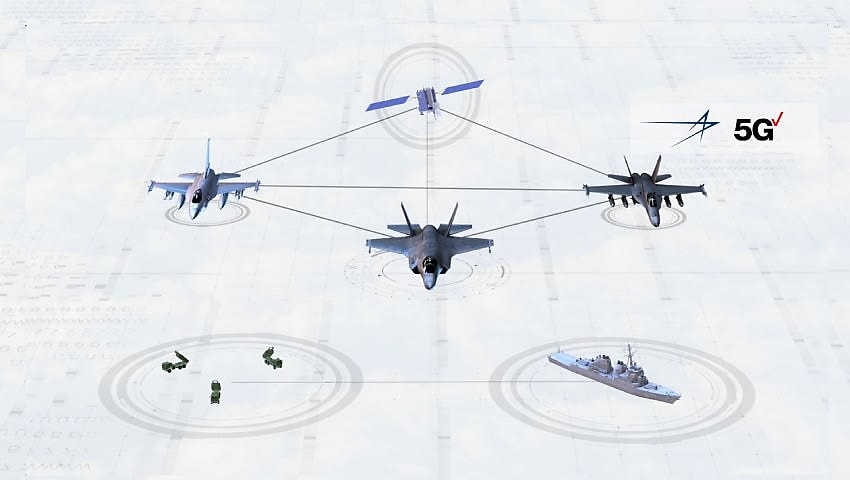
The prime has demonstrated the ISR capability of unmanned aircraft leveraging advanced 5G technology.
Lockheed Martin and Verizon have combined to test 5G-enabled drones, designed to capture and securely transfer high-speed, real-time intelligence, surveillance and reconnaissance (ISR) data from aircraft in flight to geolocate military targets.
The demonstrations reportedly confirmed two key advances in technology, capable of supporting Department of Defense (DOD) applications:
- transmitting real-time ISR radio frequency (RF) and streaming video data over 5G-millimetre wave links to allow advanced signal processing algorithms to be executed at the tactical edge.
- the passive detection and geolocation of RF signals that could be used for communications, sensing, or jamming — enabling the DOD to detect and target adversarial assets in a military environment.
Dan Rice, vice president of 5G.MIL programs at Lockheed Martin, said these capabilities would ensure warfighters can “stay ahead of their adversaries”.
“By blending advanced commercial 5G capabilities with military capabilities using secure, open standards, we are helping to make the DOD’s vision for integrated deterrence a reality,” Rice said.
According to Srini Kalapala, senior vice president for Technology and Product Development at Verizon, the company’s Private 5G Ultra-Wideband networks would provide the “security, reliability, capacity and low latency” required by the defence sector.
“By demonstrating the mission-critical connectivity that our network provides, we are demonstrating how 5G and edge computing can help the DOD address their strategic priorities and continue to develop advanced solutions,” Kalapala said.
The demonstrations, conducted in May and September 2022, form part of a broader 5G collaboration initiative, focused on the faster delivery of next-generation technologies to the US DOD.

Future demonstrations are to target the expansion of ISR test scenarios to include precision geolocation of moving RF emitters.
This is among a number of Lockheed Martin-led programs leveraging 5G technology.
Lockheed Martin and AT&T recently announced the secure transmission of UH-60M Black Hawk health and usage data via an AT&T 5G private cellular network and Lockheed Martin’s 5G.MIL multi-site pilot network.
The test, conducted on 4 August at Lockheed Martin’s Sikorsky headquarters in Connecticut, reportedly demonstrated that 5G technologies on the flight line can support accelerated maintenance operations and improved aircraft readiness.
According to the companies, the results also confirmed highly secure interoperability between the AT&T millimetre wave 5G private cellular network and the 5G.MIL pilot network.
[Related: Lockheed Martin, AT&T leverage 5G to transfer Black Hawk data]

Want to see more stories from trusted news sources?
Make Defence Connect a preferred news source on Google.
Click here to add Defence Connect as a preferred news source.