

 iscover
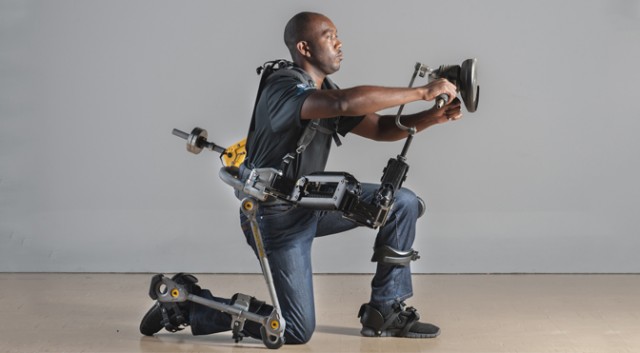
Lockheed Martin Australia and Deakin University’s Institute for Intelligent Systems Research and Innovation (IISRI) have kicked off a 12-month research partnership, which has extended the capability of Lockheed Martin’s FORTIS exoskeleton.
The FORTIS is an unpowered, lightweight exoskeleton designed by Lockheed Martin that makes tools weighing up to 16.3 kilograms feel weightless – reducing user fatigue and improving worker safety.
Using motion capture obtained from sensors on the arms and shoulders of exoskeleton operators and analysed by signal processing techniques, the team at Deakin’s IISRI used biomechanics to test the ergonomic effects of using power tools on the human body.
Deakin researchers also designed and 3D printed new attachments to expand the functionality of the FORTIS exoskeleton, allowing it to accommodate external loads usually mounted on the back of the human body.
Speaking at Land Forces 2018 in Adelaide, Lockheed Martin Australia’s strategic engagement director, Scott Thompson, said the partnership had delivered tangible outcomes for industry and further reinforced the status of Australian researchers as world class.
"Lockheed Martin invests in partnerships with Australia’s research and industry communities to support our global supply chains, providing opportunities for technology transfer, innovation, local skilled jobs and sustainable business growth. The innovative work done by Dr Mohammed Hossny and his team at IISRI extends the technological foundation for the FORTIS exoskeleton with the potential for a broad range of applications across the defence, automotive and mining industries."
James Heading, business development senior manager at Lockheed Martin Australia, commended the Deakin research team and outlined the inherent challenges associated with exoskeleton research.
"Lockheed Martin has a proud history of successfully developing and demonstrating exoskeleton applications that take the work out of many demanding, repetitive tasks," Heading said.

"Originating from Lockheed Martin’s exoskeleton research to assist soldiers to carry heavy equipment over long distances, the same principles of how the body works and expends energy were applied to exoskeleton development for use in industrial settings."
The FORTIS exoskeleton transfers loads through the exoskeleton to the ground in standing or kneeling positions and allows operators to use heavy tools as if they were weightless. An advanced ergonomic design moves naturally with the body and adapts to different body types and heights. Using the FORTIS tool arm, operators can effortlessly hold heavy hand tools, increasing productivity by reducing muscle fatigue.
Dr Hossny, senior research fellow, IISRI at Deakin University, commended the research project, led by Darius Nahavandi as part of his PhD research, for identifying the importance of biomechanic analysis of assistive devices.
"The project has accelerated the design-testing loop for designing and tuning exoskeletons,” Dr Hossny said. "There is often a trade-off to be considered when adopting assistive devices in the workplace. While assistive devices help channel the load through the skeletal structure of the exoskeleton, our work optimises the operator’s movement so they are able to cope with increased repetition and indirect loads during motions."

Want to see more stories from trusted news sources?
Make Defence Connect a preferred news source on Google.
Click here to add Defence Connect as a preferred news source.