

 iscover






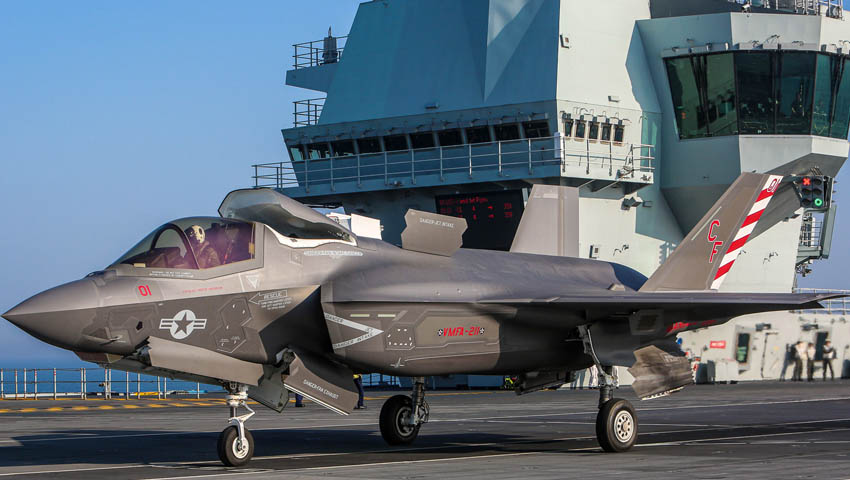
The UK’s Carrier Strike Group had embarked on its maiden operational deployment, transporting a host of personnel and advanced military platforms.
The UK’s flagship aircraft carrier HMS Queen Elizabeth is leading six Royal Navy vessels, a Royal Navy submarine, a US Navy destroyer and a Dutch frigate on a seven-month deployment through the Mediterranean, Indian Ocean and Indo-Pacific.
The fleet is carrying approximately 3,700 personnel and 32 aircraft, which include F-35B Lightning fighter jets and Royal Navy Merlin helicopters.
The Carrier Strike Group was farewelled by her majesty Queen Elizabeth II; Prime Minister Boris Johnson; Defence Secretary Ben Wallace; First Sea Lord, Admiral Tony Radakin; and Chief of the Air Staff, Air Chief Marshal Sir Mike Wigston, before setting sail from Portsmouth.
Secretary Wallace said the deployment would “write Britain’s name in the next chapter of history”, helping to “tackle the challenges of tomorrow”.
“This deployment shows that we are strong on our own, but even stronger with our allies. I want to join the nation in wishing the crews across the Carrier Strike Group every success as they depart on this truly historic endeavour,” he said.
The Carrier Strike Group is expected to interact with over 40 nations during its 26,000-nautical-mile deployment, undertaking over 70 engagements, exercises and operations with allied forces.
These engagements will include participating in NATO’s Exercise Steadfast Defender, supporting the Alliance’s Operation Sea Guardian, and conducting maritime security operations in the Black Sea.
The Carrier Strike Group will also be joined by French Aircraft Carrier Charles De Gaulle for dual carrier operations in the Mediterranean.
While deployed in the Indo-Pacific, the Carrier Strike Group is scheduled to visit India, Japan, the Republic of Korea and Singapore, in a bid to strengthen security relationships, reinforce political ties and support Britain’s exports and international trade agenda.
Elements of the Carrier Strike Group will also participate in Exercise Bersama Lima — marking the 50th anniversary of the Five Powers Defence Arrangements between Malaysia, Singapore, Australia, New Zealand and the UK.
Platform breakdown
In addition to operating HMS Queen Elizabeth, Strike Group’s 3,700 personnel, made up of troops from the UK, US and Netherlands armed forces (including a company of Royal Marines Commandos), are operating:
- a surface fleet of Type 45 destroyers, HMS Defender and HMS Diamond;
- Type 23 anti-submarine frigates HMS Kent and HMS Richmond;
- the Royal Fleet Auxiliary’s RFA Fort Victoria and RFA Tidespring;
- US Navy destroyer USS The Sullivans; and
- the Royal Netherlands Navy’s frigate HNLMS Evertsen.
Deployed aboard HMS Queen Elizabeth are:
- 18 fifth-generation F-35B jets, operated by joint RAF and Royal Navy 617 squadron, and the US Marine Corps;
- four Wildcat maritime attack helicopters;
- seven Merlin Mk2 anti-submarine helicopters; and
- three Merlin Mk4 commando helicopters.
“As the Carrier Strike Group heads to sea, a new phase opens in Britain’s maritime renaissance. A year’s worth of exercises, and more than a decade of preparation, is over,” Commodore Steve Moorhouse, Commander United Kingdom Carrier Strike Group, said.
“HMS Queen Elizabeth, her escorts and her aircraft, will now begin the most important peacetime deployment in a generation. It is the privilege of my career to lead 3,700 sailors, aviators and marines from the United Kingdom, United States and the Netherlands for the next seven-and-a-half-months.
Commodore concluded: “On their behalf, I would like to thank all those in government, the armed forces and industry who have worked so hard to get us to the start line, and will continue to support us when we are away.
“Most importantly, I would like to thank our families. I have every confidence that these young men and women will do you proud.”
[Related: UK F-35Bs to join fight against Daesh]

Want to see more stories from trusted news sources?
Make Defence Connect a preferred news source on Google.
Click here to add Defence Connect as a preferred news source.