

 iscover






Australia’s first submarine, lost at sea for over 100 years, continues to reveal its secret history through advanced 3D processing of underwater still photography.
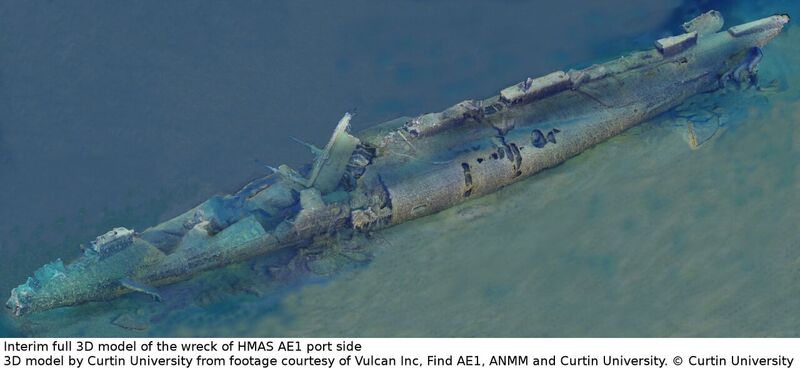
Curtin University researchers are digitally reconstructing the sunken HMAS AE1, which was the Royal Australian Navy's first-ever wartime loss, using about 8,500 still images captured of the submarine during an archaeological surveying expedition earlier this year, with the goal of gaining a better understanding of the submarine’s fate.
Maritime archaeologists at the Australian National Maritime Museum will use the 3D models as a means to analyse AE1, which in turn will inform development of a shipwreck management plan, as well as future exhibition and interpretive initiatives. This will be done in co-operation with the Papua New Guinea National Museum and Art Gallery, and to tell the story of the AE1 to future generations in both countries.
Dr Andrew Woods, manager of the HIVE (Hub for Immersive Visualisation and eResearch) at Curtin University, explained that the team has generated an interim digital 3D model of the shipwreck, providing the first ‘whole-look’ view of the vessel as it currently lies on the sea floor.
“The 3D model can be rotated to be viewed from any angle, showing the bow, stern and fin with conning tower, and also clearly shows the implosion areas on the submarine over the control room and the forward torpedo room,” Dr Woods said.
The survey and associated research is a collaborative project involving Vulcan Inc, Find AE1 Ltd., the Australian National Maritime Museum, the Western Australian Museum and Curtin University, with support from the Royal Australian Navy and the Submarine Institute of Australia.
Want to see more stories from trusted news sources?
Make Defence Connect a preferred news source on Google.
Click here to add Defence Connect as a preferred news source.