

 iscover






The UK Royal Navy has conducted “groundbreaking” unmanned vehicle trials in Norway, which saw a collection of unmanned equipment tested in an operational setting for the first time.
The trials by the Exercise Autonomous Advance Force were conducted with support from Royal Marines small boat specialists 47 Commando, the Navy’s amphibious transport dock ship HMS Albion, the Navy’s autonomous accelerator NavyX and the Office of the Chief Technology Officer.
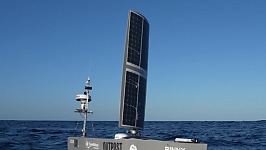
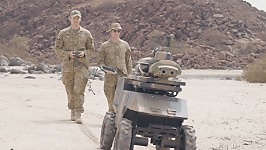
The trials, conducted in the harsh arctic conditions included testing of the MAST-13 unmanned surface vehicle (USV), the Malloy heavy-lift drone, the Puma remotely piloted air system (RPAS) and the Remus unmanned sub-surface drone.
An artificial intelligence (AI) system to control all of this tech was integrated in HMS Albion, with industry partners welcomed on board to implement and oversee the system trials.
The four-day exercise saw these technologies make their debut in an operational setting.
Colonel Chris Haw, Commanding Officer of Plymouth-based 47 Commando, said, “We wanted to operationalise the technology, both in an operational environment and as part of a NATO deployment. This exercise also enabled us to also integrate technology as far as possible into a Royal Navy warship.”
This was the first time an unmanned surface vessel has been operated from the dock in HMS Albion and the first time 700X Naval Air Squadron has flown Puma RPAS from a Royal Marines landing craft.
“Integration of autonomy equipment is a key strand in the development of Future Commando Force and the Littoral Strike concept. The future vision is of this type of system being used to control multiple assets in different domains. This technology has the potential to be revolutionary within the naval service," said Col Haw.
“This series of trials has been ground-breaking. It is at the leading edge of technology and integrating multiple systems in the uniquely challenging physical environment that Norway presents, is a significant step forward.
“In November, after the second in the series of the trials, we were challenged to make this work in Norway in an operational environment and, in a relatively short amount of time, we have made that happen. The speed with which we have managed to develop this system in conjunction with industry partners and the multiple stakeholders involved has been impressive.”
The Autonomous Advance Force trials began a year ago in Cornwall and have grown to include more new technologies as they are developed, as well as more naval service units.
Want to see more stories from trusted news sources?
Make Defence Connect a preferred news source on Google.
Click here to add Defence Connect as a preferred news source.