

 iscover
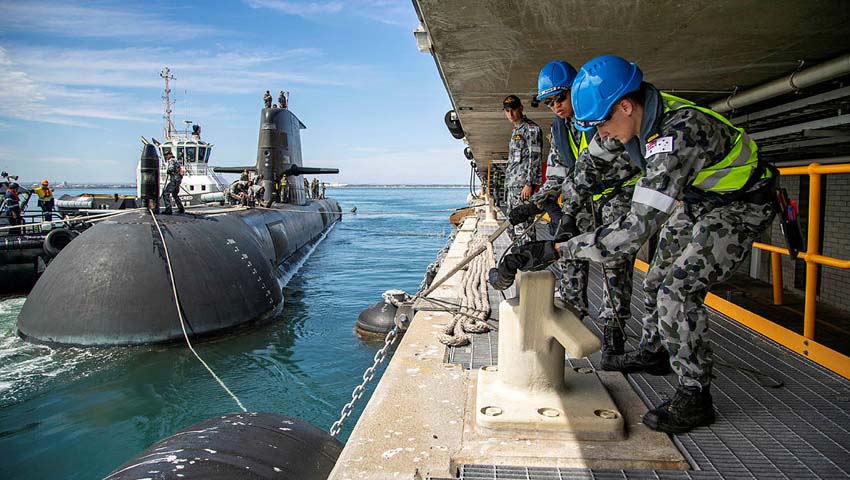
HMAS Farncomb returned to her homeport of Fleet Base West earlier this month, after a five-week deployment to the east coast of Australia.
Commander Michael Power, COmmanding Officer HMAS Farncomb, said it had been an extremely busy and rewarding deployment for his crew, the highlight of which was participation in Fleet Certification Period 2020 (FCP20).
“During the Fleet Certification Period, which involved a significant number of ships, submarines and aircraft, Farncomb was mainly operating in the Bass Strait, which is a complex and busy environment,” he said.
“Essentially, Farncomb was involved in a series of maritime warfare scenarios that tested the crews of the surface ships and the submarines, and provided invaluable training for my ship’s company.”
CMDR Power said it was important that exercises such as FCP20 involved a sub-surface component as it allowed exercise planners to inject a higher level of realism into the scenarios.
“For many of the crew this was the first time exercising with Navy’s new capabilities, such as Hobart, Canberra and the MH-60R aircraft, as well as the other ships participating in FCP20, which all presented a great learning opportunity for us,” he said.
“Submarines provide a ‘strategic deterrent’ for the Royal Australian Navy, which means that due to the covert nature of submarine operations it’s difficult for adversaries to know exactly where we are operating.
“The Collins Class submarine has a very lethal and modern weapon system and that gives us an excellent deterrent – also, the endurance of the Collins Class submarine is exceptional, which provides significant force-projection without the need to re-supply or re-fuel.”

Fleet Base West is home to Navy’s six Collins Class submarines and is situated on Garden Island near the City of Rockingham south of Perth.
HMAS Farncomb is the second of the six Collins class submarines to enter service in the Royal Australian Navy.
Since commissioning, HMAS Farncomb has successfully conducted a range of activities throughout the region in support of Australian Defence Force exercises, operations and the government's strategic directives.
Want to see more stories from trusted news sources?
Make Defence Connect a preferred news source on Google.
Click here to add Defence Connect as a preferred news source.