

 iscover



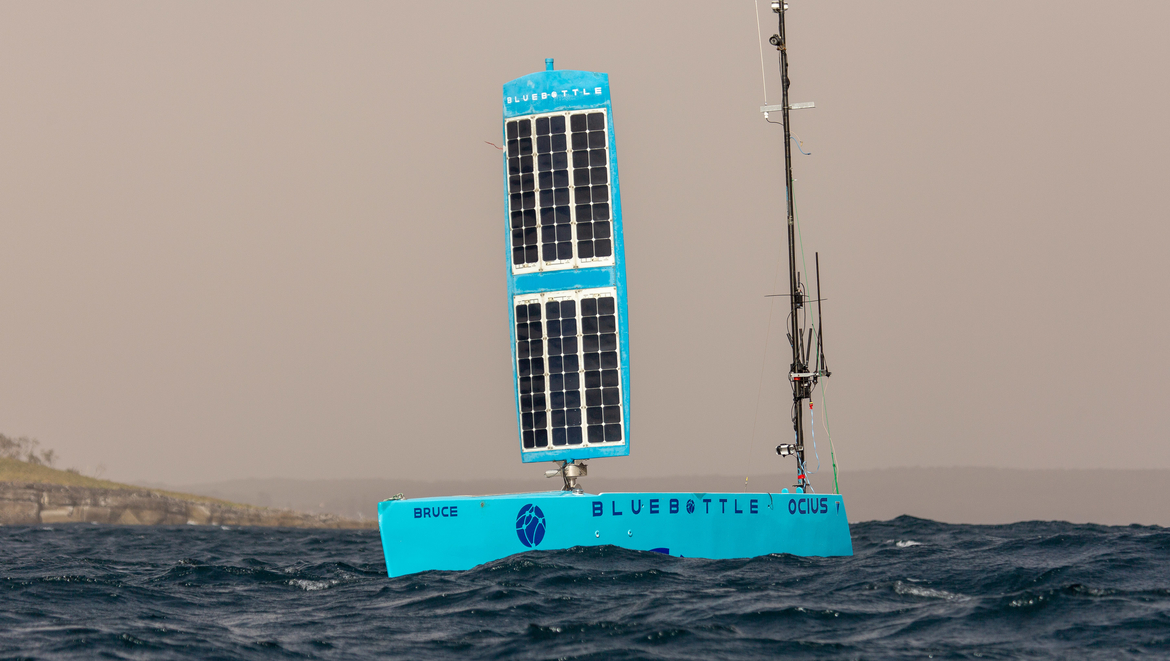
OCIUS’ flagship unmanned surface vehicle (USV), the Bluebottle, has been green-lit for autonomous operations within Australia’s EEZ. The news comes less than two years after the first successful sea trial of the next-gen, 18-foot model off the NSW coast.
While OCIUS has previously escorted its USVs out to 20 nautical miles offshore, the most recent sea trials have resulted in AMSA approval for autonomous operations out to the limit of 200 nautical miles – the limit of Australia's exclusive economic zone.
This comes as a windfall for the company, which has sought in recent years to win approval from the regulator for its Bluebottle USV. The model will be licensed as a Domestic Commercial Vessels (DCV), though the company's website assures defence customers it has direct applicability in terms of:
- Anti-submarine warfare;
- Electronic warfare;
- Communications and radar;
- Gateway communications; and
- Mine countermeasures.
The qualifying sea trial left Botany Bay Heads at 11am on 1 July, arriving at Ulladulla Heads 3pm the following day. The USV travelled a distance of 96 nautical miles, maintaining a rough average of 3.4 knots.
The Bluebottle used 360-degree cameras, radar, automatic identification systems (AIS) and collision avoidance software to autonomously navigate safely during the voyage, with engineers at OCIUS' R&D facility at UNSW Campus Randwick and at Charles Darwin University (CDU) Darwin rotating supervisory duties.
Following this successful trial, the tested model will be sent off to Darwin to begin logistics and sea trial tests, before the arrival of the next-gen Bluebottle in September.
The company said that this will be followed by four more Bluebottles in 2021, each armed with Thales thin line sonar arrays, radar, cameras and other sensors.
OCIUS maintains a Defence Innovation Hub contract valued at $5.5 million to continue the development of the Bluebottle technology. Defence said that it hopes the Bluebottle will "provide the Royal Australian Navy with a unique interoperable capability to help protect Australian maritime borders".
Under the provisions of the contract, five Bluebottles will be deployed in an intelligent networked squad to three different areas of operations across 2021.
Want to see more stories from trusted news sources?
Make Defence Connect a preferred news source on Google.
Click here to add Defence Connect as a preferred news source.